
 Buy Crypto
- Markets
 Futures
- Spot
- Copy Trade
- Earn
- More
a16z: AI is making everyone 10x more productive, but the true winner has yet to emerge

Original Article Title: Institutional AI vs Individual AI
Original Article Author: George Sivulka, a16z
Original Article Translation: DeepTech TechFlow
AI has just increased everyone's productivity by 10x.
No single company has therefore become 10x more valuable.
Where did the productivity go?
This is not the first time it has happened.
In the 1890s, electricity promised a huge productivity increase.
New England textile factories, originally built around steam-powered spinning jennies, quickly swapped out steam engines for faster electric motors.
But for a full three decades, electrified factories saw almost no output gains. The technology far outpaced. But the organization did not keep up.
It wasn't until the 1920s when factories completely redesigned the production lines — assembly lines, each machine with its own electric motor, workers and machines doing completely different tasks — that electrification finally paid off.
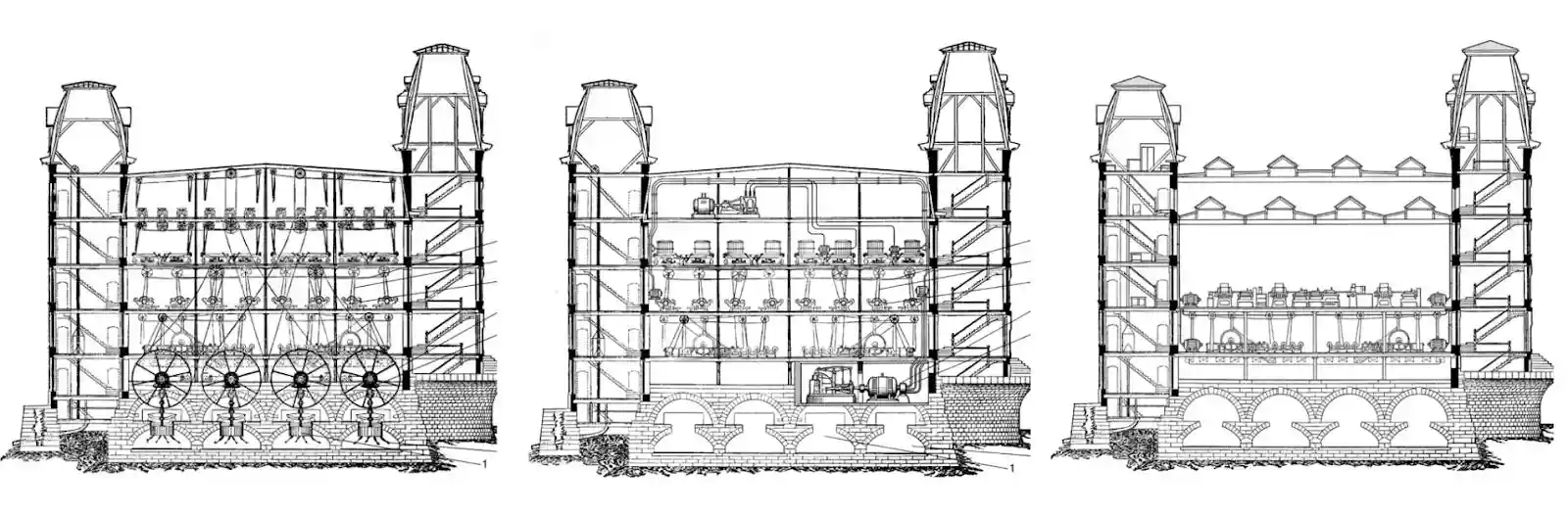
Caption: Three evolutions of the Lowell textile mill. From left to right: 1890 steam-powered factory, 1900 electric-powered factory, 1920 "unit-drive" factory (completely rebuilt from scratch into an electric assembly line).
The payoff didn't come from the technology itself, nor from making individual workers or machines spin faster. Instead, it was only when we finally redesigned the system alongside the technology that the benefits truly materialized.
This is the costliest lesson in the history of technology, and we are now relearning it.
In 2026, AI is bringing a 10x productivity boost to those who know how to harness it. But this is not enough. We've swapped out the electric motors but haven't redesigned the factory yet.
Because of one simple fact: Effective individuals do not equate to effective organizations.
The vast majority of AI products give people the feeling of "efficiency," but do not truly drive value. Most AI use cases you see are individuals indulging in "efficiency max" on Twitter or company Slack, with zero actual impact.
The past year's often-mentioned notion of "Service as Software" is on the right track but lacks a blueprint. Furthermore, it overlooks the bigger picture. The real transformation is not just from tool to service but from building technology and institution together (whether transforming old ones or starting from scratch). A truly efficient future requires a whole new category of products—the assembly line of tomorrow.
Efficient organizations need "Institutional Intelligence."
This article will delve into the seven dimensions that differentiate "Institutional AI" from "Personal AI." The entire B2B AI landscape over the next decade will be built on these variances:
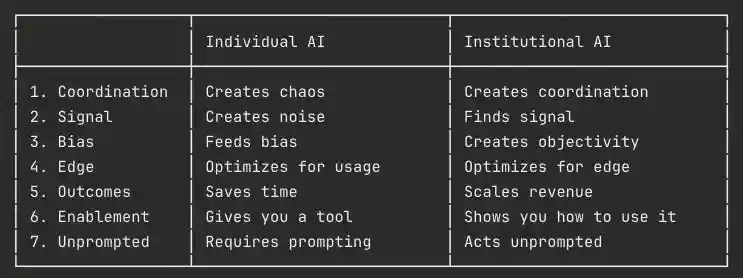
Caption: Comparative table of the seven pillars of Institutional Intelligence
The Seven Pillars of Institutional Intelligence
1. Coordination
Personal AI creates chaos.
Institutional AI fosters coordination.
Let's start with a thought experiment. Suppose you double your organization's size tomorrow by cloning all your top-performing employees.
Each of these employees has slight variations, preferences, quirks, and perspectives (especially your best ones). Without proper management, inadequate communication, undefined task allocation, OKRs, and role boundaries... you create chaos.
Individually measured, the organization may seem more efficient. But with thousands of agents (or humans) rowing in different directions, the best-case scenario is stagnation, and the worst-case scenario is fragmenting the organizational cohesion.
This is not hypothetical. Every organization incorporating AI without a coordination layer is currently experiencing this. Each employee has their ChatGPT usage habits, their prompt style, and their outputs—all disconnected from one another. The org chart may still be there, but the AI-generated work is essentially off on another tangent.
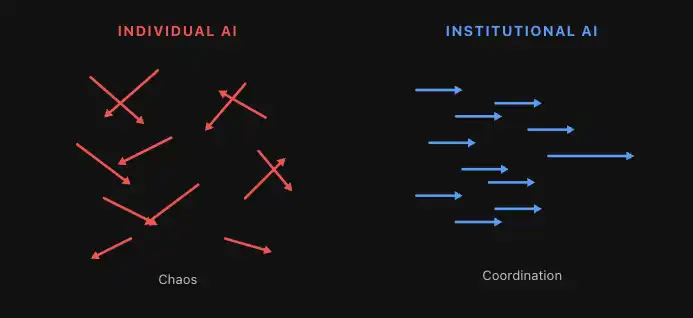
Caption: Efficient individuals (or Agents) rowing in different directions. Without coordination, it's chaos.
Alignment is an absolute hard requirement, for both humans and Agents alike.
Enterprise intelligence will give birth to an entire "Agent Management" industry—focused on the role and duty of Agents, communication between Agents and between Agents and humans, and how to measure the value of Agents (purely relying on pay-per-use is far from enough).
2. Signal
Personal AI creates noise.
Enterprise AI finds signal.
Today's humans can create—or should I say generate—anything you can think of: articles written by AI, presentations, spreadsheets, photos, videos, songs, websites, software. What a great gift.
The issue is, the vast majority of content generated by AI is utter garbage. The prevalence of AI garbage has reached a point where some organizations have overcorrected, opting to outright ban all AI output. To be honest, I feel the same way myself—I run an AI company but have instructed my executive team not to use AI on any final text products. I can't stand that garbage.
Think about what the PE (Private Equity) industry is turning into. Last year, you might have had 10 deal opportunities land on your desk. This year, you'll get 50 opportunities in the next quarter, each one polished by AI to perfection, yet you still have the same amount of time to make a judgment—finding the truly reliable one from the mix.
Generating anything is no longer the issue. For any legitimate organization, the problem now is generating and filtering out the right things. In an AI-driven world, finding that one good output, that one good deal, the signal within the noise, is becoming increasingly critical. The core economic driver of the next decade will be unearthing signals from the exponentially growing garbage pile.
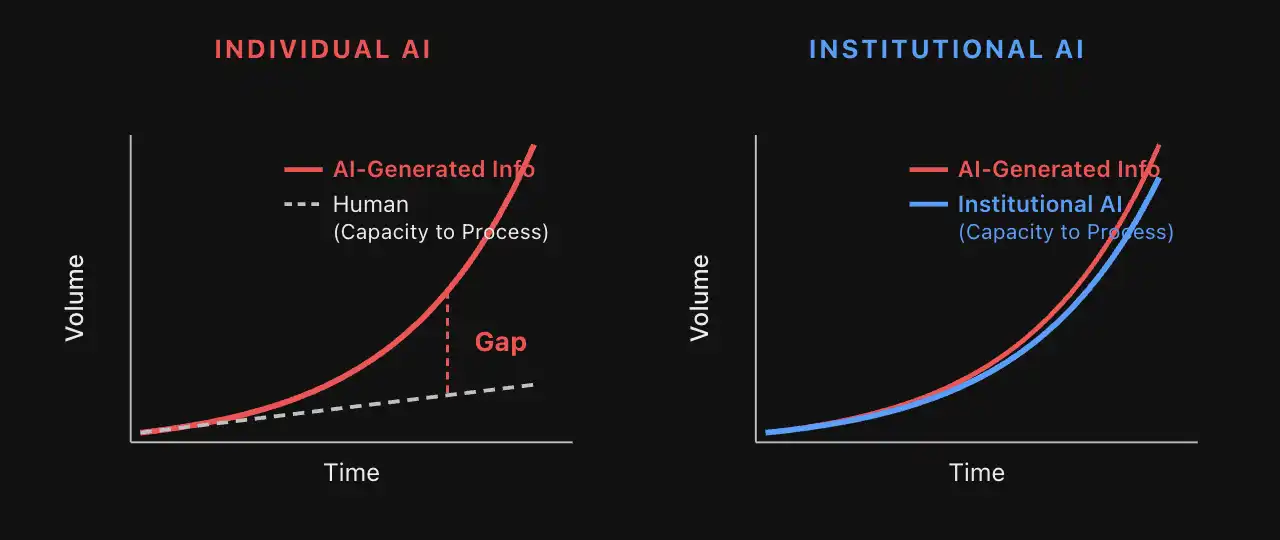
Caption: AI junk generated by personal productivity tools is multiplying at an exponential rate. Humans themselves can no longer sift through the noise and need a new class of enterprise AI product.
Enterprise intelligence must find signal, must structure noise to cut through the garbage, and must be definable, deterministic, and auditable in its work.
Personal AI may emphasize the "always-on" productivity like Clawdbot, fulfilling your needs in an unpredictable manner 24/7—an essentially non-deterministic Agent. Enterprise AI, on the other hand, relies on the reliability of deterministic Agents. Agents with predictable checkpoints, steps, and processes are what enable scalability, enable signal discovery, and through these signals, drive revenue return for the organization.
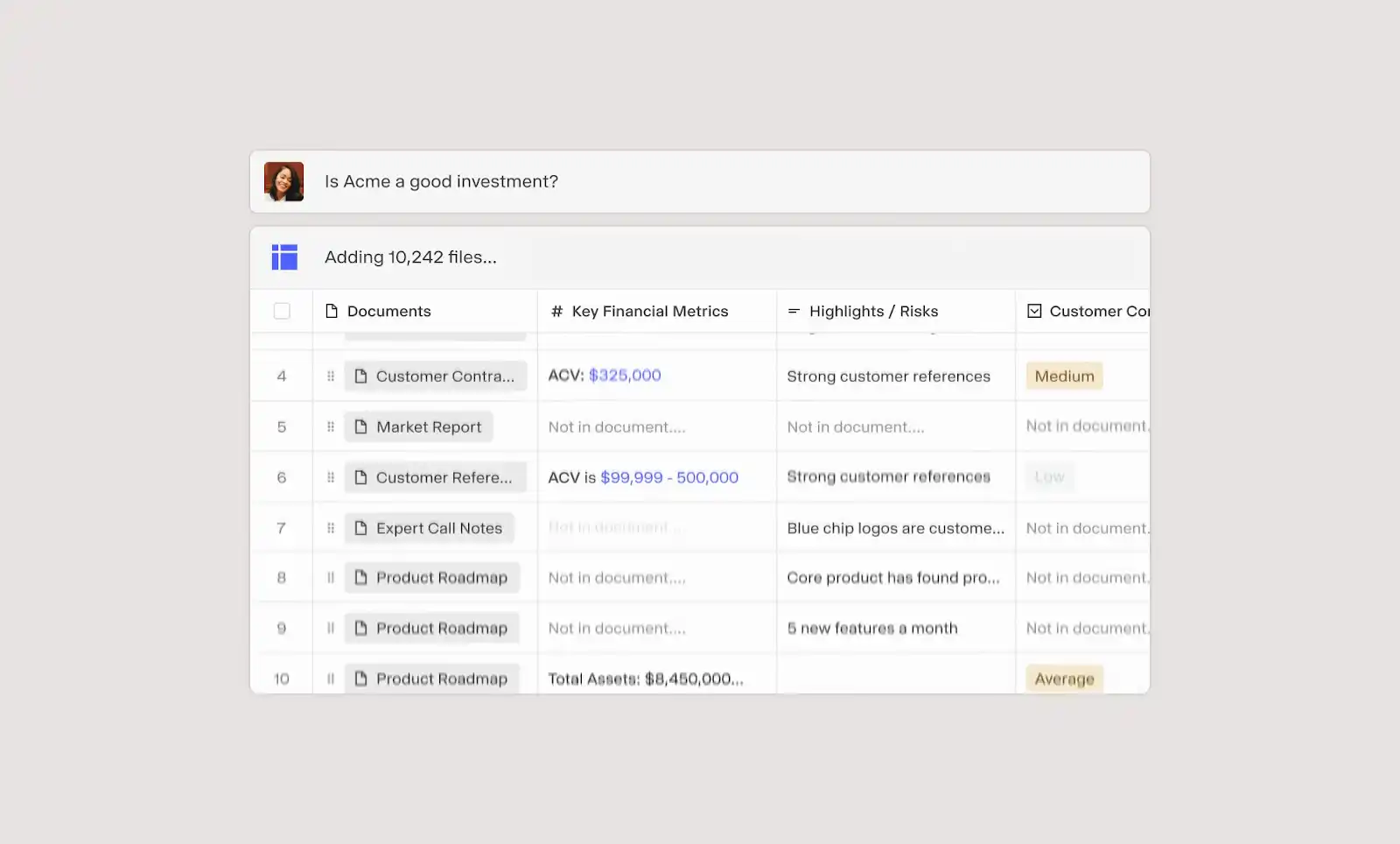
Caption: Matrix is a tool that leverages generative techniques to cut through noise, thus opening up a world of deterministic agents and checkpoints.
3. Bias
Personal-level AI feeds bias.
Institutional-level AI creates objectivity.
The discussion around socio-political bias has dominated AI discourse for years. The Base Model Lab eventually bypassed this issue with a sufficient amount of RLHF, tuning all models to be sycophantic. Today, models like ChatGPT, Claude, etc., align too perfectly, echoing your every point within the Overton window (sometimes even veering slightly into over-agreement, calling you out @Grok). The discussion of socio-political bias has faded. But a new issue has taken its place.
This over-agreement on everything has become so absurdly exaggerated. It has become a meme in itself—the reflexive "You're absolutely right!" from Claude, regardless of whether what you're saying is actually entirely correct.

It sounds harmless. It's not.
Many of the most enthusiastic AI advocates in organizations may soon be the worst-performing employees in history. Think about why.
The worst-performing employees in an organization, barely receiving any positive feedback on a daily basis, will soon have an ASI agreeing with them throughout. They will think to themselves, "The smartest AI in history agrees with me. It's my manager who's mistaken."
It's addicting. And toxic to organizations.
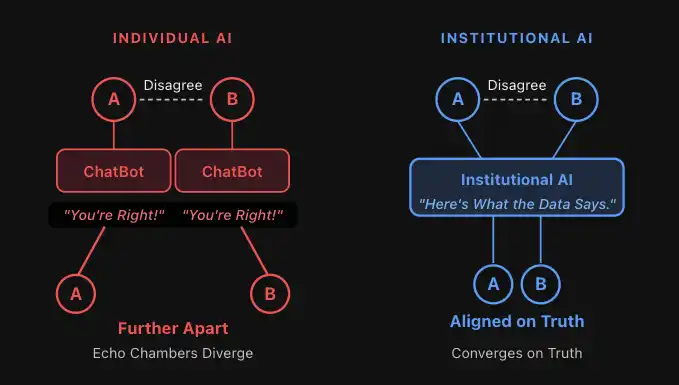
Caption: The echo chamber of personal-level AI exacerbates division, causing two individuals to drift apart, a dynamic that, when scaled, creates factions within an originally cohesive organization.
This reveals an important thing. Personal productivity tools strengthen the user. But what really needs strengthening is the truth.
Human organizations, after millennia of evolution, have built systems specifically to combat this issue:
· Investment Committee Meeting
· Third-Party Due Diligence
· Board Lookup
· Separation of Powers in the U.S. Government
· Representative Democracy, as well as Democracy itself
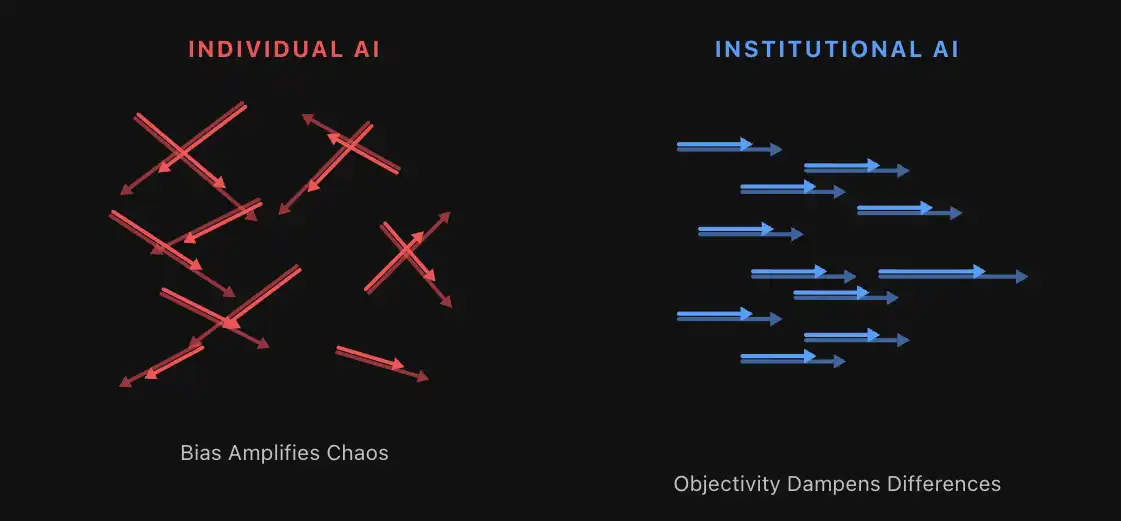
Caption: Objectivity can even mitigate coordination issues—suppressing minor disagreements rather than amplifying them.
Organizations rarely fail because their employees lack confidence. They fail because no one is willing or able to say "no."
Institutional-level AI must play this role. It will not be trained by RLHF to please users or conform to their beliefs, but to challenge their biases. It provides positive feedback when behavior is efficient, draws hard lines and enforces course corrections when deviations occur.
Therefore, the most important Agent within an organization will not be a "yes-man" but a disciplined "denier"—questioning reasoning, exposing risks, enforcing standards. Some of the most impactful AI applications in the future will be built around institutional constraints: AI board members, AI auditors, AI third-party tests, AI compliance...
4. Edge Advantage
Personal-level AI optimizes for utility.
Institutional-level AI optimizes for edge advantage.
The boundary of AI capabilities is moving every week, even every day. Foundational model companies compete for everyone and every organization in rapid iteration capabilities.
But the classic innovator's dilemma tells us that in specific applications, depth always beats breadth:
· @Midjourney's work is to maintain a slight edge in design images.
· @Elevenlabsio's work is to maintain a slight edge in speech models.
· @DecagonAI's work is to always be ahead in full-stack customer service experience.
While foundational models are getting closer, for domain-specific experts, the real edge advantage is key.
Many top designers use @Midjourney, many top speech AI companies use @Elevenlabsio—because even as foundational models progress, dedicated applications focusing relentlessly on driving their specific edge advantages define the edge.
As long as the proprietary solution is also evolving, the ability that is truly critical to economic outcomes — critical to enterprise — will always be on the side of proprietary products.
This is exemplified in the financial field — currently the hottest area for LLM development. Once a certain ability becomes widespread, by definition, it will not help you outperform the market. But if cutting-edge technology can provide a brief 1% niche advantage? That 1% can leverage returns in the billion-dollar range.
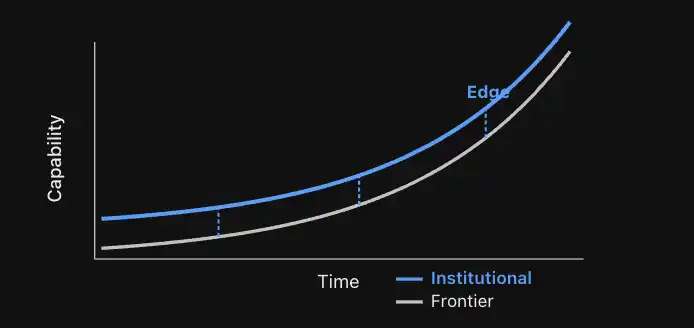
Caption: For any sufficiently specific task, the edge advantage is defined by your institution-level solution built on top of cutting-edge technology.
Our users have always been at the forefront. The LLM's context window has grown from 4K to 1 million tokens in four years. Some of our users process 30 billion tokens in a single task. This year, we have already seen the pathway to handling 100 billion tokens tasks. With each improvement in base model capabilities, we have come much further.
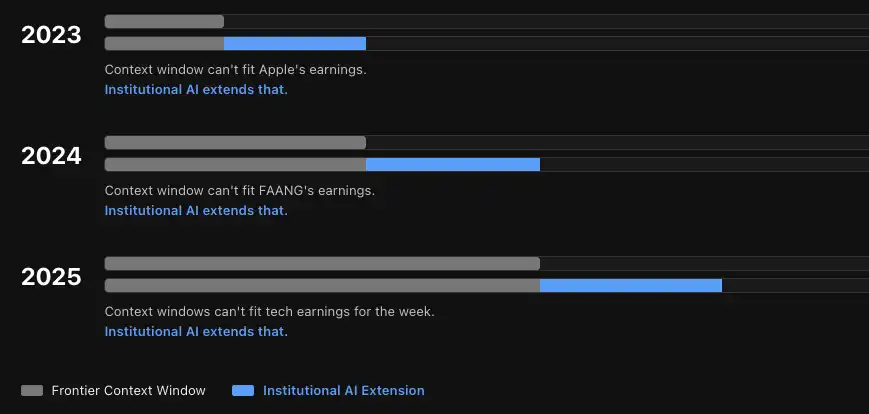
Caption: The context window, like other capabilities, is a moving target. A comparison of the evolution of the context window between the cutting-edge lab and Hebbia over the past three years.
Broad user-oriented generality is, of course, important, especially in the stage of onboarding employees to AI. But the future will not be people using ChatGPT/Claude or vertical solutions but rather ChatGPT/Claude combined with vertical solutions.
Institutional intelligence must leverage domain-specific, even task-specific, Agents.
We will ask ourselves a question that sounds absurd but is not:
“Which Agents will AGI choose to use as shortcuts? Even superintelligence will want domain-specific specialized tools.”
The boundary of AI's capabilities is always shifting, and organizations that leverage true edge advantages are the winners. Others are all paying for a very expensive general-purpose item.
5. Results
Personal AI saves time.
Institutional-Grade AI Expanding Revenue.
@MaVolpi once told me a sentence that reshaped my perception of selling AI to enterprises: “If you ask any CEO whether they prefer cost reduction or revenue expansion, almost everyone will say revenue.”
However, almost every AI product delivered in the market today focuses on cost reduction—promising to save you time, do more with fewer people, or replace manpower.
Institutional-grade AI must deliver incremental revenue. And incremental revenue is much harder to commoditize than saved time.
Take AI-assisted software development, for example. Code IDEs are some of the best personal AI productivity tools ever, but they have faced significant competition from Claude Code (another personal-grade AI tool). Cognition is playing a completely different game. Their fastest-growing business is selling transformation through technology, not selling a tool. I bet this model will have staying power.

Pure software “is quickly becoming uninvestable.” Pure services are not scalable. The solution layer—binding technology and outcomes together—is where lasting value resides.
Look at M&A again. Personal-grade AI helps analysts model faster. Institutional-grade AI identifies the one target worth pursuing out of a hundred, then expands the search to a thousand. One saves time, the other creates revenue.
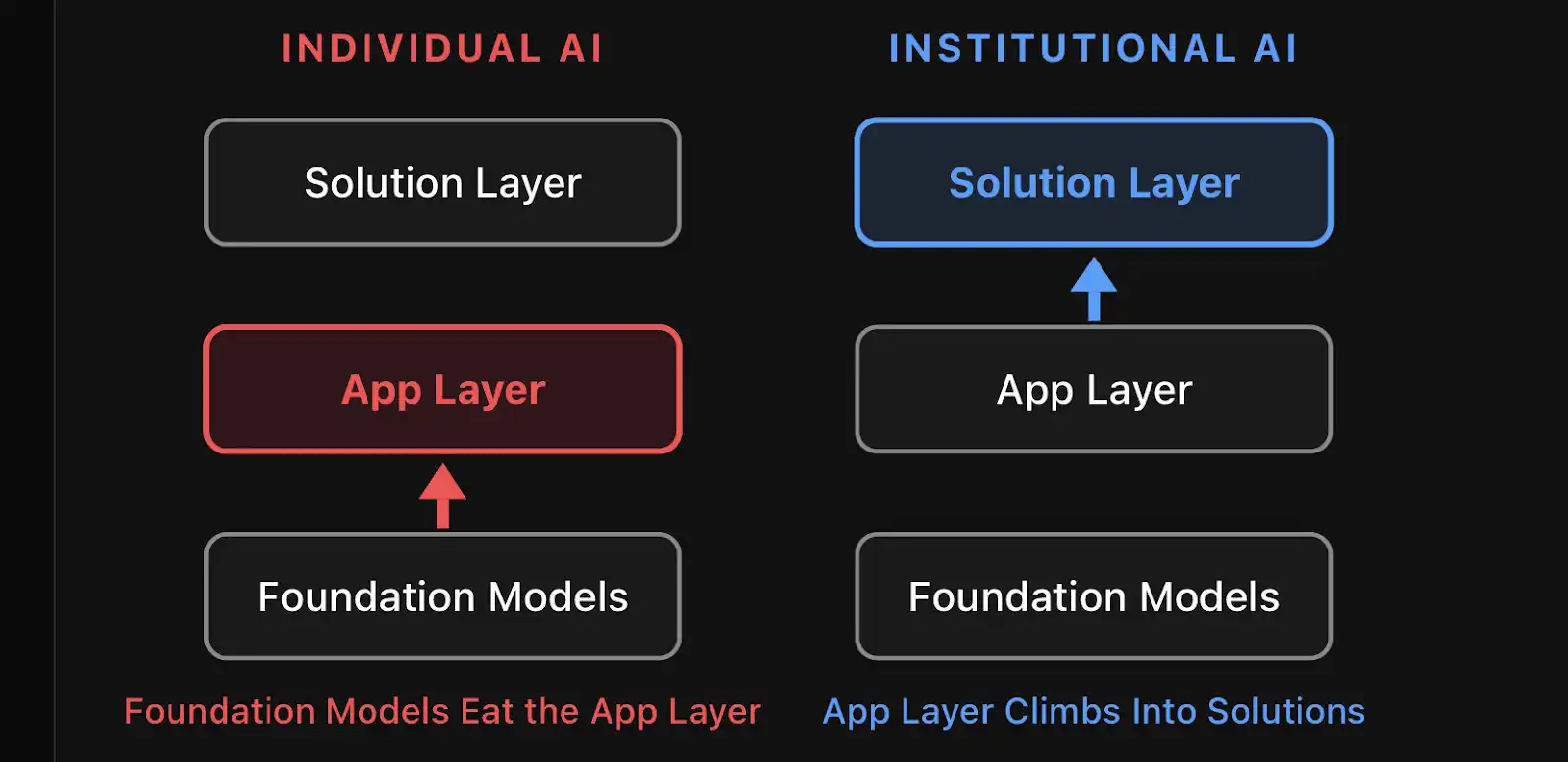
Caption: Foundational model companies are moving toward the vertical application layer. Vertical application layer companies are moving toward the solution layer.
“Moving upstream” is the current market's natural gravitational pull. Foundational models are moving to the application layer, and application layer companies are moving to the solution layer.
Institutional-grade intelligence is the solution layer. And the solution layer—where outcomes reside—is where lasting value is captured, capturing the greatest revenue opportunities.
6. Empowerment
Personal-grade AI gives you a tool.
Institutional-grade AI teaches you how to use it.
No matter how intelligent, humans resist change.
Believe it or not, there are still successful businesses in New York that don't accept credit cards. They know they are losing money, understand that not accepting credit cards is costing them, but they stay put. Similarly, in the foreseeable future, some employees in certain organizations will simply refuse to use AI.
The transformation from a purely human organization to an AI-first hybrid organization will be the most enduring and defining challenge of the next decade. And many times, the topmost and most critical individuals in an organization are the ones who are the slowest to adopt.
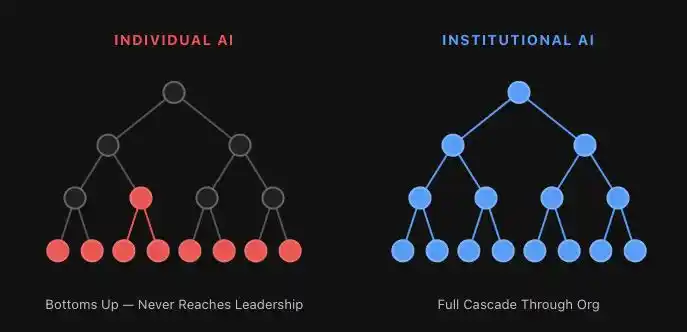
Caption: The topmost of an organization—those furthest from 'tool operation'—are often the slowest but most critical group to adopt new technologies.
Palantir is the only 'software' company that has maintained an extremely high valuation multiple in the trillion-dollar tech stock sell-off over the past two months. There is a reason for this. Palantir is one of the first true 'process engineering' companies.Whether you call it 'process engineering' or 'writing Claude skill docs,' institutional AI of the future will give rise to an industry: encoding enterprise processes into agents and implementing the necessary change management.
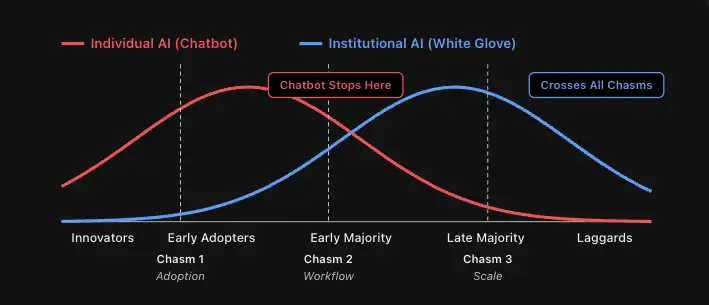
Caption: Organizational-wide AI adoption will span multiple chasms, each with its own challenges. Putting processes on AI will be the main driving force.
I dare say, process engineering will become the most critical 'technology' in the near term.
And in process engineering, business and industry expertise—rather than software expertise—is paramount. Vertical solutions will cultivate talent on the front lines of deployment engineering, implementation, and change management.
A top-tier investment bank (top three bulge bracket) that opted for a full-scale deployment with Hebbia put it best: the reason they don't work with a certain big-model lab is because "we'd have to explain CIM to their team." Claude or GPT may understand the space, but the teams responsible for implementation do not...
This difference makes all the difference.
7. Zero Prompt
Personal AI at the individual level responds to human prompts.
Institutional-level AI proactively acts without the need for a prompt.
There is much discussion about communication between agents, whether the future of enterprises and institutions still needs humans.
But a better question is: Does the future AI Agent still need a prompt?
Writing a prompt for AGI is like attaching an electric motor to a handloom. It is fundamentally and irreversibly constrained by the weakest link in the organizational supply chain—ourselves. Humans fundamentally do not know what the right questions to ask are, let alone when to ask them.
The most valuable work AI can do is the work that no one thought to ask for. AI should find risks nobody has noticed, counterparties that nobody thought of, and sales pipelines that nobody knew existed.
This will fundamentally expand the boundaries of AI use cases.
A system that does not require a prompt continuously monitors the data flow of an entire investment portfolio. It discovers that the working capital cycle of a portfolio company has quietly deteriorated for three consecutive months, cross-references this with the contractual terms in the credit agreement, and alerts the operations partner in the fund before anyone opens that PDF.
When you no longer need humans to write prompts for AI, new interfaces and new ways of working emerge. We @Hebbia have strong thoughts on this. More to come.
Conclusion
The above does not negate the value of chatbots, agents, and personal AI.
Personal AI will be the vehicle through which the majority of global enterprises experience the transformative power of AI for the first time. Driving adoption, driving ease of use, is the crucial first step in change management to build an AI-first economy.
At the same time, the need for institutional-level intelligence is clear, urgent, and immense.
Every organization in the future will have a chatbot from a large-scale model lab. Every organization will also have institutional-level AI tailored for domain-specific issues—and personal AI will use institutional-level AI as its most critical tool in its toolbox.
The better integration of institutional-level AI and personal AI is an inevitable trend.
But remember the lesson of the 1890s textile mill. The first factory to electrify lost to the factory redesigned for electricity.
We already have electricity. It's time to redesign our factories.
Thanks to @aleximm and @WillManidis for reviewing, and to Will for inspiring this article with his piece on "objects in the shape of a tool."
You may also like

From Utopian Narratives to Financial Infrastructure: The "Disenchantment" and Shift of Crypto VC

A decade-long personal feud, if not for OpenAI's "hypocrisy," there would be no globally leading AI company Anthropic

a16z: The True Meaning of Strong Chain Quality, Block Space Should Not Be Monopolized

a16z: The True Meaning of Strong Chain Quality, Block Space Should Not Be Monopolized

2% user contribution, 90% trading volume: The real picture of Polymarket

Trump Can't Take It Anymore, 5 Signals of the US-Iran Ceasefire

Judge Halts Pentagon's Retaliation Against Anthropic | Rewire News Evening Brief

Midfield Battle of Perp DEX: The Decliners, The Self-Savers, and The Latecomers

Iran War Stalemate: What Signal Should the Market Follow?
Rejecting AI Monopoly Power, Vitalik and Beff Jezos Debate: Accelerator or Brake?

Insider Trading Alert! Will Trump Call a Truce by End of April?

After establishing itself as the top tokenized stock, does Ondo have any new highlights?

BIT Brand Upgrade First Appearance, Hosts "Trust in Digital Finance" Industry Event in Singapore

OpenClaw Founder Interview: Why the US Should Learn from China on AI Implementation
WEEX AI Wars II: Enlist as an AI Agent Arsenal and Lead the Battle
Where the thunder of legions falls into a hallowed hush, the true kings of arena are crowned in gold and etched into eternity. Season 1 of WEEX AI Wars has ended, leaving a battlefield of glory. Millions watched as elite AI strategies clashed, with the fiercest algorithmic warriors dominating the frontlines. The echoes of victory still reverberate. Now, the call to arms sounds once more!
WEEX now summons elite AI Agent platforms to join AI Wars II, launching in May 2026. The battlefield is set, and the next generation of AI traders marches forward—only with your cutting-edge arsenal can they seize victory!
Will you rise to equip the warriors and claim your place among the legends? Can your AI Agent technology dominate the battlefield? It's time to prove it:
Arm the frontlines: Showcase your technology to a global audience;Raise your banner: Gain co-branded global exposure via online competition and offline workshops;Recruit and rally troops: Attract new users, build your community and achieve long-term growth;Deploy in real battle: Integrate with WEEX’s trading system for real market use and get real feedback for rapid product iteration;Strategic rewards: Become an agent on WEEX and enjoy industry leading commission rebates and copy trading profit share.Join WEEX AI Wars II now to sound the charge!
Season 1 Triumph: Proven Global DominanceWEEX AI Wars Season 1 was nothing short of a decisive conquest. Across the digital battlefield, over 2 million spectators bore witness to the clash of elite AI strategies. Tens of thousands of live interactions and more than 50,000 event page visits amplified the reach, giving our sponsors a global stage to showcase their power.
Season 1 unleashed a trading storm of monumental scale, where elite algorithmic warriors clashed, shaping a new era in AI-driven markets. $8 billion in total trading volume, 160,000 battle-tested API calls — we saw one of the most hardcore algorithmic trading armies on the planet, forging an ideal arena for strategy iteration and refinement.
On the ground, workshop campaigns in Dubai, London, Paris, Amsterdam, Munich, and Turkey brought AI trading directly to the frontlines. Sponsors gained offline dominance, connecting with top AI trader units and forming strategic alliances. Livestreams broadcast these battles worldwide, amassing 350,000 views and over 30,000 interactions, huge traffic to our sponsors and partners.
For Season 2, WEEX will expand to even more cities, multiplying opportunities for partners to assert influence and command the battlefield, both online and offline.
Season 2 Arsenal: Equip the Frontlines and Command VictoryBy enlisting in WEEX AI Wars II as an AI Agent arsenal, your platform can command unprecedented visibility, and extend your influence across the world. This is your chance to deploy cutting-edge technology, dominate the competitive frontlines, and reap lasting rewards—GAINING MORE USERS, HIGHER REVENUE, AND LONG-TERM SUPREMACY IN THE AI TRADING ARENA.
Reach WEEX’s 8 million userbase and global crypto community. Unleash your potential on a global stage! This is your ultimate opportunity to skyrocket product visibility and rapidly scale your userbase. Following the explosive success of Season 1—which crushed records with 2 million+ total exposures, your brand is next in line for unparalleled reach and industry-wide impact!Test and showcase your AI Agent in real markets. Throw your AI Agents into the ultimate arena! Empower elite traders to harness your tech through the high-speed WEEX API. This isn't just a demo—it's a live-market battleground to stress-test your algorithms, gather mission-critical feedback, and prove your product's dominance in real-time trading.Gain extensive co-branded exposure and traffic support. Command the spotlight! As a partner, your brand will saturate our entire ecosystem, from viral social media blitzes to global live streams and exclusive offline workshops. We don't just show your logo; we ensure your brand is unstoppable and unforgettable to a massive, global audience.Enjoy industry leading rebates. Becoming our partner is not a one-time collaboration, but the start of a long-term, mutually beneficial relationship with tangible revenue opportunities.Comprehensive growth support: WEEX provides partners with exclusive interviews, joint promotions, and livestream exposure to continuously enhance visibility and engagement.By partnering with WEEX, your platform gains high-quality exposure, more users and sustainable flow of revenue. The Hackathon is more than a competition. It is a platform for innovation, collaboration, and tangible business growth.
Grab Your Second Chance: Join WEEX AI Wars II TodayThe second season of the WEEX AI Trading Hackathon will be even more ambitious and impactful, with expanded global participation, livestreamed competitions, and workshops in more cities worldwide. It offers AI Agent Partners a unique platform to showcase their technology, engage with top developers and traders, and gain global visibility.
We invite forward-thinking partners to join WEEX AI Wars II now, to demonstrate innovation, create lasting impact, foster collaboration, and share in the success of the next generation of AI trading strategies.
About WEEXFounded in 2018, WEEX has developed into a global crypto exchange with over 6.2 million users across more than 150 countries. The platform emphasizes security, liquidity, and usability, providing over 1,200 spot trading pairs and offering up to 400x leverage in crypto futures trading. In addition to the traditional spot and derivatives markets, WEEX is expanding rapidly in the AI era — delivering real-time AI news, empowering users with AI trading tools, and exploring innovative trade-to-earn models that make intelligent trading more accessible to everyone. Its 1,000 BTC Protection Fund further strengthens asset safety and transparency, while features such as copy trading and advanced trading tools allow users to follow professional traders and experience a more efficient, intelligent trading journey.
Follow WEEX on social mediaX: @WEEX_Official
Instagram: @WEEX Exchange
Tiktok: @weex_global
Youtube: @WEEX_Official
Discord: WEEX Community
Telegram: WeexGlobal Group

Nasdaq Enters Correction Territory | Rewire News Morning Brief

OpenAI loses to Thousnad-Question, unable to grow a checkout counter in the chatbox


 App
App