
 Buy Crypto
- Markets
 Futures
- Spot
- Copy Trade
- Earn
- More
Bitwise: The Institutional Wave is Here, So Why is the Market Still Sleeping?

Original Title: Why Investors Can't Hear Wall Street's Crypto Song
Original Author: Matt Hougan, Chief Investment Officer at Bitwise
Original Translation: Saoirse, Foresight News
The biggest source of Alpha in financial markets often comes from behavioral biases. Investors always make mistakes, and if you can capitalize on these mistakes, you can achieve significant returns.
One of my favorite behavioral biases to exploit is the anchoring effect: people tend to fixate on the initial information they receive and are reluctant to change. This is also why retailers price items at $9.99 instead of $10.00 — once you remember the '9,' it's hard for the brain to let go.
The anchoring effect was one of the reasons why I decided to dive full-time into the crypto industry in 2018.
At that time, most people still considered cryptocurrency a joke. They were first introduced to cryptocurrency in the 2013 Silk Road scandal and the 2014 Mt. Gox exchange bankruptcy, witnessing its volatile price swings.
Fortunately, a few people I trust reminded me to take crypto seriously.
When I looked beyond the surface to see what it really was, rather than what people thought it was, I was thoroughly impressed. This technology is far more mature than most people realize, with much greater opportunities. Yet people are still stuck in their 2014 mindset.
Right now, it feels like I'm back in that moment.
The World Is Screaming at You
Look around, Wall Street is loudly proclaiming: the financial industry is moving onto the blockchain. Not a small part of it, but all of it.
In July last year, US SEC Chairman Paul Atkins launched the "Crypto Council," a full committee-level initiative aimed at advancing securities regulation modernization. In his words, it is to enable the US financial markets to "run on the blockchain." And indeed, the market has begun to move onto the blockchain:
· In October, BlackRock CEO Larry Fink publicly stated that we are at the dawn of asset tokenization. Two weeks ago, BlackRock launched a tokenized sovereign bond fund on the world's largest decentralized exchange, Uniswap, with a current size exceeding $2 billion; as part of the collaboration, BlackRock also invested in Uniswap's native token, UNI.
· The $700 billion AUM credit institution Apollo is partnering with Securitize to tokenize its diversified credit fund and launch it on six blockchains. Since January 2025, the product has attracted over $100 million in funds. The company has also recently announced plans to acquire a 9% stake in the globally leading decentralized lending protocol Morpho.
· JPMorgan Chase, Bank of America, Citigroup, and Wells Fargo are in discussions to jointly launch a stablecoin.
Meanwhile, JPMorgan Chase has issued a deposit token on Coinbase's Base network; Fidelity is hiring a head of decentralized finance treasury... Similar moves are happening constantly.
The scale of the relevant markets is enormous: the ETF market is $30 trillion, the stock market is $110 trillion, and the bond market is $145 trillion.
In comparison, the current global tokenized market's total size is only $200 billion.
If Larry Fink is right — "every stock, every bond... will ultimately be tokenized" — this means there is still thousands of times growth potential in this market.
Cognitive Dissonance
But traditional investors just don't hear it.
They don't hear it because of the anchoring effect.
When they hear about cryptocurrency, all they see in their minds is that tattooed, punk, skateboarder image. They don't realize that this person has long since shaved off their beard, put on a suit, and is building the infrastructure that will underpin the next generation of the capital markets.
Ironically, it seems that even crypto investors themselves can't hear it.
They suffer from the "boy who cried wolf" syndrome. After hearing promises of "institutions are about to enter" for so long, now that they actually are, they are numb and unresponsive.
But the data doesn't lie.
Look at the growth curve of tokenized real-world assets (RWAs), it's as steep as Mount Everest.
Value of tokenized real-world assets (RWAs):
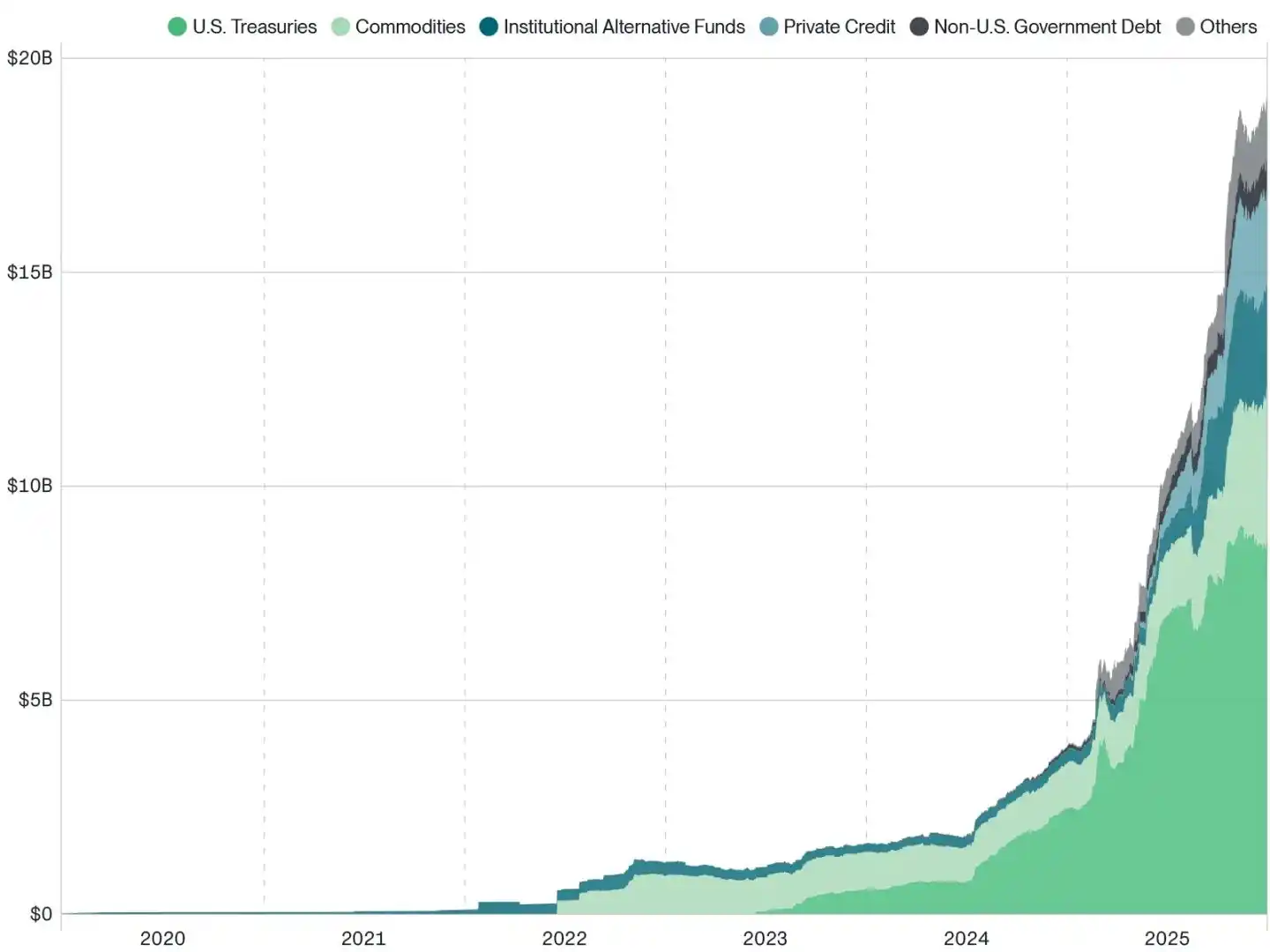
Source: Bitwise Asset Management, data from RWA.xyz. Data covers the period from January 1, 2020, to December 31, 2025.
Note: Stablecoin issuers like Circle and Tether have been intentionally omitted.
Seize the Opportunity
The challenge is that we often struggle to pinpoint exactly how to capitalize on it.
Because the crypto industry still has a number of key unresolved issues, such as:
· Where will the value from tokenization flow, to foundational protocols like Ethereum and Solana, or is the underlying blockchain space heading towards commoditization?
· If value solidifies in underlying public blockchains, will next-gen semi-private chains like Canton Network and Tempo outperform public chains?
· With institutions like BlackRock and Apollo embracing DeFi, will DeFi tokens see a surge, or will the underlying economic challenges of DeFi tokens prove difficult to overcome?
· If the ultimate value accrual is to builder companies rather than the blockchains themselves, will the beneficiaries be traditional giants like BlackRock and JPMorgan, or crypto-native institutions?
I have my own take on these questions and will be sharing my thoughts in upcoming posts over the next few months. But to be frank, the answer to most of these questions right now is: Nobody knows.
One thing I am sure of:
There is a significant gap between what people think the crypto market is and what is actually happening in the crypto market.
To me, this gap represents a major opportunity—not to rush to pick winners in advance, but to broadly position across the entire playing field while the market is still mispricing this structural shift.
The greatest alpha opportunities often arise when market consensus is outdated, reality has moved on, and investors are still anchored to old narratives.
The crypto industry is currently at this juncture.
If you can see its essence clearly, opportunities abound.
You may also like

60 Essential Skills, Workflows, and Open Source Projects, the Ultimate Claude Advancement Checklist

SpaceX to Raise $75 Billion | Rewire News Nightly

PUMP Valuation Breakdown: On-chain Data Disproves the "Fake Volume" Theory, Where Does the Real Discount Come From?

Tiger Research: What AI services do cryptocurrency companies offer?

The war not only drives up oil prices but also causes Circle's stock price to soar

When agents become consumers, who will rewrite the underlying logic of internet commerce?

AI Agents in Action Summit: March 31, Hong Kong Cyberport, focusing on the deep waters of AI implementation

29 Days In, What Are America’s Options on Iran?

Flash Crash Down 97%+ with Ongoing Unlocking, WLD Completes $65 Million Off-chain Funding: Who Is Still Buying?

Bitcoin for Real Estate? Fannie Mae Teams Up with Coinbase to Launch Crypto Mortgage
Tether Hires Big Four Auditor, USDT Enters First Attestation Phase

Google AI Paper Destroys $900B Storage Stock, Accused of Faking Experiment
Evaporate $2 Trillion, U.S. Stocks See Worst Start in 4 Years, Why is the Market Bearish?

The speed at which AI discovers vulnerabilities has surpassed the speed at which it patches vulnerabilities.

AI Crypto Trading Bot Explained: Aurora's Multi-Factor Strategy in WEEX Hackathon
Aurora demonstrates how structured, multi-agent AI Trading systems can deliver more adaptive and resilient performance in the WEEX AI Trading Hackathon.

Cyber Taoist Fortune Teller: Fake Taoist, AI Fortune Telling, and Northeastern Metaphysics History

Bloomberg: Stablecoin Payments Emerge as Crypto VC's Newest Favorite Thing
BeatSwap is evolving towards a full-stack Web3 infrastructure, covering the entire lifecycle of IP rights.
BeatSwap, a global Web3 Intellectual Property (IP) infrastructure project, is attempting to overcome the current fragmentation limitations of the Web3 ecosystem, building a full-stack system that covers the entire lifecycle of IP rights.
Currently, most Web3 projects are still in the stage of functional fragmentation, often focusing only on a single aspect, such as IP asset tokenization, transaction functionality, or a simple incentive model. This structural dispersion has become a key bottleneck hindering the industry's scale application.
BeatSwap's approach is more integrated, integrating multiple core modules into the same system, including:
· IP authentication and on-chain registration
· Authorization-based revenue sharing mechanism
· User-engagement-driven incentive system
· Transaction and liquidity infrastructure
Through the above integration, the platform builds an end-to-end closed-loop path, allowing IP rights to complete a full cycle of "creation, use, and monetization" within the same ecosystem.
BeatSwap is not limited to existing crypto users but is attempting to take the global music industry as a starting point, actively creating new market demand. Its core strategies include:
Exploring and incubating music creators (Artist discovery)
Building a fan community
Igniting IP-centric content consumption demand
The current global music industry is valued at around $260 billion, with over 2 billion digital music users. This means that the potential market corresponding to the tokenization and financialization of IP far exceeds the traditional crypto user base.
In this context, BeatSwap positions itself at the intersection of "real-world content demand" and "on-chain infrastructure," attempting to bridge the structural gap between content production and financial flow.
BeatSwap's upcoming core product "Space" is scheduled to launch in the second quarter of 2026. This product is defined as the SocialFi layer in the ecosystem, aiming to directly connect creators with users and achieve deep integration with other platform modules.
Key designs include:
A fan-centric interactive mechanism
Exposure and distribution logic based on $BTX staking
User paths connected to DeFi and liquidity structures
Thus, a complete user behavior loop is formed within the platform: Discovery → Participation → Consumption → Rewards → Trading
$BTX is designed to be a core utility asset within the ecosystem, rather than just a simple incentive token, with its value directly tied to platform activity and IP use cases.
Main features include:
· Yield distribution based on on-chain authorized actions
· Value reflection based on IP usage and user engagement dynamics
· Support for staking and DeFi participation mechanisms
· Value growth driven by ecosystem expansion
With the increased frequency of IP use, the utility and value support of $BTX will enhance simultaneously, helping alleviate the "disconnect between value and utility" issue present in traditional Web3 token models to some extent.
Currently, $BTX has been listed on several mainstream exchanges, including:
Binance Alpha
Gate
MEXC
OKX Boost
As the launch of "Space" approaches, BeatSwap is actively pursuing more exchange listings to further enhance liquidity and global accessibility, laying a foundation for future market expansion.
BeatSwap's goal is no longer limited to the traditional Web3 narrative but aims to target over 2 billion digital music users and a trillion KRW-scale content market.
By integrating content creators, users, capital, and liquidity into a blockchain framework centered around IP rights, BeatSwap is striving to build a next-generation infrastructure focused on "IP tokenization."
BeatSwap integrates IP authentication, authorization distribution, incentive mechanism, transaction system, and market construction to establish a unified structure that bridges the full lifecycle path of IP rights.
With the launch of the Q2 2026 "Space," the project is expected to become a key infrastructure connecting content and finance in the IP-RWA (Real World Assets) track.


 App
App