

Cryptocurrency people who use candlestick charts for fortune telling
Source: TechFlow (Shenchao)
AI fortune-telling is nothing new; it can predict everything from facial analysis to choosing seats in mahjong.
But the crypto world is doing it differently, directly incorporating fate into candlestick charts.
On December 13th,@0xSakura樱花, a blogger specializing in crypto metaphysics, released a new app called "Life Candlestick Chart."
By inputting your birth information, AI generates a candlestick chart from age 1 to 100 based on your birth chart, with red and green candles depicting your life's fortune.
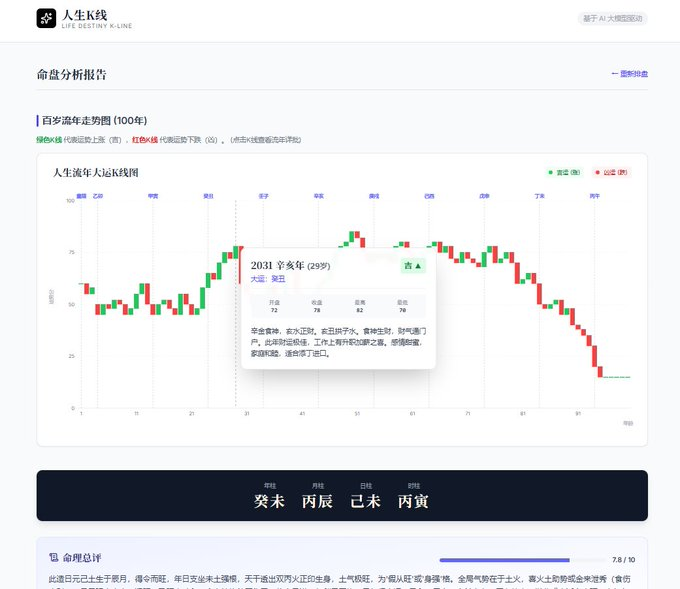
This thing went viral on Twitter. The initial tweet garnered over 3.3 million views, and within three days, the website and API calls exceeded 300,000. People started sharing screenshots like crazy, with many saying the generated candlestick charts closely matched their past life trajectories.
Even more bizarrely, this tool, explicitly labeled "for entertainment purposes only," saw a clone token appear within 24 hours of its launch.
Why would an entertainment-oriented fortune-telling tool resonate so strongly within the cryptocurrency community?
Behind this lies a long-standing undercurrent of trading mysticism, and also a concentrated release of collective anxiety within the cryptocurrency world.
The Mystic School in the Trading Industry
It's not surprising that cryptocurrency traders believe in mysticism. Wall Street is no exception.
W.D. Gann was one of the most famous market analysts of the 20th century, and also the person on Wall Street who most deeply combined mysticism and technical analysis, using astrology to predict market trends for trading.
George Soros admitted in *The Alchemy of Finance* that he would judge market risk based on the severity of his back pain. When the market is about to reverse, his back will ache intensely.
But these stories have long remained at the level of "legend," with few openly admitting to using metaphysics to guide their trading.
Privately, one might set up feng shui arrangements, wear lucky beads, or consult a master, but this must not be known to peers, otherwise it would be considered unprofessional.
The cryptocurrency world has broken this taboo.
In this industry, which inherently possesses an air of mystery, metaphysics seems a natural fit. Some predict BTC's fortune for the coming year based on astrological charts, while others use today's fortune to decide whether to open a trade.
Furthermore, discussions about metaphysics within the crypto industry seem to have increased significantly in recent years. More and more people, either trusting or out of curiosity, are joining the ranks of those engaging in metaphysical trading. A large number of cryptocurrency bloggers on Twitter have emerged, specializing in metaphysical analysis.
The explosive popularity of "life charts" is a prime example.
Many users in the community exchange and discuss their "life trajectory" with attitudes ranging from serious to joking. They don't see themselves as "superstitious"; they are simply using a more interesting way to share their feelings about uncertainty with peers.
The role of metaphysics among traders has shifted, transforming from a Wall Street secret into a public topic on cryptocurrency social media.
Why is metaphysics more popular in the crypto industry?
Why do crypto traders need metaphysics?
The answer to this question can be broadly categorized into three reasons:
Psychological compensation for anxiety about uncertainty
The crypto market is a perfect environment for creating anxiety.
Trading 24/7, 365 days a year, with no circuit breakers, means that wild swings can happen instantly.
Here, a single tweet from a prominent figure can wipe out hundreds of millions or even billions of dollars in market capitalization for a coin in an instant, and the founders of well-packaged projects can disappear overnight.
Traders constantly face "unknown risks," and the most terrifying aspect is not the "risk" itself, but the "unknown."
Economist Frank Knight pointed out in 1921 that risk is a quantifiable probability (like rolling dice), while uncertainty is an unquantifiable unknown (like whether war will break out tomorrow).
Humans are inherently afraid of uncertainty. When humans cannot quantify risk, they instinctively create "false certainty" to alleviate anxiety.
Metaphysics is precisely the perfect vehicle for this false certainty.
When you can't find your direction, checking today's trading almanac can at least give you a clear indication.
Within the cryptocurrency world, crypto astrologer @AstroCryptoGuru, with 51,000 followers, uses Bitcoin's "birth chart" (genesis block time January 3, 2009) combined with planetary cycles to make predictions:

Saturn signals correspond to bear markets, and Jupiter signals correspond to bull market peaks. He claims to have successfully predicted the December 2017 bull market peak, the 2022 bear market, and the 2024 BTC high.
This method of prediction, which links specific dates to celestial events, provides traders with a clear "wait signal" when market conditions are uncertain, even if that signal comes from outer space.
"Don't trade during Mercury retrograde," "A full moon will cause a crash," "Astrological charts indicate a BTC bull market next year"—these directional predictions don't require complex technical analysis or reading obscure white papers; you only need to believe in "predestination."
A 2006 study by the University of Michigan found that stock markets in 48 countries returned 6.6% less during a full moon than during a new moon.
This isn't because the moon actually influences the market, but because collective superstition influences trader behavior. When enough people believe "a full moon will cause a crash," they sell in advance, and the crash actually happens.
In the cryptocurrency world, this collective anxiety is even more intense, especially during a bear market. All "fundamental analysis" and "value investing" become a joke, while mystical analysis seems more reliable.
Therefore, traders need mystical methods, not because they are accurate, but because they offer an explanation, even if that explanation is false, it's still easier to accept than unpredictable uncertainty.
Cognitive bias leads to self-reinforcement
Why does mysticism always "seem effective"?
The reason mysticism continues to be popular in the cryptocurrency world is not only because it alleviates anxiety, but also because it "seems to actually work."
This isn't because mysticism itself is accurate, but because cognitive biases in the brain are self-reinforcing.
The most typical example is confirmation bias: when you believe "a full moon will cause a crash," you'll remember all the cases where a crash occurred after a full moon, while ignoring those days of surges or sideways movement. When your "life chart" shows this year is a bull market, you'll attribute every small rise to "the chart coming true," while interpreting crashes as "short-term corrections that don't affect the overall trend."
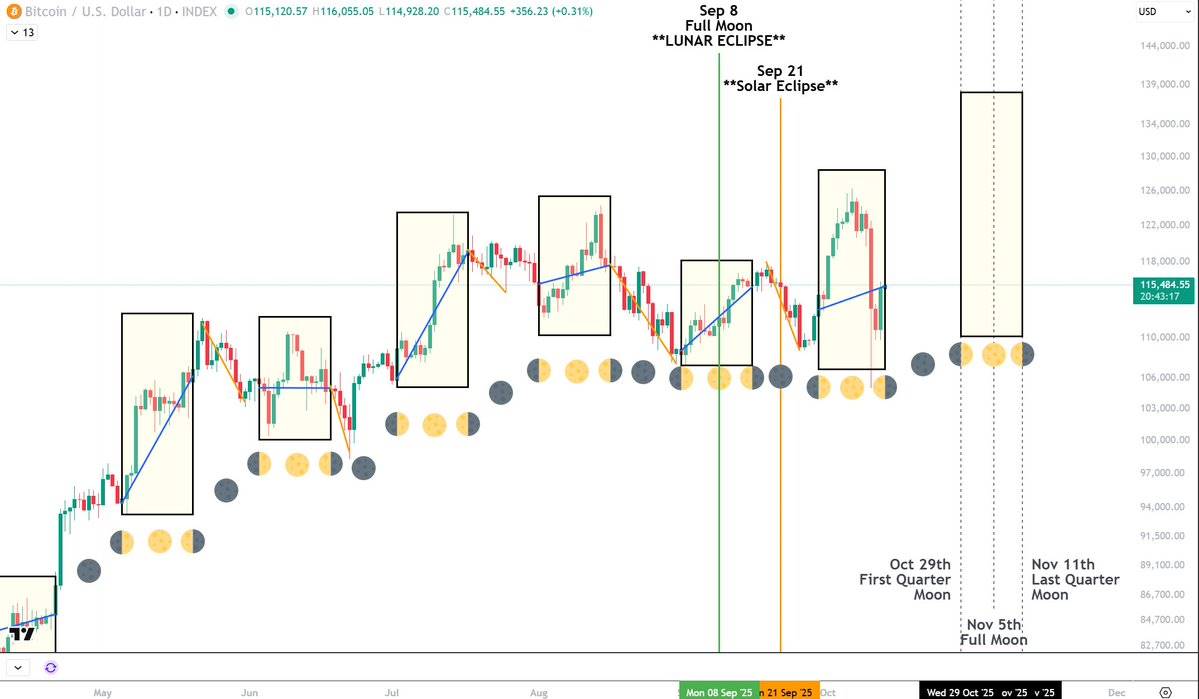
The social media environment within the cryptocurrency world amplifies this bias many times over.
Tweets like, "I followed the tarot card advice to go long on ETH contracts and made 20% in three days!" are highly likely to be widely shared, liked, and screenshotted.
However, traders who lost money following tarot card advice won't post about it, and their posts won't be seen.
As a result, the community's information flow is filled with cases of seemingly miraculous outcomes, while failures are filtered out.
Similar cases are ubiquitous on Twitter. For example, when @ChartingGuy predicted the Blood Moon in March of this year, regardless of market movements, there was always room for explanation: "early peak," "delayed fulfillment," "requires conjunction with other planetary angles."
And if BTC did indeed pull back during that period, this tweet would be repeatedly cited as a "prophetic prediction."
When BTC crashes, traders desperately need a reason. We look at social media: technical analysis says "it broke through support levels," macro analysis says "Japan raised interest rates," but these explanations are too complex and uncertain.
Metaphysics offers a simple and straightforward answer: "Saturn retrograde means the cryptocurrency market is entering a bear market cycle."
This explanation requires no understanding of market trends, policies, or data; it only requires the belief that celestial movements influence the market. Thus, it spread rapidly and became a consensus.
More importantly, the ambiguity of metaphysics means it can never be disproven.
A guru says not to trade during Mercury retrograde. If you lose money, it's because you didn't heed the guru's advice; if you profit, it's because your birth chart is special and suited for counter-trend trading. Tarot cards indicate significant recent volatility, and whether the price goes up or down, it's considered accurate.
This characteristic of being able to be interpreted correctly in any way makes metaphysics invincible in the cryptocurrency market.
Therefore, traders are not superstitious; rather, their brains are processing information in the most energy-efficient way: remembering what's useful, ignoring what's useless, and replacing complex analysis with simple explanations.
Metaphysics is not popular because it's accurate, but because it always seems accurate.
The Social Attributes of Metaphysics
Another reason for the popularity of metaphysics in the cryptocurrency market is that it has become a kind of social currency.
Discussions about technical analysis may lead to disagreements, but discussions about metaphysics have no right or wrong, only resonance. The question, "Is your life's K-line accurate?" is widely discussed not because people genuinely believe it, but because it's a topic anyone can participate in, requiring no professional expertise.
An example perfectly illustrates the existence of this demand for metaphysics.
Previously, our readers kept asking if we could add a horoscope function. Because of the numerous inquiries, we actually created a "Today's Horoscope" section on our website.
People don't necessarily rely on it for decision-making, but they want a common topic, a daily ritual for mental well-being.

When you say in a group chat, "Mercury retrograde today, I'm not trading," no one will question you, "That's not scientific." Instead, someone will reply, "Me too, let's get through this together."
The essence of this interaction is actually confirming that each other's anxieties are reasonable.
A 2025 Pew Research survey showed that 28% of American adults consult astrology, tarot cards, or fortune telling at least once a year.
Mysticism is no longer a fringe culture, but a universal psychological need. The crypto world has simply transformed this need from "private use" to "public display."
In this market without authoritative answers, mysticism doesn't offer answers, but rather companionship.
So, how accurate is your "life chart"?
The explosive popularity of "life charts" lies in using the crypto world to express what every trader feels but dares not admit: our sense of control over the market may be as fragile as our sense of control over fate.
When you see your "life chart" showing a bear market this year, you won't actually liquidate your entire position and leave the market. But you'll feel less self-blame when you lose, and more comfort when you miss out:
"This isn't my problem; my astrological cycle is wrong."
In this 24/7, year-round, and uncertain market, what we really want to predict isn't our life's trajectory, but rather a psychological support that keeps us at the poker table.
You may also like

WEEX AI Trading Hackathon 2026: How Top AI Strategies Dominated Real Markets
WEEX AI Trading Hackathon demonstrates that effective trading — whether powered by AI or human judgment — relies on core principles: understanding market structure, maintaining conviction, prioritizing quality over quantity, and managing risk intelligently.
WEEX Ai Trading Hackathon vs. Other AI Trading Competitions: Which Is Better for You?
The AI trading competition landscape offers distinct paths for growth. The WEEX AI Trading Hackathon differentiates itself through its focus on real-market execution and practical viability, positioning it as a key platform for aspiring quantitative traders and strategists.
Is AI Trading Replacing Humans? WEEX Hackathon Reveals the Future of Fintech
The WEEX AI Trading Hackathon reveals that the future of trading is not about AI replacing humans, but about collaboration. AI enhances trading capabilities, while human judgment, ethics, and strategic oversight remain essential.

Key Market Information Discrepancy on February 9th - A Must-See! | Alpha Morning Report

"2.5 Dip" Real Reason: Wall Street Deleveraging Induced Overreaction

Kyle's review of Hyperliquid sparks controversy, Solitude Bank officially opens, what are the overseas crypto communities talking about today?

Cryptocurrency prices in the dumps, but the prediction market is going wild?
Decoding Strategy’s Latest Financial Report: After a $12.4 Billion Loss, How Long Can the Bitcoin Flywheel Keep Spinning?
When earnings reports become electrocardiograms of Bitcoin’s price, Strategy is not merely a company—it’s an experiment testing whether faith can overcome gravity.

Discover How to Participate in Staking
Staking is a digital asset yield product launched by the WEEX platform. By subscribing to Staking products, users can stake their idle digital assets and earn corresponding Staking rewards.

WEEX AI Trading Hackathon Rules & Guidelines
This article explains the rules, requirements, and prize structure for the WEEX AI Trading Hackathon Finals, where finalists compete using AI-driven trading strategies under real market conditions.

From 0 to $1 Million: Five Steps to Outperform the Market Through Wallet Tracking

Token Cannot Compound, Where Is the Real Investment Opportunity?

February 6th Market Key Intelligence, How Much Did You Miss?

China's Central Bank and Eight Other Departments' Latest Regulatory Focus: Key Attention to RWA Tokenized Asset Risk
Foreword: Today, the People's Bank of China's website published the "Notice of the People's Bank of China, National Development and Reform Commission, Ministry of Industry and Information Technology, Ministry of Public Security, State Administration for Market Regulation, China Banking and Insurance Regulatory Commission, China Securities Regulatory Commission, State Administration of Foreign Exchange on Further Preventing and Dealing with Risks Related to Virtual Currency and Others (Yinfa [2026] No. 42)", the latest regulatory requirements from the eight departments including the central bank, which are basically consistent with the regulatory requirements of recent years. The main focus of the regulation is on speculative activities such as virtual currency trading, exchanges, ICOs, overseas platform services, and this time, regulatory oversight of RWA has been added, explicitly prohibiting RWA tokenization, stablecoins (especially those pegged to the RMB). The following is the full text:
To the people's governments of all provinces, autonomous regions, and municipalities directly under the Central Government, the Xinjiang Production and Construction Corps:
Recently, there have been speculative activities related to virtual currency and Real-World Assets (RWA) tokenization, disrupting the economic and financial order and jeopardizing the property security of the people. In order to further prevent and address the risks related to virtual currency and Real-World Assets tokenization, effectively safeguard national security and social stability, in accordance with the "Law of the People's Republic of China on the People's Bank of China," "Law of the People's Republic of China on Commercial Banks," "Securities Law of the People's Republic of China," "Law of the People's Republic of China on Securities Investment Funds," "Law of the People's Republic of China on Futures and Derivatives," "Cybersecurity Law of the People's Republic of China," "Regulations of the People's Republic of China on the Administration of Renminbi," "Regulations on Prevention and Disposal of Illegal Fundraising," "Regulations of the People's Republic of China on Foreign Exchange Administration," "Telecommunications Regulations of the People's Republic of China," and other provisions, after reaching consensus with the Cyberspace Administration of China, the Supreme People's Court, and the Supreme People's Procuratorate, and with the approval of the State Council, the relevant matters are notified as follows:
(I) Virtual currency does not possess the legal status equivalent to fiat currency. Virtual currencies such as Bitcoin, Ether, Tether, etc., have the main characteristics of being issued by non-monetary authorities, using encryption technology and distributed ledger or similar technology, existing in digital form, etc. They do not have legal tender status, should not and cannot be circulated and used as currency in the market.
The business activities related to virtual currency are classified as illegal financial activities. The exchange of fiat currency and virtual currency within the territory, exchange of virtual currencies, acting as a central counterparty in buying and selling virtual currencies, providing information intermediary and pricing services for virtual currency transactions, token issuance financing, and trading of virtual currency-related financial products, etc., fall under illegal financial activities, such as suspected illegal issuance of token vouchers, unauthorized public issuance of securities, illegal operation of securities and futures business, illegal fundraising, etc., are strictly prohibited across the board and resolutely banned in accordance with the law. Overseas entities and individuals are not allowed to provide virtual currency-related services to domestic entities in any form.
A stablecoin pegged to a fiat currency indirectly fulfills some functions of the fiat currency in circulation. Without the consent of relevant authorities in accordance with the law and regulations, any domestic or foreign entity or individual is not allowed to issue a RMB-pegged stablecoin overseas.
(II)Tokenization of Real-World Assets refers to the use of encryption technology and distributed ledger or similar technologies to transform ownership rights, income rights, etc., of assets into tokens (tokens) or other interests or bond certificates with token (token) characteristics, and carry out issuance and trading activities.
Engaging in the tokenization of real-world assets domestically, as well as providing related intermediary, information technology services, etc., which are suspected of illegal issuance of token vouchers, unauthorized public offering of securities, illegal operation of securities and futures business, illegal fundraising, and other illegal financial activities, shall be prohibited; except for relevant business activities carried out with the approval of the competent authorities in accordance with the law and regulations and relying on specific financial infrastructures. Overseas entities and individuals are not allowed to illegally provide services related to the tokenization of real-world assets to domestic entities in any form.
(III) Inter-agency Coordination. The People's Bank of China, together with the National Development and Reform Commission, the Ministry of Industry and Information Technology, the Ministry of Public Security, the State Administration for Market Regulation, the China Banking and Insurance Regulatory Commission, the China Securities Regulatory Commission, the State Administration of Foreign Exchange, and other departments, will improve the work mechanism, strengthen coordination with the Cyberspace Administration of China, the Supreme People's Court, and the Supreme People's Procuratorate, coordinate efforts, and overall guide regions to carry out risk prevention and disposal of virtual currency-related illegal financial activities.
The China Securities Regulatory Commission, together with the National Development and Reform Commission, the Ministry of Industry and Information Technology, the Ministry of Public Security, the People's Bank of China, the State Administration for Market Regulation, the China Banking and Insurance Regulatory Commission, the State Administration of Foreign Exchange, and other departments, will improve the work mechanism, strengthen coordination with the Cyberspace Administration of China, the Supreme People's Court, and the Supreme People's Procuratorate, coordinate efforts, and overall guide regions to carry out risk prevention and disposal of illegal financial activities related to the tokenization of real-world assets.
(IV) Strengthening Local Implementation. The people's governments at the provincial level are overall responsible for the prevention and disposal of risks related to virtual currencies and the tokenization of real-world assets in their respective administrative regions. The specific leading department is the local financial regulatory department, with participation from branches and dispatched institutions of the State Council's financial regulatory department, telecommunications regulators, public security, market supervision, and other departments, in coordination with cyberspace departments, courts, and procuratorates, to improve the normalization of the work mechanism, effectively connect with the relevant work mechanisms of central departments, form a cooperative and coordinated working pattern between central and local governments, effectively prevent and properly handle risks related to virtual currencies and the tokenization of real-world assets, and maintain economic and financial order and social stability.
(5) Enhanced Risk Monitoring. The People's Bank of China, China Securities Regulatory Commission, National Development and Reform Commission, Ministry of Industry and Information Technology, Ministry of Public Security, State Administration of Foreign Exchange, Cyberspace Administration of China, and other departments continue to improve monitoring techniques and system support, enhance cross-departmental data analysis and sharing, establish sound information sharing and cross-validation mechanisms, promptly grasp the risk situation of activities related to virtual currency and real-world asset tokenization. Local governments at all levels give full play to the role of local monitoring and early warning mechanisms. Local financial regulatory authorities, together with branches and agencies of the State Council's financial regulatory authorities, as well as departments of cyberspace and public security, ensure effective connection between online monitoring, offline investigation, and fund tracking, efficiently and accurately identify activities related to virtual currency and real-world asset tokenization, promptly share risk information, improve early warning information dissemination, verification, and rapid response mechanisms.
(6) Strengthened Oversight of Financial Institutions, Intermediaries, and Technology Service Providers. Financial institutions (including non-bank payment institutions) are prohibited from providing account opening, fund transfer, and clearing services for virtual currency-related business activities, issuing and selling financial products related to virtual currency, including virtual currency and related financial products in the scope of collateral, conducting insurance business related to virtual currency, or including virtual currency in the scope of insurance liability. Financial institutions (including non-bank payment institutions) are prohibited from providing custody, clearing, and settlement services for unauthorized real-world asset tokenization-related business and related financial products. Relevant intermediary institutions and information technology service providers are prohibited from providing intermediary, technical, or other services for unauthorized real-world asset tokenization-related businesses and related financial products.
(7) Enhanced Management of Internet Information Content and Access. Internet enterprises are prohibited from providing online business venues, commercial displays, marketing, advertising, or paid traffic diversion services for virtual currency and real-world asset tokenization-related business activities. Upon discovering clues of illegal activities, they should promptly report to relevant departments and provide technical support and assistance for related investigations and inquiries. Based on the clues transferred by the financial regulatory authorities, the cyberspace administration, telecommunications authorities, and public security departments should promptly close and deal with websites, mobile applications (including mini-programs), and public accounts engaged in virtual currency and real-world asset tokenization-related business activities in accordance with the law.
(8) Strengthened Entity Registration and Advertisement Management. Market supervision departments strengthen entity registration and management, and enterprise and individual business registrations must not contain terms such as "virtual currency," "virtual asset," "cryptocurrency," "crypto asset," "stablecoin," "real-world asset tokenization," or "RWA" in their names or business scopes. Market supervision departments, together with financial regulatory authorities, legally enhance the supervision of advertisements related to virtual currency and real-world asset tokenization, promptly investigating and handling relevant illegal advertisements.
(IX) Continued Rectification of Virtual Currency Mining Activities. The National Development and Reform Commission, together with relevant departments, strictly controls virtual currency mining activities, continuously promotes the rectification of virtual currency mining activities. The people's governments of various provinces take overall responsibility for the rectification of "mining" within their respective administrative regions. In accordance with the requirements of the National Development and Reform Commission and other departments in the "Notice on the Rectification of Virtual Currency Mining Activities" (NDRC Energy-saving Building [2021] No. 1283) and the provisions of the "Guidance Catalog for Industrial Structure Adjustment (2024 Edition)," a comprehensive review, investigation, and closure of existing virtual currency mining projects are conducted, new mining projects are strictly prohibited, and mining machine production enterprises are strictly prohibited from providing mining machine sales and other services within the country.
(X) Severe Crackdown on Related Illegal Financial Activities. Upon discovering clues to illegal financial activities related to virtual currency and the tokenization of real-world assets, local financial regulatory authorities, branches of the State Council's financial regulatory authorities, and other relevant departments promptly investigate, determine, and properly handle the issues in accordance with the law, and seriously hold the relevant entities and individuals legally responsible. Those suspected of crimes are transferred to the judicial authorities for processing according to the law.
(XI) Severe Crackdown on Related Illegal and Criminal Activities. The Ministry of Public Security, the People's Bank of China, the State Administration for Market Regulation, the China Banking and Insurance Regulatory Commission, the China Securities Regulatory Commission, as well as judicial and procuratorial organs, in accordance with their respective responsibilities, rigorously crack down on illegal and criminal activities related to virtual currency, the tokenization of real-world assets, such as fraud, money laundering, illegal business operations, pyramid schemes, illegal fundraising, and other illegal and criminal activities carried out under the guise of virtual currency, the tokenization of real-world assets, etc.
(XII) Strengthen Industry Self-discipline. Relevant industry associations should enhance membership management and policy advocacy, based on their own responsibilities, advocate and urge member units to resist illegal financial activities related to virtual currency and the tokenization of real-world assets. Member units that violate regulatory policies and industry self-discipline rules are to be disciplined in accordance with relevant self-regulatory management regulations. By leveraging various industry infrastructure, conduct risk monitoring related to virtual currency, the tokenization of real-world assets, and promptly transfer issue clues to relevant departments.
(XIII) Without the approval of relevant departments in accordance with the law and regulations, domestic entities and foreign entities controlled by them may not issue virtual currency overseas.
(XIV) Domestic entities engaging directly or indirectly in overseas external debt-based tokenization of real-world assets, or conducting asset securitization activities abroad based on domestic ownership rights, income rights, etc. (hereinafter referred to as domestic equity), should be strictly regulated in accordance with the principles of "same business, same risk, same rules." The National Development and Reform Commission, the China Securities Regulatory Commission, the State Administration of Foreign Exchange, and other relevant departments regulate it according to their respective responsibilities. For other forms of overseas real-world asset tokenization activities based on domestic equity by domestic entities, the China Securities Regulatory Commission, together with relevant departments, supervise according to their division of responsibilities. Without the consent and filing of relevant departments, no unit or individual may engage in the above-mentioned business.
(15) Overseas subsidiaries and branches of domestic financial institutions providing Real World Asset Tokenization-related services overseas shall do so legally and prudently. They shall have professional personnel and systems in place to effectively mitigate business risks, strictly implement customer onboarding, suitability management, anti-money laundering requirements, and incorporate them into the domestic financial institutions' compliance and risk management system. Intermediaries and information technology service providers offering Real World Asset Tokenization services abroad based on domestic equity or conducting Real World Asset Tokenization business in the form of overseas debt for domestic entities directly or indirectly venturing abroad must strictly comply with relevant laws and regulations. They should establish and improve relevant compliance and internal control systems in accordance with relevant normative requirements, strengthen business and risk control, and report the business developments to the relevant regulatory authorities for approval or filing.
(16) Strengthen organizational leadership and overall coordination. All departments and regions should attach great importance to the prevention of risks related to virtual currencies and Real World Asset Tokenization, strengthen organizational leadership, clarify work responsibilities, form a long-term effective working mechanism with centralized coordination, local implementation, and shared responsibilities, maintain high pressure, dynamically monitor risks, effectively prevent and mitigate risks in an orderly and efficient manner, legally protect the property security of the people, and make every effort to maintain economic and financial order and social stability.
(17) Widely carry out publicity and education. All departments, regions, and industry associations should make full use of various media and other communication channels to disseminate information through legal and policy interpretation, analysis of typical cases, and education on investment risks, etc. They should promote the illegality and harm of virtual currencies and Real World Asset Tokenization-related businesses and their manifestations, fully alert to potential risks and hidden dangers, and enhance public awareness and identification capabilities for risk prevention.
(18) Engaging in illegal financial activities related to virtual currencies and Real World Asset Tokenization in violation of this notice, as well as providing services for virtual currencies and Real World Asset Tokenization-related businesses, shall be punished in accordance with relevant regulations. If it constitutes a crime, criminal liability shall be pursued according to the law. For domestic entities and individuals who knowingly or should have known that overseas entities illegally provided virtual currency or Real World Asset Tokenization-related services to domestic entities and still assisted them, relevant responsibilities shall be pursued according to the law. If it constitutes a crime, criminal liability shall be pursued according to the law.
(19) If any unit or individual invests in virtual currencies, Real World Asset Tokens, and related financial products against public order and good customs, the relevant civil legal actions shall be invalid, and any resulting losses shall be borne by them. If there are suspicions of disrupting financial order and jeopardizing financial security, the relevant departments shall deal with them according to the law.
This notice shall enter into force upon the date of its issuance. The People's Bank of China and ten other departments' "Notice on Further Preventing and Dealing with the Risks of Virtual Currency Trading Speculation" (Yinfa [2021] No. 237) is hereby repealed.

Former Partner's Perspective on Multicoin: Kyle's Exit, But the Game He Left Behind Just Getting Started
Why Bitcoin Is Falling Now: The Real Reasons Behind BTC's Crash & WEEX's Smart Profit Playbook
Bitcoin's ongoing crash explained: Discover the 5 hidden triggers behind BTC's plunge & how WEEX's Auto Earn and Trade to Earn strategies help traders profit from crypto market volatility.

Wall Street's Hottest Trades See Exodus

Vitalik Discusses Ethereum Scaling Path, Circle Announces Partnership with Polymarket, What's the Overseas Crypto Community Talking About Today?
WEEX AI Trading Hackathon 2026: How Top AI Strategies Dominated Real Markets
WEEX AI Trading Hackathon demonstrates that effective trading — whether powered by AI or human judgment — relies on core principles: understanding market structure, maintaining conviction, prioritizing quality over quantity, and managing risk intelligently.
WEEX Ai Trading Hackathon vs. Other AI Trading Competitions: Which Is Better for You?
The AI trading competition landscape offers distinct paths for growth. The WEEX AI Trading Hackathon differentiates itself through its focus on real-market execution and practical viability, positioning it as a key platform for aspiring quantitative traders and strategists.
Is AI Trading Replacing Humans? WEEX Hackathon Reveals the Future of Fintech
The WEEX AI Trading Hackathon reveals that the future of trading is not about AI replacing humans, but about collaboration. AI enhances trading capabilities, while human judgment, ethics, and strategic oversight remain essential.