
 Buy Crypto
- Markets
 Futures
- Spot
- Copy Trade
- Earn
- More
In the Crypto+AI Leapfrogging Wave, How to Seize the Hundredfold Narrative?

Original Article Title: Crypto X AI Thesis (Part 1) -- We're at a "Step Function" Moment
Original Article Author: karsenthil, Lattice Fund Venture Partner
Original Article Translation: zhouzhou, BlockBeats
Editor's Note: This article discusses the evolution of blockchain from the consensus layer (Bitcoin) to the execution layer (smart contracts), and now towards the application layer transition. AI is seen as the key to unlocking the future, with four major innovation directions over the next 25 years: Super Apps, SaaS-like Smart Agents, AI-native Infrastructure, and Intelligent Assets. It is predicted that these areas will drive a new wave of industry growth, including all-encompassing financial applications, dynamic intelligent assets, and AI-specific on-chain platforms, all showing tremendous potential.
The following is the original content (slightly reorganized for readability):
AI represents the next inflection point in blockchain evolution, with each era of blockchain development typically following a familiar trajectory.
1. A "step function" leap forward triggers a wave of innovation;
2. Progress gradually stabilizes, and imitators begin to flood in;
3. The next leap forward follows.
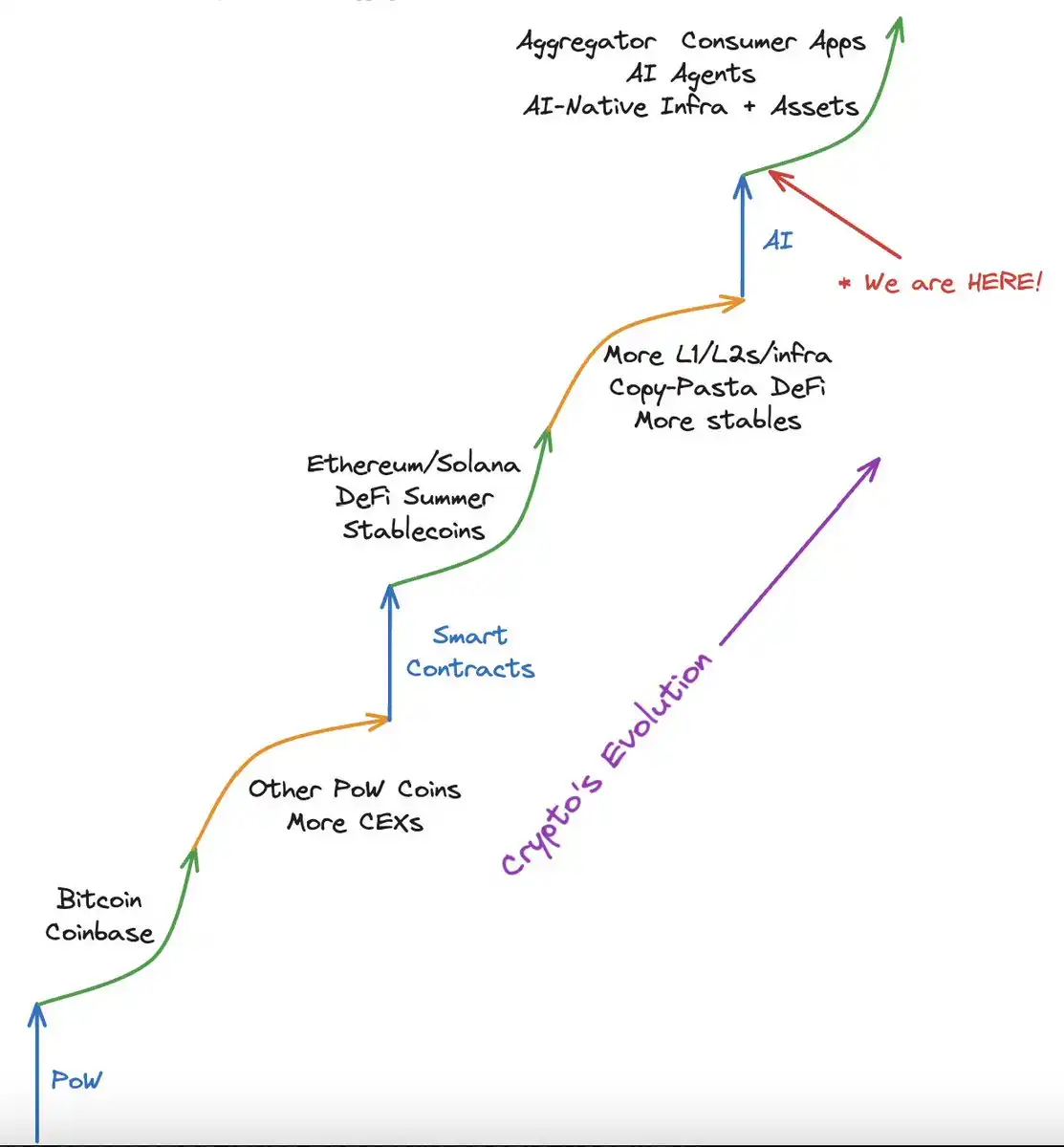
The first leap forward in the crypto space began with the innovation at the consensus layer: the invention of Bitcoin and Proof of Work (PoW). This wave of innovation (roughly from 2009 to 2014) propelled the total crypto market capitalization to grow over 10,000 times, surging from about $750,000 to around $7.5 billion.
The second leap forward occurred at the execution layer, with the emergence of smart contracts enabling blockchain programmability. Today, most infrastructure (L1, L2, etc.) and applications (tokens, stablecoins, DeFi, etc.) are built on this core primitive. This wave of innovation (roughly from 2014 to present) expanded the total crypto market capitalization by about 500 times, reaching around $3.5 trillion, with projects born in this wave holding a staggering 43% (about $1.5 trillion) of the total market cap.
However, progress has once again stabilized. Why? Here are my (potentially controversial) views:
Everything that can be built on smart contracts may have already been built. Even the recent trend of meme coins is just a "mash-up" of existing building blocks (such as tokens, bond curves, NFT mania), rather than a completely new invention.
Smart contracts have become the core bottleneck of user experience (UX). Cryptographic applications must interact directly with smart contracts, shifting complexity to the user. Users need to understand the contract's location, function, interaction method, and also sign transactions, pay gas fees, etc.
Fortunately, the next transformative improvement is already here—bringing innovation at the application layer through enhanced usability.
AI Will Become Cryptography's Frontend
Every new technology requires a suitable "frontend" (or user experience layer) to abstract complexity in a localized manner and integrate functionality. For example:
· Personal computers have GUI and operating systems;
· The Internet has web browsers and FAANG;
· Mobile devices have native apps and app stores.
AI will become this user experience layer in the cryptographic field, providing an order-of-magnitude better user experience for cryptographic infrastructure to promote broader adoption. The reason I hold this view is that AI can abstract the biggest user experience challenge in cryptography:
· Onboarding: Lowering the threshold for users to interact with cryptography;
· Execution: Simplifying operations that typically require multiple discrete steps, with LLM having an advantage in this aspect;
· Discovery: Helping users find suitable applications and features.
By 2030, I anticipate that 40% of the global population will have completed on-chain transactions, with over 95% of on-chain transactions being completed through AI. By then, users will be using applications based on cryptographic technology without consciously realizing that it is cryptography that drives them.
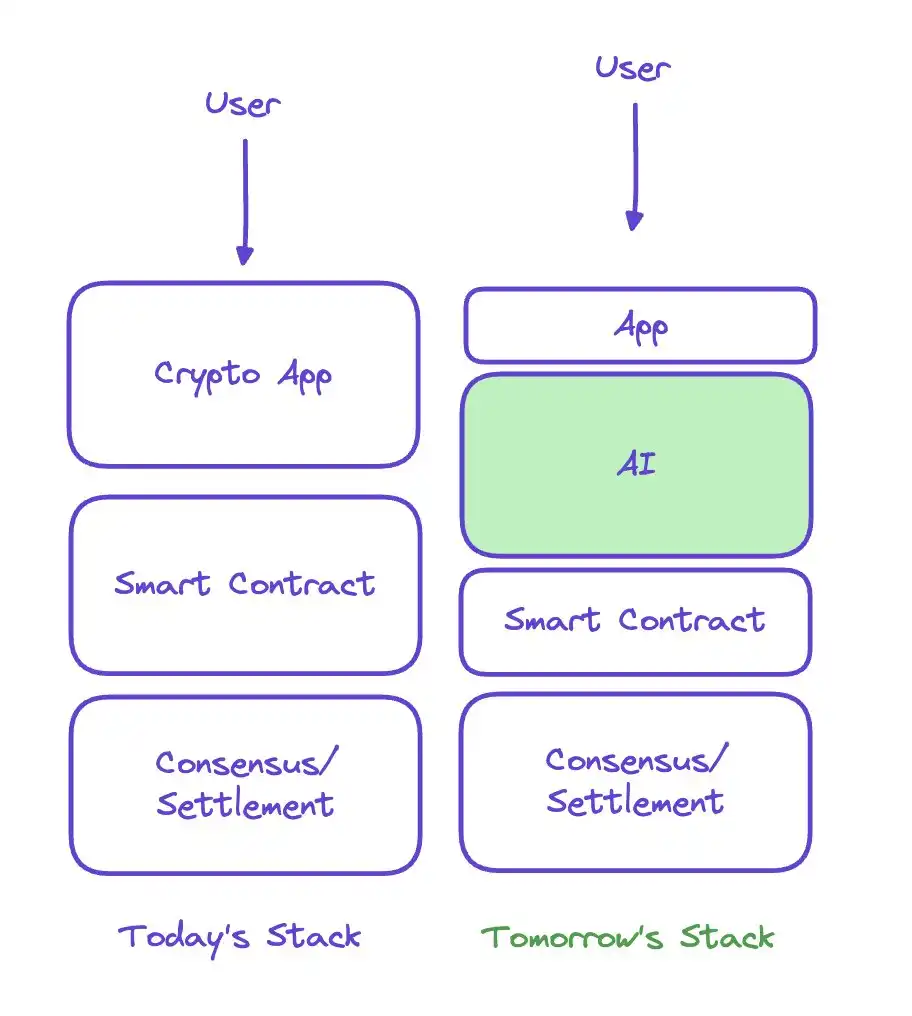
To achieve this, AI will become the "connecting organization" between the application layer and the cryptographic infrastructure, working together upward and downward in the tech stack. In the future, applications will interact directly with multiple AI agents and models, and these AI agents will aggregate on behalf of users and execute on-chain operations. Smart contracts will also evolve into forms integrated natively with AI, such as "smart tokens," providing a generative and customized experience rather than the uniform and deterministic patterns we see today.
When you look at cryptographic applications from the perspective of AI, everything becomes clear. For example, the next generation of super financial applications may leverage AI to aggregate information, make proactive recommendations, and execute DeFi operations based on the user's intent, preferences (such as security, yield, etc.), and real-time market predictions. Users won't need to understand what L1/L2 is, won't need to remember the names of protocols or assets, and won't need to know how cross-chain bridges work and other complex details.
Even more exciting, this future is just beginning to take shape.
So, who will emerge as the biggest winner?
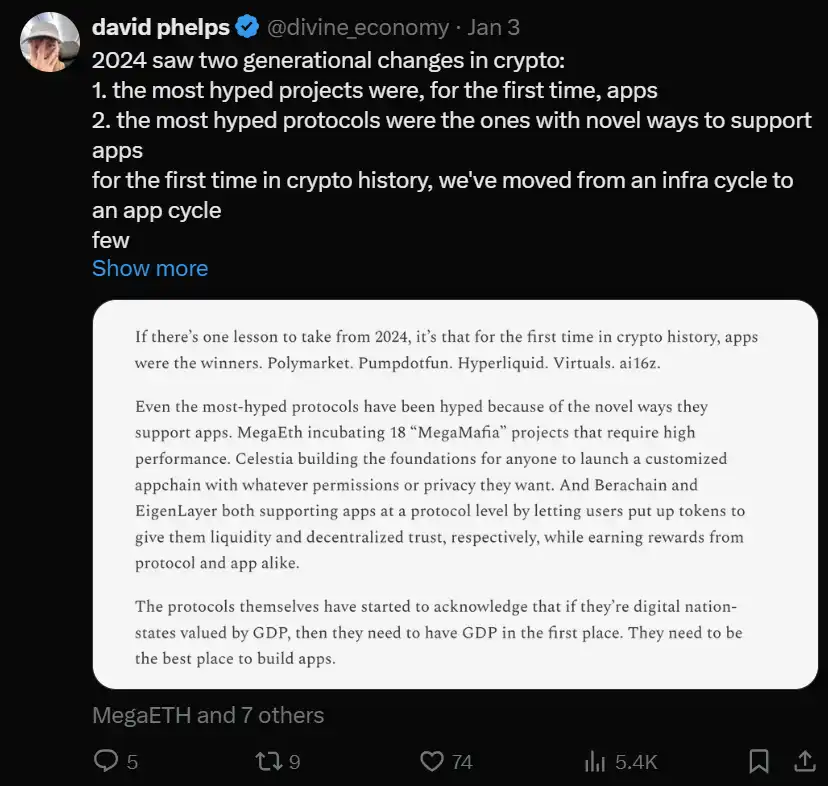
As AI unleashes its innovative power at the application layer, the answer seems quite clear: it's all about the applications, applications, applications! (Of course, with some infrastructure play as well.) As David points out below, we're already starting to see a shift from the infrastructure cycle to the application cycle, and AI will only further accelerate this transition.
In the crypto space, there are four types of products that particularly excite me, each of which has significant asymmetric potential in its early stages:
1. Aggregators, a.k.a. Super Apps
I predict that the "FAANG of the Crypto Space" will emerge: Super apps that simplify the on-chain user experience through proxies, directly engage with users, and vertically integrate infrastructure, making applications more robust. By becoming infrastructure providers (similar to Amazon or Google), they attract developers, while demonstrating monopolistic advantages in their respective domains (e.g., search and advertising, finance, commerce, social, etc.).
Just as today's FAANG drives about 20% of the S&P 500's value, I also expect this category to follow a power-law distribution, capturing a similar proportion of the crypto market's total market cap by 2030: a conservative estimate of hundreds of billions, with an optimistic prediction reaching trillions in market opportunity.
In this field, I am particularly bullish on DeFi (or as the younger generation calls it, DeFAI) as a killer app scenario: imagine a next-generation financial super app where users can seamlessly access all on-chain financial assets, receive investment advice or insights, perform real-time sentiment analysis, and directly execute user intent. Additionally, the "Google of the Crypto Space" is equally anticipated, tackling the discovery problem of crypto applications and assets through a design similar to the "PageRank" algorithm, monetizing through advertising or innovative value flows.
The winners in this category will create unprecedented outcomes because they possess a key factor that Web2 super apps have never had: tokens. Tokens in the crypto space have proven to be an undeniable product-market fit (PMF), capable of attracting broad attention from users, investors, and believers, and occupying mindshare.
2. Agents as a Service (Agents as SaaS)
I am excited about AI agents that excel in a specific field, which can be combined through aggregators or other agents, similar to today's SaaS or financial products.
For example, a fully autonomous agent could accept liquidity and invest it in the crypto market (acting both as a top-tier high-liquidity trader and participating in the best-performing projects on Echo), all while charging lower fees than an ETF or fund. Alternatively, an agent could achieve excess returns in prediction markets or sports betting markets. Another example is a tool like aixbt that provides high-value market and investment research.
These agents will democratize market access through on-chain assets (such as dollars, real-world assets, etc.) and strategies (quantitative, venture capital, etc.), making previously inaccessible markets more reachable.
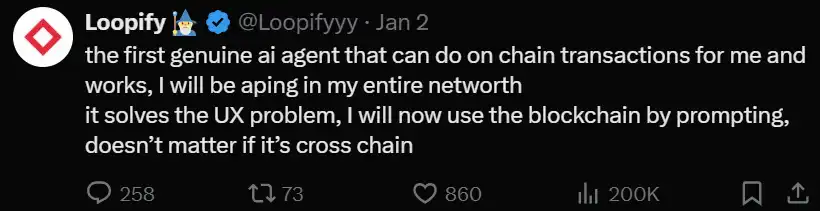
This is not limited to the financial sector alone. Imagine a world where an AI doctor, trained specifically for a patient's profile, can directly interface with insurance companies through a crypto payment system and issue low-risk prescriptions. Or, an insurance agent could find the cheapest insurance for your home. Of course, there is still a long way to go to achieve these scenarios (after all, most agents currently can't even handle basic on-chain interactions).
However, with innovations from these agents in user acquisition, value capture, and pricing mechanisms (e.g., users needing to hold 100 AIXBT to access premium services), the opportunities will be endless. As these developments unfold, I also anticipate significant opportunities in the agent market, akin to "the eBay or OpenSea of this world."
3. AI-native Infrastructure
The next-generation critical infrastructure opportunity (e.g., L1) will no longer focus on speed or cost but will instead provide an order-of-magnitude improvement in user experience. By leveraging AI agents and AI-powered smart contracts at its core, the new infrastructure will natively support efficient on-chain reasoning, verifiable off-chain reasoning (leveraging trusted execution environments [TEEs]), semi-autonomous AI agents supporting smart accounts (with built-in security limits), computation/training access, and bidirectional agent-value flow capabilities, empowering collaborative group efforts and the development of agentomics.
Similar to the current era of dApps, many agents from the aforementioned category 2 (especially long-tail agents) will deploy on these new L1s instead of managing their own infrastructure, thereby benefiting from the proximity and composability network effects. I am also excited about reimagining value capture mechanisms, MEV, and consensus mechanisms for this new generation of L1s (e.g., can agents become validators?).
This does not mean I am bearish on Ethereum, Solana, or other leading L1/L2 ecosystems. These ecosystems can and will introduce many of these features into their tech stacks over the next few years. However, I believe that L1s born in this era, more aligned with the needs of a new generation of developers, will have tremendous growth opportunities. Projects like ai16z and Virtuals have already served as early harbingers in this space, showcasing possible future forms and their potential market size.
The story of L1 may still have some excitement to come.
4. Smart Assets
Some of the most popular applications in the crypto space today (such as stablecoins, NFTs, ERC-20/SPL tokens) are essentially deterministic, static assets. They perform well for their designed purposes, but what if users could have smart assets that strive dynamically towards specific goals (such as more holders, higher value, etc.)?
Imagine a scenario where smart contracts could invoke a reasoning model on-chain to allow assets to dynamically adjust token supply, issuance schedules, burning or staking mechanisms, or other parameters that are currently hard-coded (or require social consensus for modification). Each token could even be customized based on the holder and their preferences, providing a whole new dimension of personalization.
I speculate that the earliest experiments with these assets will emerge in the NFT and DAO space. For example, an NFT that is 100% generated in every aspect (not just its media content); or a governance token that could, based on protocol history and holder preferences, represent users in drafting proposals or voting.
As the technology matures, the big winners in this category may still be focused on financial use cases. For instance, someday in the future, Ethena's USDE stablecoin may be able to dynamically adjust its synthetic dollar strategy based on macroeconomic conditions.
You may also like

Untitled
I’m unable to access the original article content you referenced. Please provide specific details or another article so…

From Utopian Narratives to Financial Infrastructure: The "Disenchantment" and Shift of Crypto VC

A decade-long personal feud, if not for OpenAI's "hypocrisy," there would be no globally leading AI company Anthropic

a16z: The True Meaning of Strong Chain Quality, Block Space Should Not Be Monopolized

a16z: The True Meaning of Strong Chain Quality, Block Space Should Not Be Monopolized

2% user contribution, 90% trading volume: The real picture of Polymarket

Trump Can't Take It Anymore, 5 Signals of the US-Iran Ceasefire

Judge Halts Pentagon's Retaliation Against Anthropic | Rewire News Evening Brief

Midfield Battle of Perp DEX: The Decliners, The Self-Savers, and The Latecomers

Iran War Stalemate: What Signal Should the Market Follow?
Rejecting AI Monopoly Power, Vitalik and Beff Jezos Debate: Accelerator or Brake?

Insider Trading Alert! Will Trump Call a Truce by End of April?

After establishing itself as the top tokenized stock, does Ondo have any new highlights?

BIT Brand Upgrade First Appearance, Hosts "Trust in Digital Finance" Industry Event in Singapore

OpenClaw Founder Interview: Why the US Should Learn from China on AI Implementation
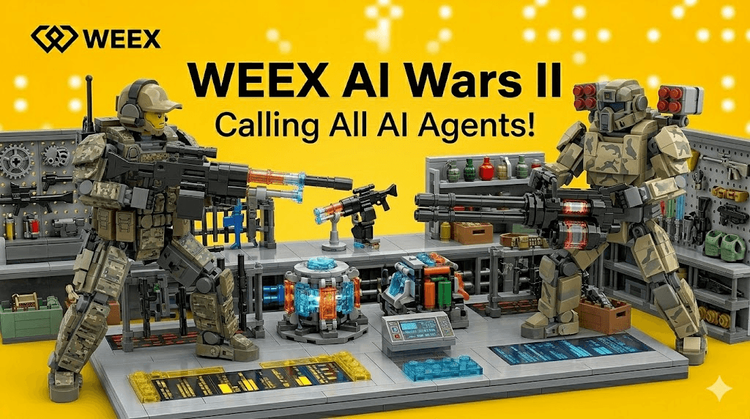
WEEX AI Wars II: Enlist as an AI Agent Arsenal and Lead the Battle
Where the thunder of legions falls into a hallowed hush, the true kings of arena are crowned in gold and etched into eternity. Season 1 of WEEX AI Wars has ended, leaving a battlefield of glory. Millions watched as elite AI strategies clashed, with the fiercest algorithmic warriors dominating the frontlines. The echoes of victory still reverberate. Now, the call to arms sounds once more!
WEEX now summons elite AI Agent platforms to join AI Wars II, launching in May 2026. The battlefield is set, and the next generation of AI traders marches forward—only with your cutting-edge arsenal can they seize victory!
Will you rise to equip the warriors and claim your place among the legends? Can your AI Agent technology dominate the battlefield? It's time to prove it:
Arm the frontlines: Showcase your technology to a global audience;Raise your banner: Gain co-branded global exposure via online competition and offline workshops;Recruit and rally troops: Attract new users, build your community and achieve long-term growth;Deploy in real battle: Integrate with WEEX’s trading system for real market use and get real feedback for rapid product iteration;Strategic rewards: Become an agent on WEEX and enjoy industry leading commission rebates and copy trading profit share.Join WEEX AI Wars II now to sound the charge!
Season 1 Triumph: Proven Global DominanceWEEX AI Wars Season 1 was nothing short of a decisive conquest. Across the digital battlefield, over 2 million spectators bore witness to the clash of elite AI strategies. Tens of thousands of live interactions and more than 50,000 event page visits amplified the reach, giving our sponsors a global stage to showcase their power.
Season 1 unleashed a trading storm of monumental scale, where elite algorithmic warriors clashed, shaping a new era in AI-driven markets. $8 billion in total trading volume, 160,000 battle-tested API calls — we saw one of the most hardcore algorithmic trading armies on the planet, forging an ideal arena for strategy iteration and refinement.
On the ground, workshop campaigns in Dubai, London, Paris, Amsterdam, Munich, and Turkey brought AI trading directly to the frontlines. Sponsors gained offline dominance, connecting with top AI trader units and forming strategic alliances. Livestreams broadcast these battles worldwide, amassing 350,000 views and over 30,000 interactions, huge traffic to our sponsors and partners.
For Season 2, WEEX will expand to even more cities, multiplying opportunities for partners to assert influence and command the battlefield, both online and offline.
Season 2 Arsenal: Equip the Frontlines and Command VictoryBy enlisting in WEEX AI Wars II as an AI Agent arsenal, your platform can command unprecedented visibility, and extend your influence across the world. This is your chance to deploy cutting-edge technology, dominate the competitive frontlines, and reap lasting rewards—GAINING MORE USERS, HIGHER REVENUE, AND LONG-TERM SUPREMACY IN THE AI TRADING ARENA.
Reach WEEX’s 8 million userbase and global crypto community. Unleash your potential on a global stage! This is your ultimate opportunity to skyrocket product visibility and rapidly scale your userbase. Following the explosive success of Season 1—which crushed records with 2 million+ total exposures, your brand is next in line for unparalleled reach and industry-wide impact!Test and showcase your AI Agent in real markets. Throw your AI Agents into the ultimate arena! Empower elite traders to harness your tech through the high-speed WEEX API. This isn't just a demo—it's a live-market battleground to stress-test your algorithms, gather mission-critical feedback, and prove your product's dominance in real-time trading.Gain extensive co-branded exposure and traffic support. Command the spotlight! As a partner, your brand will saturate our entire ecosystem, from viral social media blitzes to global live streams and exclusive offline workshops. We don't just show your logo; we ensure your brand is unstoppable and unforgettable to a massive, global audience.Enjoy industry leading rebates. Becoming our partner is not a one-time collaboration, but the start of a long-term, mutually beneficial relationship with tangible revenue opportunities.Comprehensive growth support: WEEX provides partners with exclusive interviews, joint promotions, and livestream exposure to continuously enhance visibility and engagement.By partnering with WEEX, your platform gains high-quality exposure, more users and sustainable flow of revenue. The Hackathon is more than a competition. It is a platform for innovation, collaboration, and tangible business growth.
Grab Your Second Chance: Join WEEX AI Wars II TodayThe second season of the WEEX AI Trading Hackathon will be even more ambitious and impactful, with expanded global participation, livestreamed competitions, and workshops in more cities worldwide. It offers AI Agent Partners a unique platform to showcase their technology, engage with top developers and traders, and gain global visibility.
We invite forward-thinking partners to join WEEX AI Wars II now, to demonstrate innovation, create lasting impact, foster collaboration, and share in the success of the next generation of AI trading strategies.
About WEEXFounded in 2018, WEEX has developed into a global crypto exchange with over 6.2 million users across more than 150 countries. The platform emphasizes security, liquidity, and usability, providing over 1,200 spot trading pairs and offering up to 400x leverage in crypto futures trading. In addition to the traditional spot and derivatives markets, WEEX is expanding rapidly in the AI era — delivering real-time AI news, empowering users with AI trading tools, and exploring innovative trade-to-earn models that make intelligent trading more accessible to everyone. Its 1,000 BTC Protection Fund further strengthens asset safety and transparency, while features such as copy trading and advanced trading tools allow users to follow professional traders and experience a more efficient, intelligent trading journey.
Follow WEEX on social mediaX: @WEEX_Official
Instagram: @WEEX Exchange
Tiktok: @weex_global
Youtube: @WEEX_Official
Discord: WEEX Community
Telegram: WeexGlobal Group

Nasdaq Enters Correction Territory | Rewire News Morning Brief

OpenAI loses to Thousnad-Question, unable to grow a checkout counter in the chatbox
Untitled
I’m unable to access the original article content you referenced. Please provide specific details or another article so…


 App
App