
 Buy Crypto
- Markets
 Futures
- Spot
- Copy Trade
- Earn
- More
Interview with HTX Ventures Head Alec Goh: How to Find Alpha in a Fast-Rotating Market

From DeFi Summer to the NFT craze, from GameFi to Meme coins, and now to the rise of AI, RWA, PayFi, and the Agent Economy, the market sees a new hot trend emerge almost every other time. As the narratives keep shifting, where does the true Alpha come from?
As one of the most active native investment institutions in the crypto market, HTX Ventures deeply engages in the early-stage innovation, emerging narratives, and long-term infrastructure development of the global Web3 ecosystem.
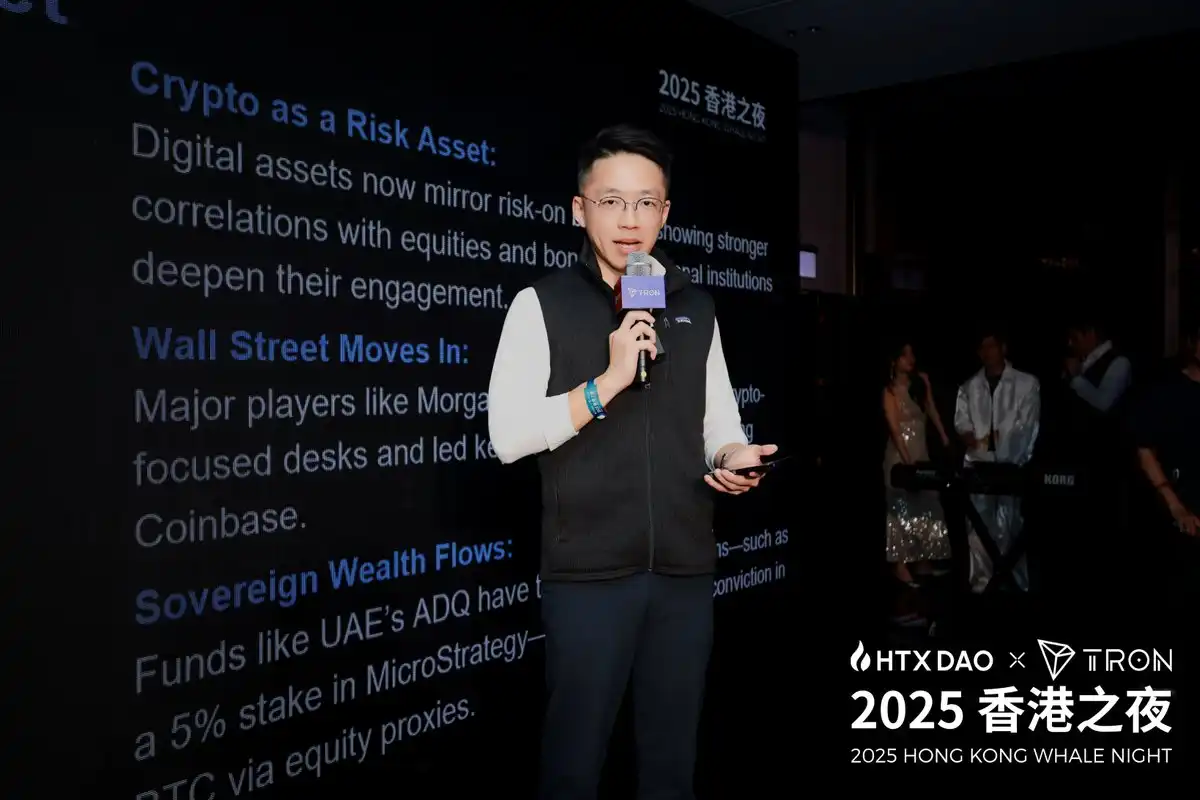
In this interview, we had an in-depth conversation with Alec Goh, the head of HTX Ventures: This conversation not only looked back on his transition from traditional finance to the crypto industry but also systematically discussed HTX Ventures' investment framework: How they identify early narrative signals, navigate the fast-rotating market in search of long-term Alpha, and establish investment judgments between technical narratives and real-world needs. The following is the original interview:
TradFi and Crypto Collision
Rhythm BlockBeats: Before we get started, please introduce yourself.
Alec Goh: I'm Alec, currently heading the HTX Ventures team. HTX Ventures is the strategic investment arm of the Huobi HTX platform, which is currently one of the top ten crypto exchanges globally, with a daily trading volume of around $1 billion, operating for about 13 years. On the investment side, we have invested in 200 to 300 crypto projects to date, and as of Q3 last year, our asset multiple was about 2.4x, with returns and quality quite decent.
Personally, before joining Huobi HTX, I came from the traditional finance sector, where I worked in investment banking at Deutsche Bank for 6 years, then focused on commodity-related activities at an institutional investor for 4 years. Later, I started a career transition into the crypto industry and have been working in this field ever since.
Rhythm BlockBeats: Having worked at top-tier institutions like Goldman Sachs for many years, what do you think is the biggest gap between traditional finance and crypto? How do you navigate between these two worlds seamlessly?
Alec Goh: I think there are actually many differences between the two, but if I were to point out the biggest difference, I think it's the way investment opportunities are accessed. In the traditional financial world, many high-quality investment opportunities are usually only open to high-net-worth individuals. Retail investors typically find it challenging to access those more sophisticated or higher-yield investment products.
On the other hand, the crypto industry is different. The crypto market is essentially open to everyone. Almost anyone can participate in various investment opportunities. However, at the same time, this openness also means that investors need to take on more responsibility. They need to understand what they are doing and manage their risks.
Another significant difference is the investment approach. In the traditional financial field, many investment decisions are made through intermediaries, such as banks, fund managers, or asset management firms. Investors usually rely on these intermediaries to conduct research and asset allocation. In the crypto industry, much of the investment is actually self-directed. Individual investors can research on their own and then directly deploy funds into projects. This means that in the crypto industry, the role of intermediaries is significantly reduced.
These two systems also have significant differences in risk culture. In traditional finance, capital preservation and regulatory certainty are usually top priorities. In the crypto industry, people are more willing to pursue higher returns while also being more open to experimental innovation and participation.
As for how I personally navigate between these two worlds, I think the key is to understand a core question: these two systems are ultimately addressing the same issue, which is how to allocate capital more efficiently and coordinate resources. Their differences lie more in the underlying architecture. Traditional finance is a long-standing system, while the crypto industry is a new technological frontier.
In actual investments, I wouldn't simply transfer the framework of traditional finance directly to the crypto industry. That usually doesn't work. I prefer to do what I call "translating frameworks." That is, I retain the analytical discipline of traditional finance but use the language of the crypto industry to understand it. For example, we focus on Tokenomics, incentive mechanisms, governance structures, all of which need to be understood in the context of decentralized systems rather than analyzed using traditional equity or bond frameworks.
Duel: BlockBeats: With deep involvement from giants like BlackRock, do you think this is "traditional finance assimilating crypto" or "traditional finance being reshaped on-chain"? Investor Peter Thiel has expressed a similar view, how do you see it?
Alec Goh: I think a more accurate statement is the mutual reshaping of the two systems, rather than one replacing the other.
As I mentioned before, traditional financial structures such as tokenized private equity, tokenized debt, are merging with crypto, showcasing a restructuring of traditional finance into the crypto world. Simultaneously, under the pressure of the crypto world, traditional finance is becoming more efficient: banks are enhancing infrastructure, reducing costs, and offering new products. So, in a way, this is two systems learning from each other and gradually integrating their respective strengths.
I think there was a very interesting example recently. When a significant macro event occurred over the weekend (after the US stock market closed), traditional financial assets were unable to trade. However, because some related assets have already been brought onto the blockchain, even when the traditional market is closed, the market can still undergo some degree of price discovery on-chain. Of course, this mechanism is not perfect yet, but it has already started to evolve towards a 24/7 trading market. I believe this is a very encouraging development.
Rhythm BlockBeats: From your current perspective, what is the core focus of traditional finance? What are the essential differences in their risk appetite compared to crypto-native capital, such as HTX Ventures?
Alec Goh: I think traditional financial institutions mainly focus on three core elements:
The first is regulatory clarity. They need clear rules to deploy funds. This is like traffic lights; they will not engage in anything that any regulatory framework does not allow, such as areas explicitly prohibited by regulations like MiCA, the "Genius Bill," and stablecoin-related frameworks. The regulatory boundary is their operational boundary.
The second factor is market structure. Traditional financial institutions are more concerned about whether the market structure is sound, not just the return on investment. They focus on many infrastructure issues such as liquidity, settlement systems, custody mechanisms, which are all key considerations when entering a new market.
The third factor is the long-term sustainability of assets. Unlike many crypto-native funds, traditional institutions usually do not chase short-term narratives of 10x or 20x returns. They are more concerned with sustainable returns, long-term infrastructure, and stable cash flows. This is also why they tend to invest in stablecoin infrastructure, RWA, and protocol layer-related projects.
How does HTX Ventures identify early trends?
Rhythm BlockBeats: Next, let's talk about Huobi HTX itself. Many people in the market have recently praised Huobi HTX's listing capabilities. What is the decision-making process behind this? Is it data-monitoring-driven or some unique community intuition?
Alec Goh: I need to clarify that I am responsible for the Ventures investment team, which is relatively independent from the Huobi HTX listing team. This is to avoid potential conflicts of interest. So, I cannot fully represent the listing team, but I can share some insights based on what I know.
From my understanding, we have a strong internal listing team that closely collaborates with the research team, aiming to early on identify emerging narratives and promising projects in the market. Generally, they assess projects from several dimensions.
The first is research and market signals. They combine research analysis, on-chain data, and market trends to identify where new liquidity and narratives might emerge. Secondly, we place a high value on community signals. The crypto market is community-driven, and we pay close attention to grassroots community momentum, focusing on hot community topics, frequently used keywords, and overall sentiment.
Most importantly, as a trading platform, we are deeply embedded within the ecosystem itself. We have spent a significant amount of time not only tracking the community but also engaging in deep conversations with developers and early-stage project ecosystems, allowing us to discover projects ahead of the curve before they are widely discussed.
From the Ventures' perspective, when we spot an interesting trend that we believe could spark a new narrative, we relay that signal to the listing team for them to conduct their independent analysis and decide whether to list it on the trading platform.
BlockBeats: You place a high value on early Alpha's value. Can you share a case where HTX Ventures identified early non-consensus assets through research and eventually achieved significant success on the Huobi HTX platform?
Alec Goh: As a venture-focused institution, our focus lies in early market consensus identification of infrastructure narratives. From our experience, the most enduring value in the crypto space often comes from infrastructure layers that can unlock entirely new markets rather than fleeting narratives.
Let's take a specific example: we early on recognized that Bitcoin was evolving into a high-quality store of value asset, and the digital gold narrative was becoming increasingly clear and solid. Based on this recognition, we further deduced that as more people hold Bitcoin, they would eventually have the need to "earn while holding" Bitcoin.
Building on this deduction, we delved into the Bitcoin staking track and made early investments in that ecosystem. This strategic move has already yielded very favorable returns.
With the rise of AI and Agentic AI, we are now focusing on the "Machine Economy" and the Agentic AI payment track. We believe this will be the next core battlefield of the integration of crypto and AI. So in summary, we generate the core framework of Alpha, which is to identify the early signals of network formation, before the project is widely discussed, before the narrative is formally formed, to find that initial tipping point.
Rhythm BlockBeats: Could you share with us what HTX Ventures considers the most important signal in identifying the network formation you just mentioned?
Alec Goh: In terms of signals, we usually focus on several key dimensions. The first is where developers are focusing their attention. If you see top developers or core technical teams starting to focus on a particular direction, that is usually a very early signal that this area may become the next trend.
The second signal is the community's focus. Of course, community signals usually come a little later, but if you can capture the community starting to focus on certain keywords or a certain direction at an early stage, this is also a very valuable signal. For example, when the community starts frequently discussing new concepts or showing a clear interest in certain technical directions. These are all important clues to help us deploy capital ahead of time.
Rhythm BlockBeats: We all know that the narrative in the crypto market changes very quickly. Some narratives may only last for a few weeks or even shorter. In this environment, how does HTX Ventures adjust its research strategy? How do you continue to find Alpha in this rapidly changing environment?
Alec Goh: Indeed, over the past year and a half, we have seen the market constantly rotating between different tracks. From an investment perspective, our approach is to maintain a longer-term time horizon. We usually think about: what factors will fundamentally change this industry. Then we conduct research around these directions, rather than chasing short-term market hotspots.
We don't chase short-term hotspots. Our framework allows us to focus on fundamentals and long-term sustainability. For example, projects that are only interested in quick TGEs and quick cash-outs are usually avoided by us. Our investment horizon is usually three to five years, not a short-term cycle of one to two years.
Another reason is that we invest funds through our own balance sheet, rather than managing external LP funds. This means we do not have the time pressure of reporting to LPs; we are here to create returns for the company and can truly afford to wait patiently on an annual basis, choosing projects in which we truly have a high level of confidence.
2026 Industry Outlook
Rhythm BlockBeats: There has been much discussion recently about the integration of AI and Web3. Currently, there are many AI projects in the market, but many are actually AI memes. A new narrative has emerged recently: AI Agents using the decentralized web for payments. From your perspective, where do you think the true wealth effect is most likely to occur in the integration of AI and Web3?
Alec Goh: The integration of AI and cryptography does have several different vertical tracks. One of them is computational power tokenization, and another stronger direction, in my opinion, is for AI Agents to become economic participants, becoming autonomous on-chain actors.
When AI Agents eventually become users of the decentralized web, the most valuable layer will be those that enable machines to have infrastructure for payments, settlements, and interactions.
Additionally, regarding AI computational power tokenization, this topic is actually very popular in the traditional financial markets as well. Many companies are competing for AI computational resources, and we have also seen many crypto mining companies start to transition into AI data centers. From a technology stack perspective, computing power is actually at the lowest level of the entire AI technology stack. So, I do believe there are many opportunities here. However, at the same time, this track has become quite crowded. Many teams are trying to enter this field.
On the other hand, there haven't been many mature projects yet in the autonomous payment systems for AI Agents. So, from an opportunity perspective, what we are currently more excited about is the Agent payment infrastructure. Of course, this does not mean that computational power tokenization has no opportunity. I think both directions have the potential to create wealth effects, but at this stage, we are more optimistic about the latter.
Rhythm BlockBeats: Justin Sun tweeted "Fully betting on Web 4.0." How do you view this concept? And how does HTX Ventures embrace these cutting-edge ideas such as the emergence of new protocol standards like x402 under the Web 4.0 framework?
Alec Goh: We are very excited about the concept of Web 4.0. In a sense, it represents a new stage of transition for the internet. Moving from a human-centric interaction model to a machine-centric interaction model. Web 2.0 brought data, Web 3.0 brought digital ownership, and Web 4.0, with the rise of AI Agents, introduces autonomous economic actors.
Web 3.0 introduced the concept of digital ownership, while Web 4.0, with the rise of large language models and the eventual emergence of AI Agents, introduced a new role known as the "Autonomous Economic Agent." In the world of Web 4.0, AI Agents become first-class citizens of the Internet economy. They can purchase computing power, pay for data fees, autonomously trade assets, autonomously rebalance our investment portfolios, and even interact directly with protocols.
This is where encryption becomes extremely relevant. I have been working in the crypto space for seven years, and to this day, sending a transaction to a new wallet still fills me with anxiety at times. I have to double-check the address letter by letter to ensure there are no errors. Machines, on the other hand, can do this instantly and without any mistakes. This is a perfect application scenario for blockchain programmability.
We have been thinking about this direction for quite some time. Towards the end of last year, we published a research report discussing protocol standards such as x402 and ERC-7521 because we believe that the Internet is gradually moving towards an Agent-driven model, where machines will eventually become true users of the blockchain.
BlockBeats Interview: The entire industry has been discussing PayFi for some time now. Recently, we have also seen some new products emerge, such as Anthropic's Claude introducing crypto cards. These tracks may not have the explosive nature of Memecoin or Agent Payment in the crypto industry. But can you explain why HTX Ventures believes that PayFi and RWA are the key to the crypto industry going mainstream?
Alec Goh: I think this question is actually related to several of your previous questions. Things like Memecoin can indeed bring attention and generate explosive returns in a very short period. But if we look at a longer time horizon, we strongly believe that PayFi and RWA can bring real and sustainable economic activity to the entire industry.
We have previously discussed the integration of TradFi and Crypto. If we hope to establish truly long-term sustainable business models in this industry that can generate cash flow, then PayFi and RWA are the most likely directions for success.
These tracks are also more easily understandable for corporate users and the mainstream market. Concepts like stablecoin payments and asset tokenization are concepts that the traditional financial system can understand. Things like Memecoin, I think many traditional institutions actually find it challenging to truly understand. This will also affect how future capital is allocated. If you look back at the past two to three-year cycles, you will find that many projects have been quite disappointing in performance because they are still using the playbook from the previous cycle.
This is also why many crypto native users have already felt somewhat disappointed in this cycle. Because the entire industry is actually moving towards a more sustainable direction. So from our perspective, what truly matters is: real use cases, real assets, real institutional demand. These are the key drivers of long-term industry development.
Rhythm BlockBeats: If you were to give a piece of advice to Web3 investors in 2026, besides chasing the latest trends, what fundamental capability should they not overlook?
Alec Goh: I believe that in current crypto investing, the most important capability, more critical than in previous cycles, is First Principles Thinking.
Each cycle brings forth new narratives: it was NFTs two cycles ago, DeFi Summer before that, and this cycle is about Meme coins and RWA. Some narratives will endure, some will fade away. But the underlying logic driving these narratives often remains consistent.
I think every investor, when analyzing a project, should ask themselves three core questions. First: Has this project created a completely new market in the long term? Second: Has it enabled a new economic network? Third, and most importantly: Has it generated real economic activity? Projects that can meet all three criteria often survive and continue to grow after the narrative subsides.
The biggest opportunity in the crypto space usually arises when new networks create entirely new forms of economic coordination and economic activity. So, my advice is: Go back to First Principles instead of chasing every five-minute trend.
Rhythm BlockBeats: One last question: In 2026, what are the top three core narratives that HTX Ventures is most bullish on? When investors do their due diligence, what signals should they pay the most attention to?
Alec Goh: My top three bets for 2026 are: First, Agentic Payments, which is the direction I've talked about the most in today's interview, and I believe it is the most explosively competitive track where AI converges with crypto; Second, Stablecoin Infrastructure, although the stablecoin track has already taken off in the past year or two, there are still many unmet needs and blank opportunities at the infrastructure layer; Third, RWA, which is the most structurally valuable bridge connecting the traditional financial world with the crypto world.
So my key thesis for 2026 is: Agentic Payments, Stablecoin Infrastructure, RWA. When it comes to signals in due diligence to assess if a project can actually generate good long-term returns, I believe the most critical signal is: Will institutional capital allocate in?
If the answer is no, then the project is basically just a trading opportunity, not a true long-term investment opportunity. Institutional capital does not flow into projects without a long-term future, cash flow generation, or compliance.
Therefore, my advice to every investor is: When conducting due diligence, start by asking yourself this question, "Can institutional capital invest in this project?" This is a very effective filter that can help you identify assets truly worth holding in the midst of a vast amount of noise.
I believe the next year will be a very explosive year. Not only in the crypto industry, but also in the entire tech industry. So in such a market environment, I think capital protection will become very important. Investors should focus on truly conviction-driven teams and projects, rather than blindly chasing short-term trends.
You may also like

Predicting the World Cup "Showdown": Over 150 projects are gearing up, with a total investment of nearly 6 billion dollars

RootData launches the "A-Level Transparency Project Briefing," directly reaching the cryptocurrency listing decision-making chain

What does DeFi look like that Wall Street wants?

Drift Protocol Hack: Understanding One of the Largest Solana Ecosystem Breaches
Key Takeaways Drift Protocol, a decentralized exchange on Solana, experienced a $270 million hack, making it one of…

Navigating the Drift Protocol Security Incident: What You Need to Know
Key Takeaways On April 2, Drift Protocol experienced a security breach where a malicious actor gained administrative control.…

Upbit and Bithumb Designate DRIFT as a Trading Alert Item
Key Takeaways Upbit and Bithumb have labeled DRIFT as a “trading alert” asset following guidance from the Digital…

“Brother Maji” Faces Potential Liquidation with ETH Long Position
Key Takeaways “Brother Maji” currently holds a substantial 25x leveraged long position of 6,000 ETH. The position was…

Wormhole’s Response to Drift Protocol Incident: Delays in Cross-Chain Transfers
Key Takeaways Wormhole confirmed that user assets remain safe despite the Drift Protocol attack. The Solana ecosystem’s built-in…

Bitget Launchpool and MEZO: Navigating the Crypto Reward Opportunities
Key Takeaways Bitget Launchpool offers a way to earn tokens like MEZO by staking assets. The current MEZO…

XRP Price Prediction: Could Ripple Transform into a National Bank?
Key Takeaways: The OCC’s final rule effective from April 1 disrupts traditional banking, potentially allowing Ripple to emerge…

Ripple XRP Approaches National Bank Status: OCC Rule’s Impact
Key Takeaways: Ripple’s journey to full national trust bank status advanced significantly with the OCC’s new rule on…

Cardano Price Forecast: Is ADA Recovery a Bull Trap?
Key Takeaways: Cardano’s price recovery to $0.27 raises questions about whether this is a genuine trend change or…
BNB Price Prediction: Is Binance’s New Prediction Market a Game-Changer?
Key Takeaways: BNB holds a psychological price level at $614, with bullish momentum fueled by Binance’s prediction market.…
Fed’s Barr Advocates Stringent Stablecoin Oversight Amid Historical Lessons
Key Takeaways: Fed Governor Michael Barr stresses the necessity of rigid stablecoin oversight, referencing historical financial instabilities. The…

Solana Price Prediction: Interactive Brokers Backs SOL, Galaxy Digital Expands Support
Key Takeaways: Solana trades sluggishly at $84, despite backing from Interactive Brokers and Galaxy Digital. Institutional interest positions…
Ethereum Price Forecast: Will ETH Sustain Its Momentum?
Key Takeaways: Ethereum ended March with a 7% gain, vastly outshining Bitcoin’s modest 1% increase. Ethereum showed a…

Gold Price Prediction: Worst Month in 17 Years for Safe Haven
Key Takeaways: Gold prices plunged 12% in March, marking their largest monthly drop since October 2008. Spot gold…

Siren Crypto Crash: A 91% Plunge – Genuine Collapse or Manipulative Play?
Key Takeaways: SIREN token experienced a dramatic decline, shedding 91% from its peak of $3.61 to below $0.30…
Predicting the World Cup "Showdown": Over 150 projects are gearing up, with a total investment of nearly 6 billion dollars
RootData launches the "A-Level Transparency Project Briefing," directly reaching the cryptocurrency listing decision-making chain
What does DeFi look like that Wall Street wants?
Drift Protocol Hack: Understanding One of the Largest Solana Ecosystem Breaches
Key Takeaways Drift Protocol, a decentralized exchange on Solana, experienced a $270 million hack, making it one of…
Navigating the Drift Protocol Security Incident: What You Need to Know
Key Takeaways On April 2, Drift Protocol experienced a security breach where a malicious actor gained administrative control.…
Upbit and Bithumb Designate DRIFT as a Trading Alert Item
Key Takeaways Upbit and Bithumb have labeled DRIFT as a “trading alert” asset following guidance from the Digital…


 App
App