
 Buy Crypto
- Markets
 Futures
- Spot
- Copy Trade
- Earn
- More
Leveraging $6,000 to Move a $200M Market Cap? How Polymarket Creates an "Insider Trading Illusion"

Original Article Title: "A Failed Market Manipulation Becomes a Template for Mischief on Polymarket"
Original Article Author: Eric, Foresight News
On the evening of February 23rd Beijing time, ZachXBT posted a bombshell on X: an investigation targeting one of the cryptocurrency industry's most profitable companies would be announced on February 26th. This investigation would expose the company's employees for engaging in insider trading using internal data.

At the time of writing, this tweet had already garnered over 8.5 million views. In the midst of the crypto bear market, the title of "most profitable company" struck a chord with the sensitive nerves of the hodlers, and this tweet sparked a massive "no-prize guessing game" on X.
As a leader in prediction markets, Polymarket certainly wouldn't miss out on this extravagant wealth and traffic. Currently, the heat of the market "Which company will ZachXBT expose" is second only to the U.S. attack on Iran timing prediction market. Although the trading volume is not even comparable to predicting Bitcoin's price movement in 5 minutes, the topic is trending.

At the inception of this market, many initially believed that the chosen "lucky one" would be World Liberty Financial, as the event of Eric Trump, the project's co-founder and current U.S. President's son, deleting a tweet made it hard not to speculate.
However, as time passed, Meteora rose to the highest probability position. An operation involving a newly created address added a hint of conspiracy to the market.
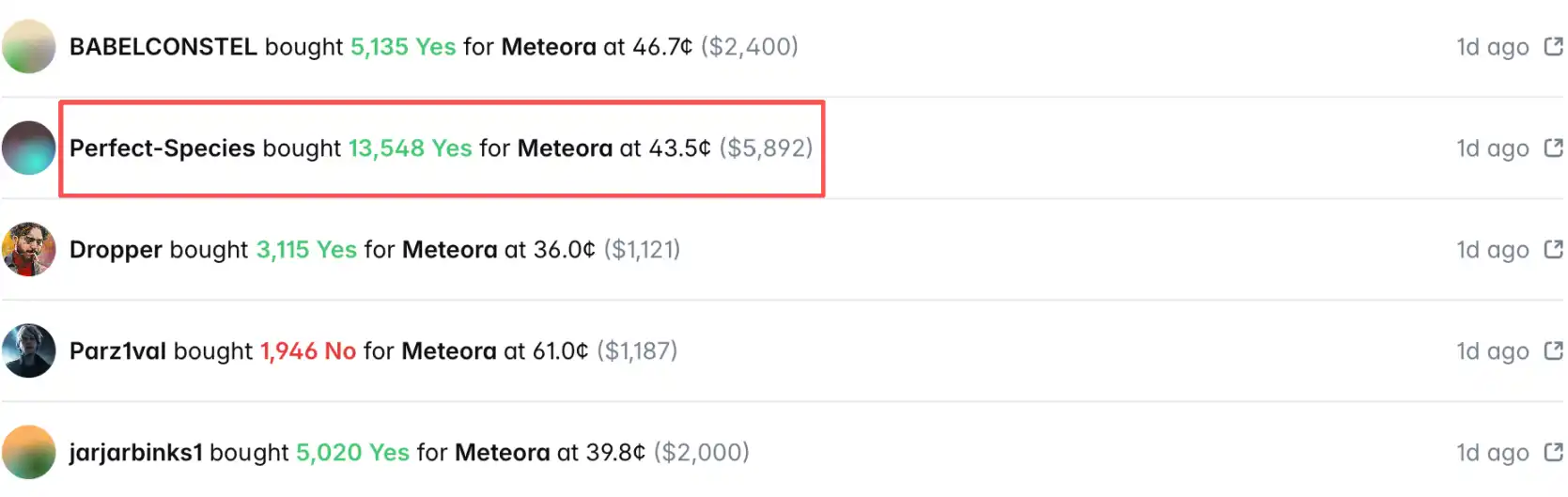
Around 7:00 am Beijing time on February 24th, a newly created address (0x9b65a8d272ef7daeba9ebec479895b3ee89bf52c) spent nearly $6,000 on Polymarket betting that the company exposed by ZachXBT would be Meteora, raising the probability by around 5% with a single transaction.
Approximately an hour after placing orders on Polymarket, another address (0x2537C69391cD0bD00CE9E827E0680438cB0C87Aa) went short on the Meteora token MET on Hyperliquid, with a position value exceeding $33,000.
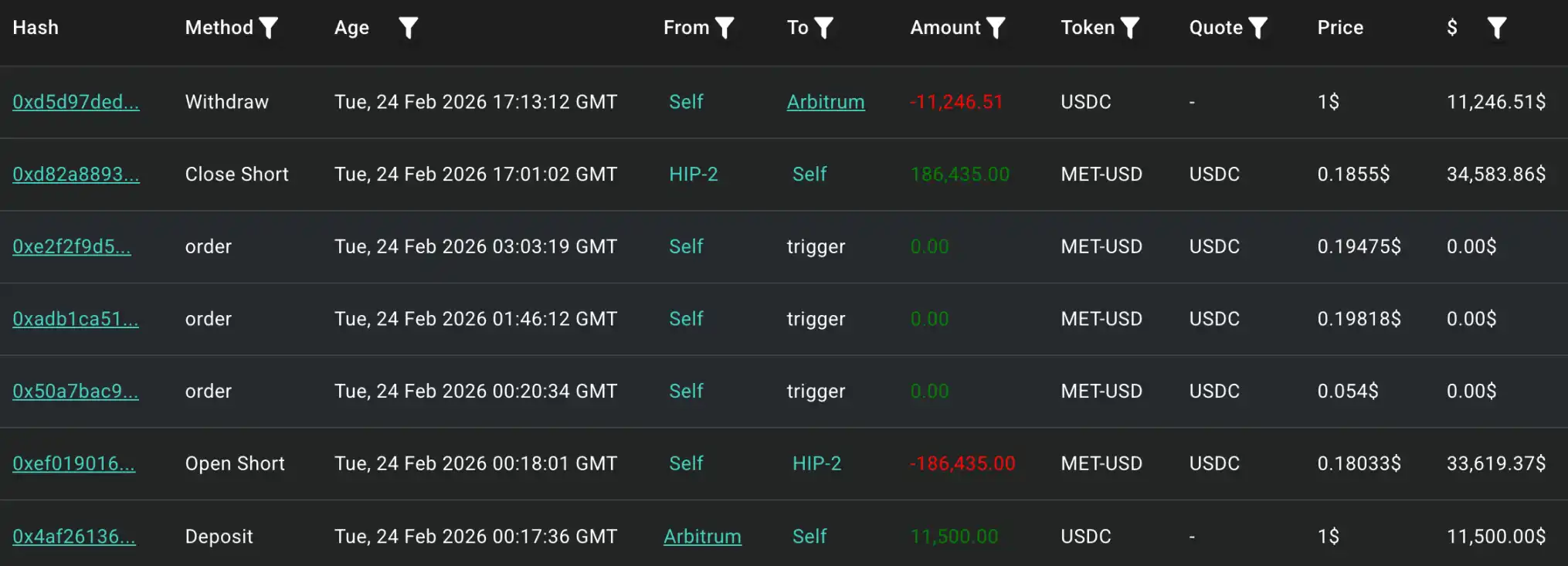
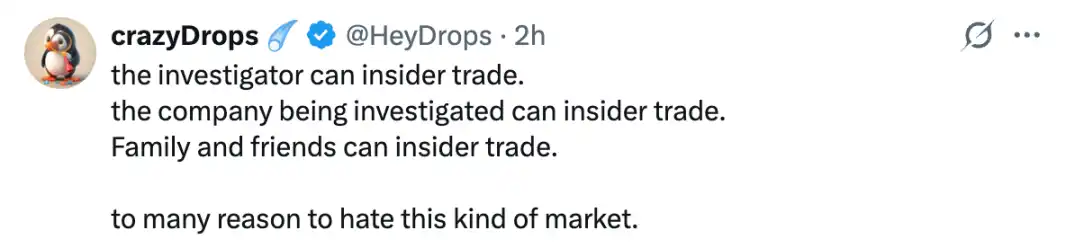
This temporal coincidence led many bystanders to believe that this was a case of market manipulation using Polymarket. A user known as Bold openly remarked that the brilliance of ZachXBT's announcement of an insider trading investigation lies in the fact that the implicated company would be aware of being investigated, allowing them to continue insider trading in the prediction market.
Whether the anonymous figure believed to have manipulated the market is an insider at the target company or simply privy to information, this nested behavior of conducting insider trading in a market about "which company engaged in insider trading" is highly ironic. Some users expressed astonishment that for less than $6000, one could manipulate a project with a token's FDV close to 200 million, demonstrating how Polymarket has indeed lowered the barrier to market manipulation.
After my investigation, there is no on-chain evidence linking these two addresses to the same individual; the only basis for this connection is the close timing of their operations, which is a very tenuous piece of evidence. Furthermore, the address starting with 0x2537 ended up exiting its short position at a loss on Hyperliquid, while the newly created address starting with 0x9b65 subsequently made a small bet on World Liberty Financial on Polymarket, speculated to be the subject of ZachXBT's exposure.
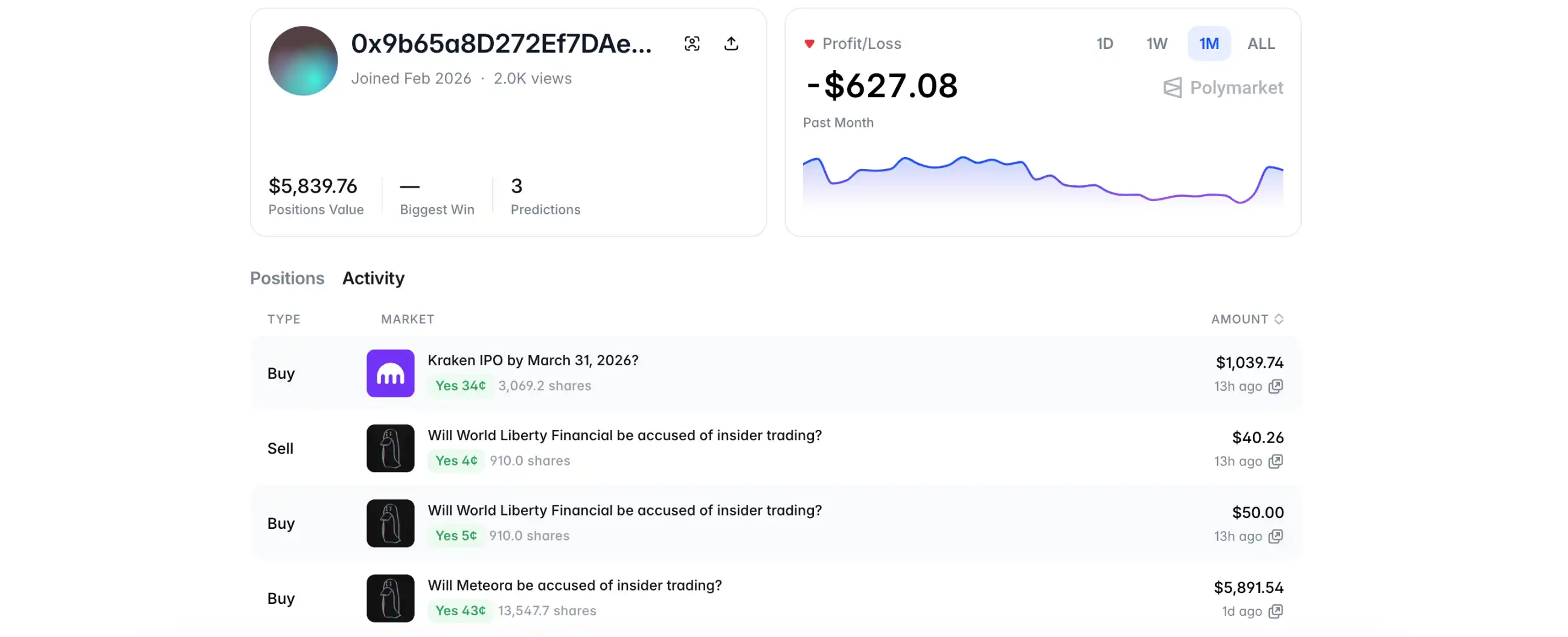
My conclusion is that these two seemingly market-manipulative transactions are most likely just a coincidence. If indeed carried out by the same person, such unprofessional trading behavior can only be explained as part of a testing phase. Just an hour after making a large bet on Meteora on Polymarket, the price of MET not only did not drop but rose, making no sense to initiate a short position at that time.
Some individuals also noted that if this were an insider trading scheme, MET would have likely crashed outright, causing a surge in the probability on Polymarket. However, based on the current stable probability changes, it seems that this is not the case.
Shortly before this post, Zen, co-founder of Meteora, addressed the market's concerns by stating that since taking over Meteora in March of last year, the team has been very vigilant about insider trading risks and has taken preventive measures. Zen mentioned that Meteora is a permissionless platform, so the team usually only learns relevant information after a project has gone live or integration is completed.
While this incident may once again be a case of the market being overly sensitive and causing a misunderstanding, it genuinely serves as a blueprint for utilizing Polymarket for market manipulation.
For example, recently the Federal Reserve began discussing interest rate hikes again. If there were a market on Polymarket around "The Fed will start raising interest rates in xxx", a market manipulator would not need to know insider information. They would simply need to suddenly place a large bet on one of the options, triggering a market reaction that could cause a short-term fluctuation in the Bitcoin price. Given the relatively low liquidity of the order book on Polymarket, a manipulator could potentially spend just a few thousand or tens of thousands of dollars to receive returns of tens or hundreds of times on the contract market.
If you knew the truth in advance, Polymarket could bring you significant returns, which to some extent is the purpose of prediction markets. When an event betting on a U.S. invasion of Venezuela appeared on Polymarket before, the public was just amazed that government insiders would personally leak information, and there was no excessive condemnation of insider trading.
This time, amid a lot of condemnation on X, although it still appears to be about insider trading on the surface, deep down, everyone's real concern is: Polymarket has provided yet another low-cost tool for manipulating sentiment in a market whose trust is almost collapsing.
In other words, if this event was indeed a case of market manipulation, the price of MET was indeed affected. Then the manipulator really manipulated the market value fluctuation of a $200 million project with less than $6,000. Even scarier, this process has no barriers to entry— you just need to have a cryptocurrency browser extension wallet and be willing to place orders on Polymarket, which is basically a "take matters into your own hands" scenario.
Even if this event turns out not to be factual, it absolutely serves as another alarm bell ringing about the flaw in the Polymarket model: a platform that was originally thought to replace traditional news media has become a breeding ground for insider trading. In the past, insider trading could at least provide some truth in advance, but the act of purely using influence to manipulate the market once again demonstrates the unbridled pursuit of interests in a permissionless environment.
You may also like

PUMP Valuation Breakdown: On-chain Data Disproves the "Fake Volume" Theory, Where Does the Real Discount Come From?

Tiger Research: What AI services do cryptocurrency companies offer?

The war not only drives up oil prices but also causes Circle's stock price to soar

When agents become consumers, who will rewrite the underlying logic of internet commerce?

AI Agents in Action Summit: March 31, Hong Kong Cyberport, focusing on the deep waters of AI implementation

29 Days In, What Are America’s Options on Iran?

Flash Crash Down 97%+ with Ongoing Unlocking, WLD Completes $65 Million Off-chain Funding: Who Is Still Buying?

Bitcoin for Real Estate? Fannie Mae Teams Up with Coinbase to Launch Crypto Mortgage
Tether Hires Big Four Auditor, USDT Enters First Attestation Phase

Google AI Paper Destroys $900B Storage Stock, Accused of Faking Experiment
Evaporate $2 Trillion, U.S. Stocks See Worst Start in 4 Years, Why is the Market Bearish?

The speed at which AI discovers vulnerabilities has surpassed the speed at which it patches vulnerabilities.

AI Crypto Trading Bot Explained: Aurora's Multi-Factor Strategy in WEEX Hackathon
Aurora demonstrates how structured, multi-agent AI Trading systems can deliver more adaptive and resilient performance in the WEEX AI Trading Hackathon.

Cyber Taoist Fortune Teller: Fake Taoist, AI Fortune Telling, and Northeastern Metaphysics History

Bloomberg: Stablecoin Payments Emerge as Crypto VC's Newest Favorite Thing
BeatSwap is evolving towards a full-stack Web3 infrastructure, covering the entire lifecycle of IP rights.
BeatSwap, a global Web3 Intellectual Property (IP) infrastructure project, is attempting to overcome the current fragmentation limitations of the Web3 ecosystem, building a full-stack system that covers the entire lifecycle of IP rights.
Currently, most Web3 projects are still in the stage of functional fragmentation, often focusing only on a single aspect, such as IP asset tokenization, transaction functionality, or a simple incentive model. This structural dispersion has become a key bottleneck hindering the industry's scale application.
BeatSwap's approach is more integrated, integrating multiple core modules into the same system, including:
· IP authentication and on-chain registration
· Authorization-based revenue sharing mechanism
· User-engagement-driven incentive system
· Transaction and liquidity infrastructure
Through the above integration, the platform builds an end-to-end closed-loop path, allowing IP rights to complete a full cycle of "creation, use, and monetization" within the same ecosystem.
BeatSwap is not limited to existing crypto users but is attempting to take the global music industry as a starting point, actively creating new market demand. Its core strategies include:
Exploring and incubating music creators (Artist discovery)
Building a fan community
Igniting IP-centric content consumption demand
The current global music industry is valued at around $260 billion, with over 2 billion digital music users. This means that the potential market corresponding to the tokenization and financialization of IP far exceeds the traditional crypto user base.
In this context, BeatSwap positions itself at the intersection of "real-world content demand" and "on-chain infrastructure," attempting to bridge the structural gap between content production and financial flow.
BeatSwap's upcoming core product "Space" is scheduled to launch in the second quarter of 2026. This product is defined as the SocialFi layer in the ecosystem, aiming to directly connect creators with users and achieve deep integration with other platform modules.
Key designs include:
A fan-centric interactive mechanism
Exposure and distribution logic based on $BTX staking
User paths connected to DeFi and liquidity structures
Thus, a complete user behavior loop is formed within the platform: Discovery → Participation → Consumption → Rewards → Trading
$BTX is designed to be a core utility asset within the ecosystem, rather than just a simple incentive token, with its value directly tied to platform activity and IP use cases.
Main features include:
· Yield distribution based on on-chain authorized actions
· Value reflection based on IP usage and user engagement dynamics
· Support for staking and DeFi participation mechanisms
· Value growth driven by ecosystem expansion
With the increased frequency of IP use, the utility and value support of $BTX will enhance simultaneously, helping alleviate the "disconnect between value and utility" issue present in traditional Web3 token models to some extent.
Currently, $BTX has been listed on several mainstream exchanges, including:
Binance Alpha
Gate
MEXC
OKX Boost
As the launch of "Space" approaches, BeatSwap is actively pursuing more exchange listings to further enhance liquidity and global accessibility, laying a foundation for future market expansion.
BeatSwap's goal is no longer limited to the traditional Web3 narrative but aims to target over 2 billion digital music users and a trillion KRW-scale content market.
By integrating content creators, users, capital, and liquidity into a blockchain framework centered around IP rights, BeatSwap is striving to build a next-generation infrastructure focused on "IP tokenization."
BeatSwap integrates IP authentication, authorization distribution, incentive mechanism, transaction system, and market construction to establish a unified structure that bridges the full lifecycle path of IP rights.
With the launch of the Q2 2026 "Space," the project is expected to become a key infrastructure connecting content and finance in the IP-RWA (Real World Assets) track.

Mag 7 Evaporates $2 Trillion | Rewire News Morning Edition



 App
App