

One picture to recall the joys and sorrows of the crypto world over the past 12 months.
Source: TechFlow
Less than 10 days remain in 2025.
It's often said that a day in the crypto world is like a year in the real world. But those truly in the thick of it probably understand better:
This year has flown by; things that happened at the beginning of the year now seem like three years ago.
How was your year? Did you seize any opportunities, or did the market teach you a lesson in a particular month? Is that coin you heavily invested in at the beginning of the year still around? Which month was that story that got you so excited?
Many answers may have become blurred.
The crypto market's memory is too short; what was hot three months ago is no longer mentioned today, and the confident predictions made then are now embarrassing to revisit.
We've compiled a complete market record for 2025, broken down by month: what happened, which coins rose, and what everyone was talking about.
No predictions, no judgments, just a way to help you recall what we experienced this year.
January: The Highlights of AI Coins and Trump
Keywords: AI Agent, Political Meme, Optimism, and the First Cooling Down at the End of the Month
January's protagonist was the AI Agent.
AI16Z reached an all-time high of $2.47 on January 2nd, with its market capitalization soaring to $2.5 billion, becoming the first AI token on the Solana chain to break this milestone. AIXBT, ARC, ZEREBRO, GRIFFAIN… these names were mentioned almost daily at the time.
Political memes were equally eye-catching. On January 17th, the official Trump token was launched, surging from less than $1 to an all-time high of $75 within two days, with its market capitalization exceeding $14 billion at one point.
I vaguely remember waking up one morning to the shock of Trump's crazy surge. At the time, everyone was wondering if it was officially issued, and later, as the information was confirmed, a president issuing a token became a first in the industry.
Furthermore, XRP surged 50% that month due to news of a meeting between Ripple executives and the Trump team, with the market betting it would be among the first altcoins to receive ETF approval.
On a macro level, Trump signed an executive order on January 23rd: establishing a digital asset task force, exploring a national crypto reserve, and prohibiting the issuance of a CBDC in the US. Market sentiment was initially very optimistic.
However, the tide turned at the end of the month. Around January 20th, DeepSeek released a low-cost AI model, directly impacting the narrative of crypto AI agents, making many agents seem more like toys.
Many of those AI concept coins that had just risen plummeted back to their original levels in the following weeks.
February: LIBRA scam, Bybit hacked
Keywords: Bybit theft, $LIBRA scam, massive liquidation
On February 21st, Bybit suffered the largest cryptocurrency theft in history. North Korean hackers from Lazarus transferred approximately 400,000 ETH (worth about $1.5 billion) to addresses under their control.
This is larger than the losses during the FTX crash and far exceeds any previous exchange theft.
Meanwhile, trust in political memes completely collapsed this month. On Valentine's Day, February 14th, Argentine President Milei posted about a cryptocurrency on social media, causing the token to surge to $5 within 40 minutes, reaching a market capitalization of $4.5 billion. Hours later, the price plummeted by 85%, resulting in losses exceeding $250 million for approximately 40,000 investors.
Milei subsequently deleted the post and denied involvement, and the token named after Trump and his wife also gradually declined throughout the month.
From February 24th to 27th, Bitcoin experienced its worst three-day losing streak since the FTX crash in 2022, plummeting 12.6% and liquidating nearly $3 billion in leveraged positions.
The entire Meme coin sector halved in value, with Solana's TVL crashing 30%, reaching its lowest level since November of last year.
However, there were exceptions. Pi Network officially launched its mainnet on February 20th, with the token reaching a high of $2.98, sparking discussions about "pump and dump schemes finally cashing out."
March: Strategic reserves to the left, tariff fears to the right.
Keywords: Strategic Reserves, Tariff Panic, Meme Crash, Micro-Strategy
March saw the initial effects of favorable policies. Trump hosted the first-ever crypto summit at the White House, signing an executive order to establish a "strategic Bitcoin reserve."
A few days earlier, he announced on Truth Social that XRP, SOL, and ADA would also be included in the digital asset reserve. ADA surged 70% in a single day, breaking through $1, leading the market to believe that regulatory attitudes had completely shifted.
However, the favorable policies failed to support the market. Trump's tariff threats triggered trade war panic, leading to a widespread sell-off of risk assets. The Meme sector experienced a collective collapse: an overall drop of 40-60%.
The BSC chain unexpectedly became a safe haven. The Middle East-themed Meme coin Mubarak surged over a thousandfold after multiple endorsements from CZ, and BSC chain trading volume at one point surpassed Solana.
Meanwhile, the biggest trust crisis in March occurred at Hyperliquid. Attackers used the JELLY token to short-sell, manipulating the price and causing HLP vaults to face losses of approximately $12 million. Hyperliquid's response—a vote to delist tokens and forced settlement—led many to re-evaluate the definition of a DEX, highlighting the centralized handling of the crisis by "decentralized exchanges."
Off-chain, Strategy (formerly MicroStrategy) continued to increase its holdings, announcing on March 18th a $500 million preferred stock offering specifically for purchasing BTC. Bitcoin hoarders' faith remained steadfast.
April: Policy Shift, Sentiment Recovery
Keywords: Tariff Suspension, Regulatory Shift, SOL ETF, Sentiment Reversal
April was a month of sentiment recovery.
On April 9th, Trump announced a 90-day tariff suspension. The news sent the S&P 500 surging 9.5% in a single day, its largest single-day gain since 2008. On the same day, the SEC approved ETH ETF options trading, further improving institutional allocation tools.
Meanwhile, the appointment of Paul Atkins as the new SEC chairman, with his pro-crypto stance, gave the market hope.
The total market capitalization of the crypto market rebounded by 10.8% that month, with Bitcoin recovering from a low of $76,000 to break $90,000 by the end of the month.
Canada launched the world's first Solana spot ETF that month. SUI benefited from news of a partnership between Grayscale Trust and Mastercard, with a monthly gain exceeding 50%.
Meme coin also revived. Fartcoin rebounded hundreds of times from its bottom, becoming the leading stock in the rally, while RFC (often referred to as "Musk's mouthpiece") rose thousands of times.
After the brutal trials of February and March, April was the first time many felt, "We're back!"
May: We're So Back!
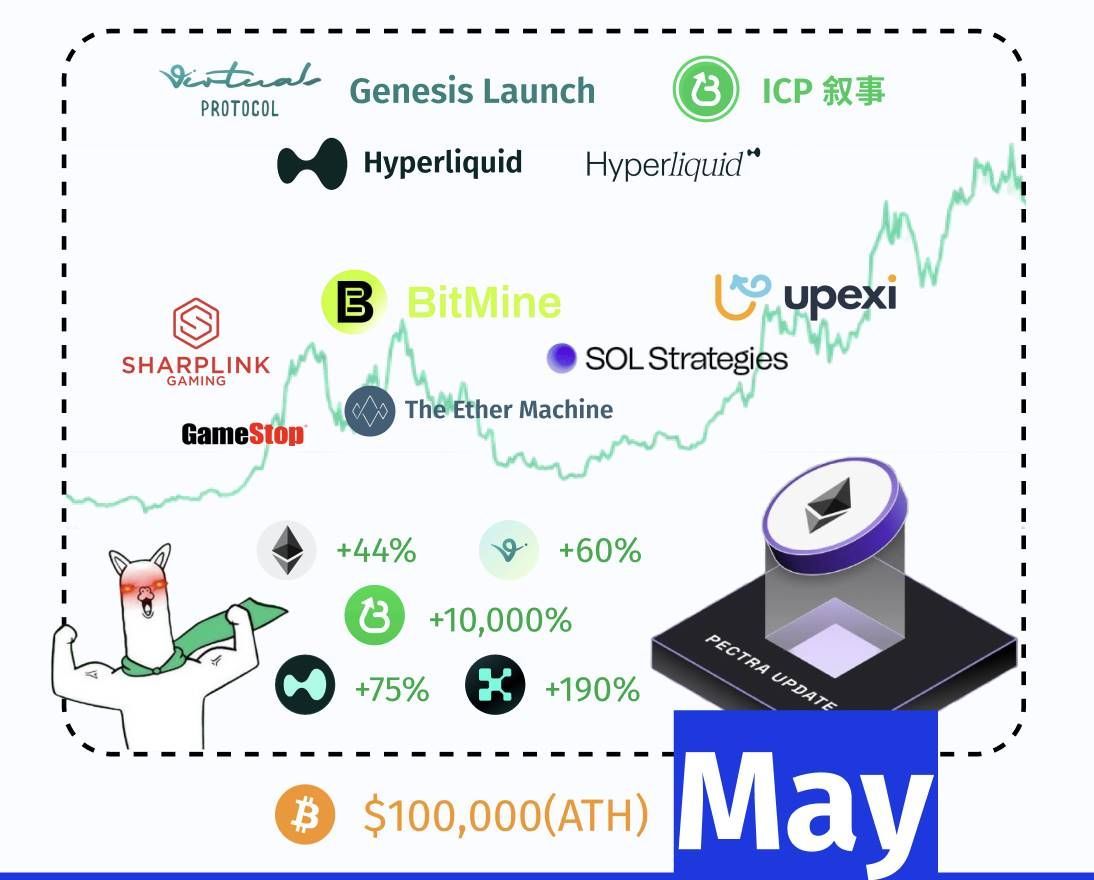
Keywords: All-time high, US-China easing, DAT narrative, ICP, Hyperliquid
May was the most sentiment-driven month of 2025 so far.
On May 2nd, the US and China reached a 90-day tariff suspension agreement, temporarily alleviating the trade war shadow and triggering a broad rebound in risk assets.
On May 7th, Ethereum completed the Pectra upgrade, the largest hard fork since the 2022 Merge. Although not immediately reflected in the price, ETH rose 44% that month, indicating a significant improvement in market sentiment.
Meanwhile, Bitcoin broke through $110,000, setting a new all-time high. Everything seemed to be back, and the crypto market began to flourish on multiple fronts:
The narrative of listed companies' "Digital Asset Treasury" (DAT) continued to heat up. GameStop, SharpLink Gaming, and others initiated buying BTC and ETH, and the Strategy model is being replicated.
On-chain, new gameplay is emerging one after another. The Believe platform became a hit, allowing users to launch their own tokens with a single click by simply adding the token name to @launchcoin on X, giving rise to the so-called ICP narrative (Internet Capital Market); the platform's token, LAUNCHCOIN, surged that month.
Virtuals Protocol launched the Genesis Launch platform, reigniting the AI token ICO craze, with VIRTUAL rising by 60%. Kaito's Yap Points reward system took on-chain social interaction to a new level, with its token rising by 190%, and "talking" (or "voice-based") tokens gradually becoming a mainstream way to generate profits.
Meanwhile, Hyperliquid's token, HYPE, rose by 75% that month, prompting a belated but enthusiastic discussion within the Chinese crypto community about the new DEX model and the so-called "human efficiency ratio," namely Hyperliquid's ability to generate massive profits with a minimal workforce.
May was good for everyone; everything finally came back to life.
June: DAT heats up, stablecoins go wild.
Keywords: Circle IPO, DAT Expansion, Tokenization of US Stocks
June saw the stablecoin narrative explode.
On June 5th, Circle went public on the NYSE under the ticker symbol CRCL, with an IPO price of $31 and an oversubscription of 25 times. By June 23rd, the stock price had surged to an all-time high of $298.99, nearly nine times its IPO price.
This was a high point for crypto-native companies on the US stock market and a landmark event signifying traditional capital's recognition of the stablecoin sector.
Four days later, another stablecoin project created an even bigger sensation. Plasma launched its public offering on Cobie's Sonar platform, raising $500 million in just 5 minutes.
The daily limit was raised to $1 billion, which was filled in 30 minutes. Tether CEO, Peter Thiel, and Bybit were among the early investors. The market's fervor for "stablecoin infrastructure" exceeded everyone's expectations.
The DAT narrative continued to gain momentum. Strategy continued its buying spree, with Metaplanet purchasing 1088 BTC in a month. DeFi Development Corp announced a $5 billion equity funding round specifically for increasing its SOL holdings, aiming to become the "SOL version of MicroStrategy." SharpLink Gaming continued to increase its ETH holdings, bringing its total to 188,000 ETH.
On the 30th, another new narrative quietly emerged: the tokenization of US stocks.
Kraken and Bybit simultaneously launched xStocks, allowing over 60 US stocks (Tesla, Nvidia, Apple, Microsoft, etc.) to be traded as tokens on Solana.
Meanwhile, Hyperliquid solidified its position as the leader in on-chain derivatives trading, with Ethereum staking reaching a record high. The meme sector also saw highlights, with BANANAS31 experiencing a surge; USELESS, due to its absurd and seemingly useless name, also rose by over 2000%.
July: The Genius Bill was passed, and both BTC and ETH reached new highs.
Keywords: GENIUS Act, BTC/ETH New High, Tokenization Expansion, Stablecoin Public Chains
On July 18th, Trump signed the GENIUS Act, the first federal regulatory law for stablecoins in US history.
Bitcoin was also active. It began breaking out on July 10th, reaching a new all-time high of over $120,000 on July 14th, with ETF inflows reaching a record $1.2 billion in a single day.
ETH also surged, reaching a new 2025 high of $3,848 on July 21st.
Meanwhile, the tokenization narrative intensified. Robinhood launched tokenized trading of over 200 US stocks, running on Arbitrum, including private equity tokens from OpenAI and SpaceX.
PENGU also made a significant move, submitting an application for a PENGU ETF; this could be the world's first ETF to include NFTs.
The stablecoin public chain war has also begun. Tether and Bitfinex-backed "Stable" released its roadmap on July 1st, entering competition with Tempo and Circle's own Arc.
Regarding Memecoins, SPX6900 rose by over 100%, and the established stablecoin ENA rose by over 160%. Everything is going well.
August: OKB surged, and BTC hit a new high again.
Keywords: Exchange Token Surge
August's overall impression was "not bad."
BTC reached a new high of $124,000 in mid-August before pulling back, closing at around $108,000 at the end of the month. However, the altcoin market was booming, with exchange tokens being the biggest winners.
On August 13th, OKX announced a one-time burn of 65.25 million OKB tokens, locking the total supply from 300 million to 21 million; simultaneously, it upgraded its XLayer public chain. Upon the announcement, OKB surged 170% that day, reaching a new high of $148, and subsequently continued to climb to $255, a nearly 400% increase from its bottom.
Meanwhile, MNT (Mantle) was integrated into the Bybit exchange, primarily for the RWA public chain. In the future, MNT will be used as a transaction fee token on Bybit, similar to a platform coin.
On August 28th, the U.S. Department of Commerce announced a partnership with Chainlink and Pyth to put macroeconomic data such as GDP and PCE on the blockchain; the news drove LINK up by about 61% in August, and Pyth surged over 70% that day.
Hong Kong's stablecoin regulation also officially came into effect. The Stablecoin Ordinance took effect on August 1st, and the Hong Kong Monetary Authority opened license applications, attracting many mainland companies such as JD.com (although they later withdrew for various reasons).
Of course, there was also the drama surrounding celebrity tokens. On August 21st, Kanye West launched the YZY token on Solana, which surged 1400% to $3 within an hour, with the FDV briefly reaching $3 billion, and then… plummeted 80%, gradually returning to zero.
Kanye claimed his Instagram was hacked and that the token being promoted was fake. Regardless of the truth, this is yet another classic case of celebrity tokens becoming a "fan-driven" scam.
ZORA, a SocialFi platform, also saw a surge in popularity, riding the wave of Coinbase's Base App integration and the Creator Coins boom. Its August gains exceeded 100%, reaching an all-time high of $0.15.
Pump.fun also recovered, regaining a significant share of the Solana launcher market, with August revenue reaching $46 million.
September: Fed rate cuts, ASTER rises.
Keywords: Interest Rate Cut, Crypto IPO, Aster
On September 17th, the FOMC announced a 25 basis point interest rate cut, the first rate cut in 2025.
That same month, Tether raised funds privately at a valuation of $500 billion, once again highlighting its financial strength, but irrelevant to most retail investors.
However, Tether co-founder Reeve Collins launched the STBL protocol, which debuted on Binance Alpha on September 16th, surging 455% on its first day, with FDV exceeding $1 billion. Within a month, it had increased 44 times from its lowest point to its highest.
A mini-boom occurred in crypto company IPOs. On September 11th, Figure listed on Nasdaq, becoming the first RWA stock; Gemini followed suit the next day. Wall Street's attitude towards crypto has visibly shifted.
In the crypto space, a "DEX war" erupted in the on-chain contract sector, with Aster emerging and its token surging 2800% in its first week; its seven-day trading volume even surpassed Hyperliquid at one point.
Regarding tokens, PUMP rose 160% in a month thanks to an aggressive buyback strategy (accumulating over $95 million in buybacks), hitting an ATH on September 14th. AVNT surged 660% after its quick listing on Upbit and Binance within a week. BNB rose 19.7% after expanding its Benji platform in Franklin Templeton. MNT rose 130% due to its integration into the Bybit ecosystem.
Coinbase's x402 protocol was announced this month, foreshadowing the 402 sector's explosive growth in the following two months.
October: A Binance experience followed by a bloody liquidation.
Keywords: Epic Liquidation, Binance Life
October was supposed to be "Uptober."
The first Chinese meme coin, "Binance Life," launched on October 4th, with the slogan "Drive a Binance car, live in a Binance community, enjoy the Binance life." This meme resonated with the collective sentiment of the Chinese-speaking world, causing its market capitalization to surge from zero to $500 million within five days, a gain of over 3000%.
For the past seven years, BTC had never fallen in October. But October 2025 completely shattered this tradition.
At the beginning of October, BTC was still hitting new highs, reaching an all-time high of $126,000 on October 3rd. Then, on October 11th, an epic liquidation occurred, with $19 billion in leveraged positions forcibly liquidated within 24 hours, resulting in the largest single-day liquidation disaster in crypto history.
The crypto market, sentiment, and liquidity all began to plummet from this point onward.
Although Zcash saw a localized surge this month thanks to Naval's recommendations, no other major market drivers emerged afterward. Both institutional and retail investors suffered immeasurable losses in this wave.
November: A disheartening decline, privacy-focused stocks bucking the trend.
Keywords: BTC $80K, DeFi collapse, privacy rise, x402, fraudsters' BTC seized
October's liquidation wave was thought to be the worst, but November proved the market could be even worse.
BTC plummeted from $110K at the beginning of the month to $80K, a seven-month low. The total market capitalization evaporated by nearly $1 trillion, falling from $4.2 trillion to $3.2 trillion. BlackRock's IBIT saw a monthly outflow of $2.34 billion, marking the largest monthly outflow since the ETF's inception.
But some people profited in the bear market. Privacy coins unexpectedly became a safe haven, with ZEC surging from $40 in September to over $600 in November, a gain of over 1200%. DASH also rose from $20 to $136, a more than sixfold increase.
The AI payment narrative also briefly gained traction. Coinbase's x402 protocol allowed AI agents to autonomously pay for services, causing its ecosystem token PING to surge from zero to a $70 million market capitalization, with related cryptocurrencies like PayAI and Santana following suit. However, the hype was short-lived, and the trend began to subside by the end of the month.
Meanwhile, the "Digital Asset Treasury" (DAT) sector collectively faced difficulties.
Strategy plummeted 36% in November, and MSCI is evaluating whether to remove it from its index; other ETH and SOL-based companies also continued their decline.
Furthermore, the confiscation of nearly 190,000 BTC by authorities in the cases of fraudsters Qian Zhimin and Chen Zhi raised concerns about potential selling pressure and amplified the "crypto = money laundering" label.
December: Boring, Gossip, and Infighting
I hopped on my electric scooter and finished the delivery. No narrative, just emotions.
The group chat wasn't about positions, it was gossip: who ran off with the money, who committed fraud, who had a dispute over profit sharing.
Some call this a "silent bear market." Slowly, silently, it's wearing down everyone's enthusiasm. The only consensus is: wait. Wait for liquidity to return.
Next year is almost here.
Those of us in the crypto world don't know where we're going, but we're still on the road.
Hopefully, 2026 will be better for us all.
You may also like

WEEX AI Trading Hackathon 2026: How Top AI Strategies Dominated Real Markets
WEEX AI Trading Hackathon demonstrates that effective trading — whether powered by AI or human judgment — relies on core principles: understanding market structure, maintaining conviction, prioritizing quality over quantity, and managing risk intelligently.
WEEX Ai Trading Hackathon vs. Other AI Trading Competitions: Which Is Better for You?
The AI trading competition landscape offers distinct paths for growth. The WEEX AI Trading Hackathon differentiates itself through its focus on real-market execution and practical viability, positioning it as a key platform for aspiring quantitative traders and strategists.
Is AI Trading Replacing Humans? WEEX Hackathon Reveals the Future of Fintech
The WEEX AI Trading Hackathon reveals that the future of trading is not about AI replacing humans, but about collaboration. AI enhances trading capabilities, while human judgment, ethics, and strategic oversight remain essential.

Key Market Information Discrepancy on February 9th - A Must-See! | Alpha Morning Report

"2.5 Dip" Real Reason: Wall Street Deleveraging Induced Overreaction

Kyle's review of Hyperliquid sparks controversy, Solitude Bank officially opens, what are the overseas crypto communities talking about today?

Cryptocurrency prices in the dumps, but the prediction market is going wild?
Decoding Strategy’s Latest Financial Report: After a $12.4 Billion Loss, How Long Can the Bitcoin Flywheel Keep Spinning?
When earnings reports become electrocardiograms of Bitcoin’s price, Strategy is not merely a company—it’s an experiment testing whether faith can overcome gravity.

Discover How to Participate in Staking
Staking is a digital asset yield product launched by the WEEX platform. By subscribing to Staking products, users can stake their idle digital assets and earn corresponding Staking rewards.

WEEX AI Trading Hackathon Rules & Guidelines
This article explains the rules, requirements, and prize structure for the WEEX AI Trading Hackathon Finals, where finalists compete using AI-driven trading strategies under real market conditions.

From 0 to $1 Million: Five Steps to Outperform the Market Through Wallet Tracking

Token Cannot Compound, Where Is the Real Investment Opportunity?

February 6th Market Key Intelligence, How Much Did You Miss?

China's Central Bank and Eight Other Departments' Latest Regulatory Focus: Key Attention to RWA Tokenized Asset Risk
Foreword: Today, the People's Bank of China's website published the "Notice of the People's Bank of China, National Development and Reform Commission, Ministry of Industry and Information Technology, Ministry of Public Security, State Administration for Market Regulation, China Banking and Insurance Regulatory Commission, China Securities Regulatory Commission, State Administration of Foreign Exchange on Further Preventing and Dealing with Risks Related to Virtual Currency and Others (Yinfa [2026] No. 42)", the latest regulatory requirements from the eight departments including the central bank, which are basically consistent with the regulatory requirements of recent years. The main focus of the regulation is on speculative activities such as virtual currency trading, exchanges, ICOs, overseas platform services, and this time, regulatory oversight of RWA has been added, explicitly prohibiting RWA tokenization, stablecoins (especially those pegged to the RMB). The following is the full text:
To the people's governments of all provinces, autonomous regions, and municipalities directly under the Central Government, the Xinjiang Production and Construction Corps:
Recently, there have been speculative activities related to virtual currency and Real-World Assets (RWA) tokenization, disrupting the economic and financial order and jeopardizing the property security of the people. In order to further prevent and address the risks related to virtual currency and Real-World Assets tokenization, effectively safeguard national security and social stability, in accordance with the "Law of the People's Republic of China on the People's Bank of China," "Law of the People's Republic of China on Commercial Banks," "Securities Law of the People's Republic of China," "Law of the People's Republic of China on Securities Investment Funds," "Law of the People's Republic of China on Futures and Derivatives," "Cybersecurity Law of the People's Republic of China," "Regulations of the People's Republic of China on the Administration of Renminbi," "Regulations on Prevention and Disposal of Illegal Fundraising," "Regulations of the People's Republic of China on Foreign Exchange Administration," "Telecommunications Regulations of the People's Republic of China," and other provisions, after reaching consensus with the Cyberspace Administration of China, the Supreme People's Court, and the Supreme People's Procuratorate, and with the approval of the State Council, the relevant matters are notified as follows:
(I) Virtual currency does not possess the legal status equivalent to fiat currency. Virtual currencies such as Bitcoin, Ether, Tether, etc., have the main characteristics of being issued by non-monetary authorities, using encryption technology and distributed ledger or similar technology, existing in digital form, etc. They do not have legal tender status, should not and cannot be circulated and used as currency in the market.
The business activities related to virtual currency are classified as illegal financial activities. The exchange of fiat currency and virtual currency within the territory, exchange of virtual currencies, acting as a central counterparty in buying and selling virtual currencies, providing information intermediary and pricing services for virtual currency transactions, token issuance financing, and trading of virtual currency-related financial products, etc., fall under illegal financial activities, such as suspected illegal issuance of token vouchers, unauthorized public issuance of securities, illegal operation of securities and futures business, illegal fundraising, etc., are strictly prohibited across the board and resolutely banned in accordance with the law. Overseas entities and individuals are not allowed to provide virtual currency-related services to domestic entities in any form.
A stablecoin pegged to a fiat currency indirectly fulfills some functions of the fiat currency in circulation. Without the consent of relevant authorities in accordance with the law and regulations, any domestic or foreign entity or individual is not allowed to issue a RMB-pegged stablecoin overseas.
(II)Tokenization of Real-World Assets refers to the use of encryption technology and distributed ledger or similar technologies to transform ownership rights, income rights, etc., of assets into tokens (tokens) or other interests or bond certificates with token (token) characteristics, and carry out issuance and trading activities.
Engaging in the tokenization of real-world assets domestically, as well as providing related intermediary, information technology services, etc., which are suspected of illegal issuance of token vouchers, unauthorized public offering of securities, illegal operation of securities and futures business, illegal fundraising, and other illegal financial activities, shall be prohibited; except for relevant business activities carried out with the approval of the competent authorities in accordance with the law and regulations and relying on specific financial infrastructures. Overseas entities and individuals are not allowed to illegally provide services related to the tokenization of real-world assets to domestic entities in any form.
(III) Inter-agency Coordination. The People's Bank of China, together with the National Development and Reform Commission, the Ministry of Industry and Information Technology, the Ministry of Public Security, the State Administration for Market Regulation, the China Banking and Insurance Regulatory Commission, the China Securities Regulatory Commission, the State Administration of Foreign Exchange, and other departments, will improve the work mechanism, strengthen coordination with the Cyberspace Administration of China, the Supreme People's Court, and the Supreme People's Procuratorate, coordinate efforts, and overall guide regions to carry out risk prevention and disposal of virtual currency-related illegal financial activities.
The China Securities Regulatory Commission, together with the National Development and Reform Commission, the Ministry of Industry and Information Technology, the Ministry of Public Security, the People's Bank of China, the State Administration for Market Regulation, the China Banking and Insurance Regulatory Commission, the State Administration of Foreign Exchange, and other departments, will improve the work mechanism, strengthen coordination with the Cyberspace Administration of China, the Supreme People's Court, and the Supreme People's Procuratorate, coordinate efforts, and overall guide regions to carry out risk prevention and disposal of illegal financial activities related to the tokenization of real-world assets.
(IV) Strengthening Local Implementation. The people's governments at the provincial level are overall responsible for the prevention and disposal of risks related to virtual currencies and the tokenization of real-world assets in their respective administrative regions. The specific leading department is the local financial regulatory department, with participation from branches and dispatched institutions of the State Council's financial regulatory department, telecommunications regulators, public security, market supervision, and other departments, in coordination with cyberspace departments, courts, and procuratorates, to improve the normalization of the work mechanism, effectively connect with the relevant work mechanisms of central departments, form a cooperative and coordinated working pattern between central and local governments, effectively prevent and properly handle risks related to virtual currencies and the tokenization of real-world assets, and maintain economic and financial order and social stability.
(5) Enhanced Risk Monitoring. The People's Bank of China, China Securities Regulatory Commission, National Development and Reform Commission, Ministry of Industry and Information Technology, Ministry of Public Security, State Administration of Foreign Exchange, Cyberspace Administration of China, and other departments continue to improve monitoring techniques and system support, enhance cross-departmental data analysis and sharing, establish sound information sharing and cross-validation mechanisms, promptly grasp the risk situation of activities related to virtual currency and real-world asset tokenization. Local governments at all levels give full play to the role of local monitoring and early warning mechanisms. Local financial regulatory authorities, together with branches and agencies of the State Council's financial regulatory authorities, as well as departments of cyberspace and public security, ensure effective connection between online monitoring, offline investigation, and fund tracking, efficiently and accurately identify activities related to virtual currency and real-world asset tokenization, promptly share risk information, improve early warning information dissemination, verification, and rapid response mechanisms.
(6) Strengthened Oversight of Financial Institutions, Intermediaries, and Technology Service Providers. Financial institutions (including non-bank payment institutions) are prohibited from providing account opening, fund transfer, and clearing services for virtual currency-related business activities, issuing and selling financial products related to virtual currency, including virtual currency and related financial products in the scope of collateral, conducting insurance business related to virtual currency, or including virtual currency in the scope of insurance liability. Financial institutions (including non-bank payment institutions) are prohibited from providing custody, clearing, and settlement services for unauthorized real-world asset tokenization-related business and related financial products. Relevant intermediary institutions and information technology service providers are prohibited from providing intermediary, technical, or other services for unauthorized real-world asset tokenization-related businesses and related financial products.
(7) Enhanced Management of Internet Information Content and Access. Internet enterprises are prohibited from providing online business venues, commercial displays, marketing, advertising, or paid traffic diversion services for virtual currency and real-world asset tokenization-related business activities. Upon discovering clues of illegal activities, they should promptly report to relevant departments and provide technical support and assistance for related investigations and inquiries. Based on the clues transferred by the financial regulatory authorities, the cyberspace administration, telecommunications authorities, and public security departments should promptly close and deal with websites, mobile applications (including mini-programs), and public accounts engaged in virtual currency and real-world asset tokenization-related business activities in accordance with the law.
(8) Strengthened Entity Registration and Advertisement Management. Market supervision departments strengthen entity registration and management, and enterprise and individual business registrations must not contain terms such as "virtual currency," "virtual asset," "cryptocurrency," "crypto asset," "stablecoin," "real-world asset tokenization," or "RWA" in their names or business scopes. Market supervision departments, together with financial regulatory authorities, legally enhance the supervision of advertisements related to virtual currency and real-world asset tokenization, promptly investigating and handling relevant illegal advertisements.
(IX) Continued Rectification of Virtual Currency Mining Activities. The National Development and Reform Commission, together with relevant departments, strictly controls virtual currency mining activities, continuously promotes the rectification of virtual currency mining activities. The people's governments of various provinces take overall responsibility for the rectification of "mining" within their respective administrative regions. In accordance with the requirements of the National Development and Reform Commission and other departments in the "Notice on the Rectification of Virtual Currency Mining Activities" (NDRC Energy-saving Building [2021] No. 1283) and the provisions of the "Guidance Catalog for Industrial Structure Adjustment (2024 Edition)," a comprehensive review, investigation, and closure of existing virtual currency mining projects are conducted, new mining projects are strictly prohibited, and mining machine production enterprises are strictly prohibited from providing mining machine sales and other services within the country.
(X) Severe Crackdown on Related Illegal Financial Activities. Upon discovering clues to illegal financial activities related to virtual currency and the tokenization of real-world assets, local financial regulatory authorities, branches of the State Council's financial regulatory authorities, and other relevant departments promptly investigate, determine, and properly handle the issues in accordance with the law, and seriously hold the relevant entities and individuals legally responsible. Those suspected of crimes are transferred to the judicial authorities for processing according to the law.
(XI) Severe Crackdown on Related Illegal and Criminal Activities. The Ministry of Public Security, the People's Bank of China, the State Administration for Market Regulation, the China Banking and Insurance Regulatory Commission, the China Securities Regulatory Commission, as well as judicial and procuratorial organs, in accordance with their respective responsibilities, rigorously crack down on illegal and criminal activities related to virtual currency, the tokenization of real-world assets, such as fraud, money laundering, illegal business operations, pyramid schemes, illegal fundraising, and other illegal and criminal activities carried out under the guise of virtual currency, the tokenization of real-world assets, etc.
(XII) Strengthen Industry Self-discipline. Relevant industry associations should enhance membership management and policy advocacy, based on their own responsibilities, advocate and urge member units to resist illegal financial activities related to virtual currency and the tokenization of real-world assets. Member units that violate regulatory policies and industry self-discipline rules are to be disciplined in accordance with relevant self-regulatory management regulations. By leveraging various industry infrastructure, conduct risk monitoring related to virtual currency, the tokenization of real-world assets, and promptly transfer issue clues to relevant departments.
(XIII) Without the approval of relevant departments in accordance with the law and regulations, domestic entities and foreign entities controlled by them may not issue virtual currency overseas.
(XIV) Domestic entities engaging directly or indirectly in overseas external debt-based tokenization of real-world assets, or conducting asset securitization activities abroad based on domestic ownership rights, income rights, etc. (hereinafter referred to as domestic equity), should be strictly regulated in accordance with the principles of "same business, same risk, same rules." The National Development and Reform Commission, the China Securities Regulatory Commission, the State Administration of Foreign Exchange, and other relevant departments regulate it according to their respective responsibilities. For other forms of overseas real-world asset tokenization activities based on domestic equity by domestic entities, the China Securities Regulatory Commission, together with relevant departments, supervise according to their division of responsibilities. Without the consent and filing of relevant departments, no unit or individual may engage in the above-mentioned business.
(15) Overseas subsidiaries and branches of domestic financial institutions providing Real World Asset Tokenization-related services overseas shall do so legally and prudently. They shall have professional personnel and systems in place to effectively mitigate business risks, strictly implement customer onboarding, suitability management, anti-money laundering requirements, and incorporate them into the domestic financial institutions' compliance and risk management system. Intermediaries and information technology service providers offering Real World Asset Tokenization services abroad based on domestic equity or conducting Real World Asset Tokenization business in the form of overseas debt for domestic entities directly or indirectly venturing abroad must strictly comply with relevant laws and regulations. They should establish and improve relevant compliance and internal control systems in accordance with relevant normative requirements, strengthen business and risk control, and report the business developments to the relevant regulatory authorities for approval or filing.
(16) Strengthen organizational leadership and overall coordination. All departments and regions should attach great importance to the prevention of risks related to virtual currencies and Real World Asset Tokenization, strengthen organizational leadership, clarify work responsibilities, form a long-term effective working mechanism with centralized coordination, local implementation, and shared responsibilities, maintain high pressure, dynamically monitor risks, effectively prevent and mitigate risks in an orderly and efficient manner, legally protect the property security of the people, and make every effort to maintain economic and financial order and social stability.
(17) Widely carry out publicity and education. All departments, regions, and industry associations should make full use of various media and other communication channels to disseminate information through legal and policy interpretation, analysis of typical cases, and education on investment risks, etc. They should promote the illegality and harm of virtual currencies and Real World Asset Tokenization-related businesses and their manifestations, fully alert to potential risks and hidden dangers, and enhance public awareness and identification capabilities for risk prevention.
(18) Engaging in illegal financial activities related to virtual currencies and Real World Asset Tokenization in violation of this notice, as well as providing services for virtual currencies and Real World Asset Tokenization-related businesses, shall be punished in accordance with relevant regulations. If it constitutes a crime, criminal liability shall be pursued according to the law. For domestic entities and individuals who knowingly or should have known that overseas entities illegally provided virtual currency or Real World Asset Tokenization-related services to domestic entities and still assisted them, relevant responsibilities shall be pursued according to the law. If it constitutes a crime, criminal liability shall be pursued according to the law.
(19) If any unit or individual invests in virtual currencies, Real World Asset Tokens, and related financial products against public order and good customs, the relevant civil legal actions shall be invalid, and any resulting losses shall be borne by them. If there are suspicions of disrupting financial order and jeopardizing financial security, the relevant departments shall deal with them according to the law.
This notice shall enter into force upon the date of its issuance. The People's Bank of China and ten other departments' "Notice on Further Preventing and Dealing with the Risks of Virtual Currency Trading Speculation" (Yinfa [2021] No. 237) is hereby repealed.

Former Partner's Perspective on Multicoin: Kyle's Exit, But the Game He Left Behind Just Getting Started
Why Bitcoin Is Falling Now: The Real Reasons Behind BTC's Crash & WEEX's Smart Profit Playbook
Bitcoin's ongoing crash explained: Discover the 5 hidden triggers behind BTC's plunge & how WEEX's Auto Earn and Trade to Earn strategies help traders profit from crypto market volatility.

Wall Street's Hottest Trades See Exodus

Vitalik Discusses Ethereum Scaling Path, Circle Announces Partnership with Polymarket, What's the Overseas Crypto Community Talking About Today?
WEEX AI Trading Hackathon 2026: How Top AI Strategies Dominated Real Markets
WEEX AI Trading Hackathon demonstrates that effective trading — whether powered by AI or human judgment — relies on core principles: understanding market structure, maintaining conviction, prioritizing quality over quantity, and managing risk intelligently.
WEEX Ai Trading Hackathon vs. Other AI Trading Competitions: Which Is Better for You?
The AI trading competition landscape offers distinct paths for growth. The WEEX AI Trading Hackathon differentiates itself through its focus on real-market execution and practical viability, positioning it as a key platform for aspiring quantitative traders and strategists.
Is AI Trading Replacing Humans? WEEX Hackathon Reveals the Future of Fintech
The WEEX AI Trading Hackathon reveals that the future of trading is not about AI replacing humans, but about collaboration. AI enhances trading capabilities, while human judgment, ethics, and strategic oversight remain essential.