
- Buy Crypto
- Markets
 Futures
- Spot
- Copy Trade
- Earn
- More
Public Sale Cold Reception, Rule Reversal, Market Prediction Front-Running: Infinex Tangled in Multiple Controversies

Original Title: "Infinex Public Sale Cold Response Acknowledges Mistake, Why Doesn't the Project Team Understand User Needs?"
Original Author: ChandlerZ, Foresight News
On January 5, during the cross-chain aggregation DeFi platform Infinex's INX token public sale on Sonar, the team publicly admitted on January 5 that the "sale mechanism was wrong" and announced three key adjustments to the rules: removing the $2500 investment cap per user, allowing users to decide the investment amount themselves; transitioning from random allocation to "max-min fair distribution" to ensure equal distribution among all participants until the supply runs out, with any excess contributions being refunded; while maintaining Patron holder priority, the specific details of priority allocation will be determined after the sale ends.
In the announcement, the team attributed the problem to attempting to simultaneously consider existing sponsors, new participants, and fair distribution, which resulted in almost no one participating. "Regular consumers hate lock-ins, whales hate caps, everyone hates complicated rules."
Infinex Sale Mechanism
Infinex is a crypto product project launched by Synthetix co-founder Kain Warwick. Its initial positioning was more towards DeFi unified entry/front-end layer. With iterations, Infinex's positioning gradually converged into a non-custodial wallet super app, as well as chain abstraction/intent-driven multi-chain experience, placing stronger emphasis on approaching CEX-level usability.
The Infinex token sale on Sonar will take place from January 3 to 6, offering 5% of the token supply, with the fundraising amount reduced from $15 million to $5 million, and FDV reduced from $300 million to $99.99 million. User registration will open on December 27, and the sale will start on January 3. Additionally, the team will sell an additional 2% of the tokens to Uniswap CCA.
Another significant part of the sales rules will allocate tokens to Patron NFT holders, while another part will be distributed to non-Patron holders through a lottery. Each Patron NFT entitles its holder to receive 100,000 INX tokens at TGE, with holders of liquid Patron NFTs receiving allocation rights based on the number of Patrons they own.
According to Infinex, one Patron token can allocate a value of $2,000, five Patrons correspond to $15,000, 25 Patrons can allocate up to $100,000, while 100 Patrons can unlock a maximum allocation of $500,000. Participants without a Patron NFT can still participate in this sale through a separate random draw pathway. Their quota is capped at $5,000 per person, with a minimum purchase amount of $200.
In October 2024, Infinex raised $67.7 million last year by selling Patron NFTs, including participation from billionaires, top Silicon Valley investor Peter Thiel's Founder Fund, Wintermute Ventures, Framework Ventures, Solana Ventures, as well as angel investors such as Ethereum co-founder Vitalik Buterin, Solana co-founder Anatoly Yakovenko, and Aave founder Stani Kulechov. Infinex stated that this fundraising model sold Patron NFTs to venture capitalists, angel investors, and the community.
In addition, it has sold approximately 43,244 Patron NFTs across the Ethereum, Solana, Arbitrum, Base, Polygon, and Optimism blockchains. On Monday, these NFTs were distributed to buyers on the Ethereum blockchain and are now available for purchase on the OpenSea and Blur NFT markets.
Why the Change? Less Than 10% Raised on Launch Day
Following the sales rules, the community was briefly embroiled in controversy. Most of the criticism centered on the fact that the "retail-oriented public sale is subject to a one-year lockup." Many believed this was at odds with the liquidity expectations of a public offering, especially in a macro-environment that is cautious and where funds prefer a quick in-and-out strategy, as a long lockup naturally raises opportunity costs.
Many also questioned the sky-high FDV. In a stage where validation is not yet sufficient, and revenue and cash flow have not formed stable quantifiable expectations, the project conducted a public sale at a nearly six-figure or even higher fully diluted valuation, essentially requiring participants to foot the bill in advance for years of execution and growth.
As a result, during the actual sale, the token sale launched on Sonar by Infinex on the first day only slightly exceeded $400,000, representing around 8% of the $5 million target. This INX token sale will last for 7 days, and the probability of a public sale amount exceeding $5 million on Polymarket has now dropped to 25%.
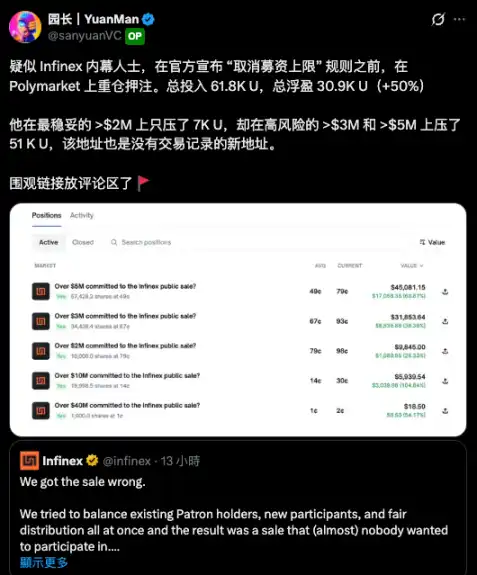
Following the rule change, the relevant webpage shows that Infinex's sales amount has exceeded $1.33 million, accounting for 26.68% of the $5 million target, with 466 participating addresses and a total of 497 transactions.
Polymarket Suspicious Betting Activity During the Same Period
Aside from the controversy surrounding the sales rules themselves, there was also a more topical clue related to a prediction market during the same period. Some community members noticed that prior to Infinex's official announcement of canceling the individual fundraising cap and adjusting the allocation mechanism, there was front-running buying activity on Polymarket related to this fundraising threshold.
@sanyuanVC discovered that before the official announcement of canceling the fundraising cap rule, they invested a total of $61,800 in Polymarket, with a floating profit of approximately $30,900. This address only wagered $7,000 in the conservative bets over $2 million, but wagered $51,000 in the high-risk bets over $3 million and $5 million. This address is also a new address with no transaction history.
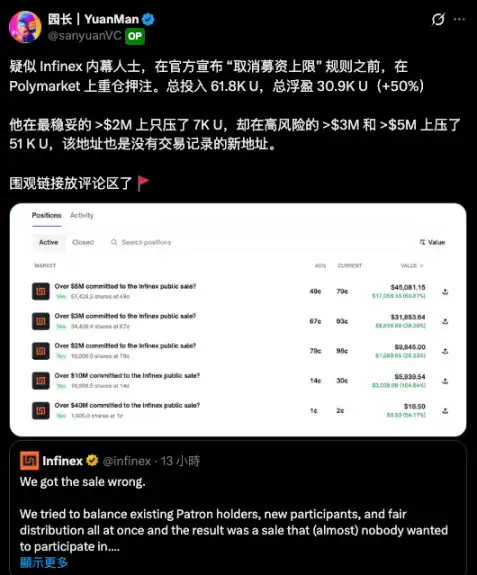
In response to some commentators speculating on insider trading or information leakage based on this, there is no conclusive evidence yet, and the project team has not responded either.
As of the time of writing, the probability on Polymarket for Infinex's public sale total subscription amount to exceed $2 million has risen to 98%. The probability for it to exceed $3 million is 93%, and for it to exceed $5 million is 78%. The cumulative transaction volume for this event has now reached $3.25 million.
You may also like

Who's at the CFTC Table? A Rebalancing of American Fintech Discourse

AI Trading vs Human Crypto Traders: $10,000 Live Trading Battle Results in Munich, Germany (WEEX Hackathon 2026)
Discover how AI trading outperformed human traders in WEEX's live Munich showdown. Learn 3 key strategies from the battle and why AI is changing crypto trading.

Elon Musk's X Money vs. Crypto's Synthetic Dollars: Who Wins the Future of Money?
How do Synthetic Dollars work? This guide explains their strategies, benefits over traditional stablecoins like USDT, and risks every crypto trader must know.

The Israeli military is hunting a mole on Polymarket

Q4 $667M Net Loss: Coinbase Earnings Report Foreshadows Challenging 2026 for Crypto Industry?

BlackRock Buying UNI, What's the Catch?

Lost in Hong Kong

Gold Plunges Over 4%, Silver Crashes 11%, Stock Market Plummet Triggers Precious Metals Algorithmic Selling Pressure?

Coinbase and Solana make successive moves, Agent economy to become the next big narrative

Aave DAO Wins, But the Game Is Not Over
Coinbase Earnings Call, Latest Developments in Aave Tokenomics Debate, What's Trending in the Global Crypto Community Today?
ICE, the parent company of the NYSE, Goes All In: Index Futures Contracts and Sentiment Prediction Market Tool

On-Chain Options: The Crossroads of DeFi Miners and Traders

How WEEX and LALIGA Redefine Elite Performance
WEEX x LALIGA partnership: Where trading discipline meets football excellence. Discover how WEEX, official regional partner in Hong Kong & Taiwan, brings crypto and sports fans together through shared values of strategy, control, and long-term performance.

Best Crypto to Buy Now February 10 – XRP, Solana, Dogecoin
Key Takeaways XRP is set to revolutionize cross-border transactions, potentially reaching $5 by the end of Q2 with…
Kyle Samani Criticizes Hyperliquid in Explosive Post-Departure Market Commentary
Key Takeaways: Kyle Samani, former co-founder of Multicoin Capital, publicly criticizes Hyperliquid, labeling it a systemic risk. Samani’s…
Leading AI Claude Forecasts the Price of XRP, Cardano, and Ethereum by the End of 2026
Key Takeaways: XRP’s value is projected to reach $8 by 2026 due to major institutional adoption. Cardano (ADA)…
Bitcoin Price Prediction: Alarming New Research Cautions Millions in BTC at Risk of ‘Quantum Freeze’ – Are You Ready?
Key Takeaways Quantum Threat to Bitcoin: The rise of quantum computing presents a unique security challenge to Bitcoin,…
Who's at the CFTC Table? A Rebalancing of American Fintech Discourse
AI Trading vs Human Crypto Traders: $10,000 Live Trading Battle Results in Munich, Germany (WEEX Hackathon 2026)
Discover how AI trading outperformed human traders in WEEX's live Munich showdown. Learn 3 key strategies from the battle and why AI is changing crypto trading.
Elon Musk's X Money vs. Crypto's Synthetic Dollars: Who Wins the Future of Money?
How do Synthetic Dollars work? This guide explains their strategies, benefits over traditional stablecoins like USDT, and risks every crypto trader must know.


 App
App