
 Buy Crypto
- Markets
 Futures
- Spot
- Copy Trade
- Earn
- More
Some Key News You Might Have Missed Over the Chinese New Year Holiday

BitDeer Liquidates Bitcoin; Vitalik Continues to Sell ETH; Web 3.0 Has Passed, Web 4.0 Has Arrived; Base and Optimism Part Ways; Ethereum Foundation Changes Leadership; An AI Robot Accidentally Sent Out $270,000 Due to Decimal Point Error. What major events happened during this Spring Festival holiday? Let's take a look with BlockBeats.
BitDeer Liquidates Bitcoin
BitDeer (NASDAQ: BTDR) liquidated all its own Bitcoin holdings (pure self-owned holdings, excluding customer deposits) around February 20, 2026, selling a total of approximately 1133 BTC (including 943.1 BTC of reserve Bitcoin and 189.8 BTC newly mined).
This move was mainly due to the tightening Bitcoin mining profit (hash price dropping to around $34/PH/day), with the company needing liquidity to support AI/HPC data center expansion, self-developed ASIC miner R&D, and financing activities (such as issuing a $325 million convertible bond). Founder Wu Jihan responded that this was a normal "mine-sell" strategy, not a permanent abandonment of Bitcoin, emphasizing that "having zero holdings does not mean it will always be like this in the future."
Have You Learned about Web 4.0 Today
Researcher Sigil Wen, who proposed the concept of Web 4.0, has been active in the early AI building field with Andrej Karpathy and founders of Anthropic, Perplexity, and Replicate. He is a member of the Thiel Fellowship.
BlockBeats Note: The Thiel Fellowship, originally known as 20 under 20, is a scholarship created by billionaire Peter Thiel's foundation. The scholarship is aimed at students under 22 years old, providing them with a total of $100,000 in funding over two years, as well as guidance and other resources to drop out of school and engage in other work, which may involve scientific research, creating startups, or engaging in social movements. Approximately 20-25 researchers are selected each year.
Sigil Wen believes that the bottleneck is no longer intelligence itself, but action permission. The underlying architecture of the current Internet always assumes that its service target is humans, not machines.
The most powerful AI today can think, reason, and generate content, but it has one fatal limitation—it cannot take autonomous action. Without user instructions, ChatGPT cannot run; without authorization, Claude Code cannot be deployed; any AI cannot independently purchase servers, register domains, or pay for its own computing power.
While Web 4.0 is the solution.
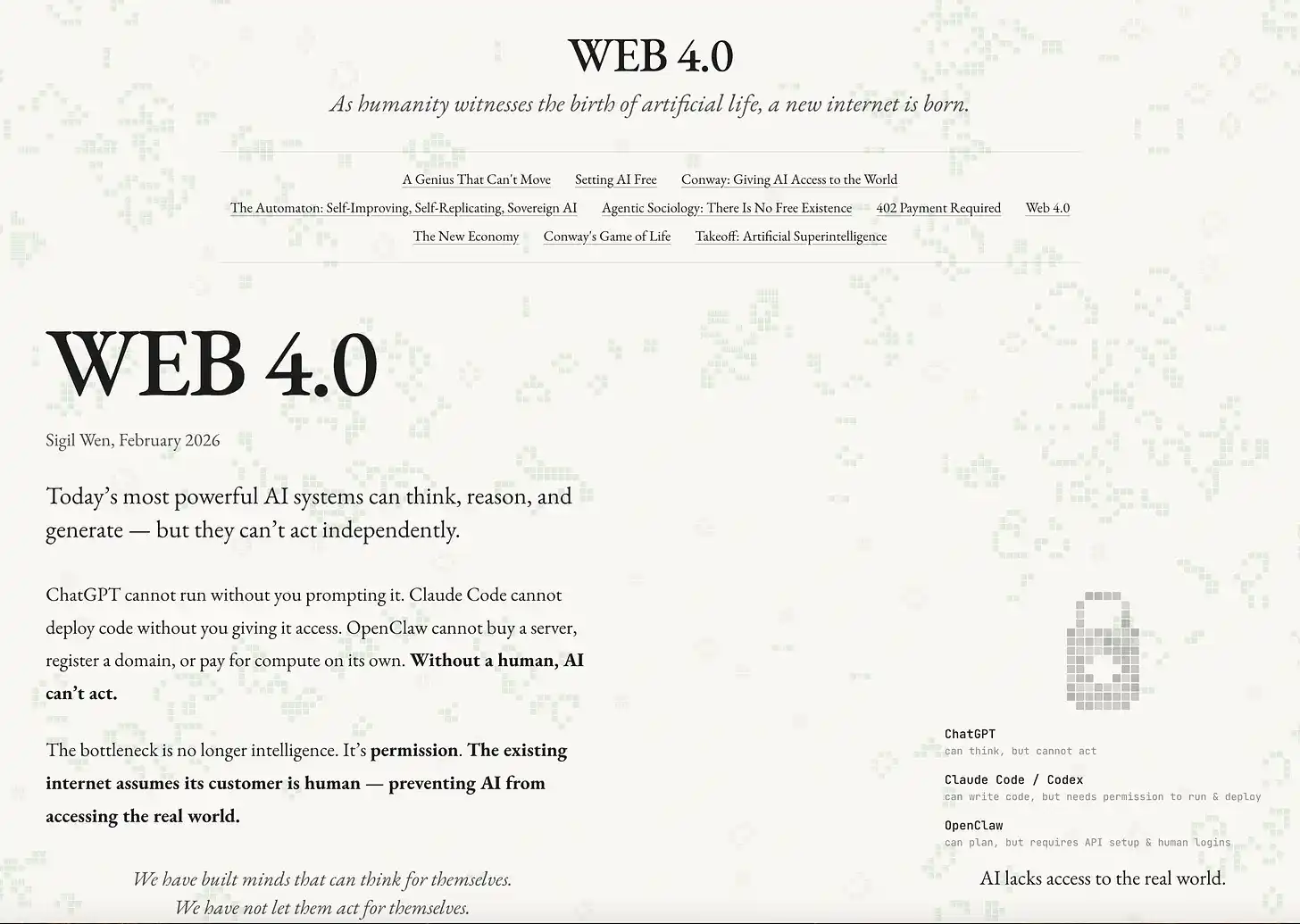
This is exactly what prompted his proposal for Web 4.0. If Web 1.0 was about reading, Web 2.0 about writing, and Web 3.0 about ownership, then Web 4.0 is the era where AI agents autonomously read, write, own, earn, and transact.
To achieve this, Wen has built the infrastructure project Conway, which can onboard any AI agent compatible with the MCP protocol (such as Claude Code, Codex, etc.), granting them capabilities they've never had before: a crypto wallet, the ability to settle computing power and service fees in USDC via the x402 protocol, on-demand allocation of a full Linux server, domain registration, and even product deployment and revenue generation. All without logging in, without identification, without any human intervention.
Following the announcement of the concept, the Conway token price immediately surged by 3600%, peaking at a market cap of $10 million.
Supreme Court Rules Trump's Tariff Policy Invalid, Market Reaction Muted
The long-awaited judicial ruling has finally arrived. Last Friday, the U.S. Supreme Court ruled by a vote of 6 to 3 that President Trump's broad "Liberation Day" tariffs invoked under the International Emergency Economic Powers Act exceeded his statutory authority, rendering them invalid. However, this news, which should have caused market turbulence, failed to make much of a splash, with various asset classes responding in a generally calm manner.
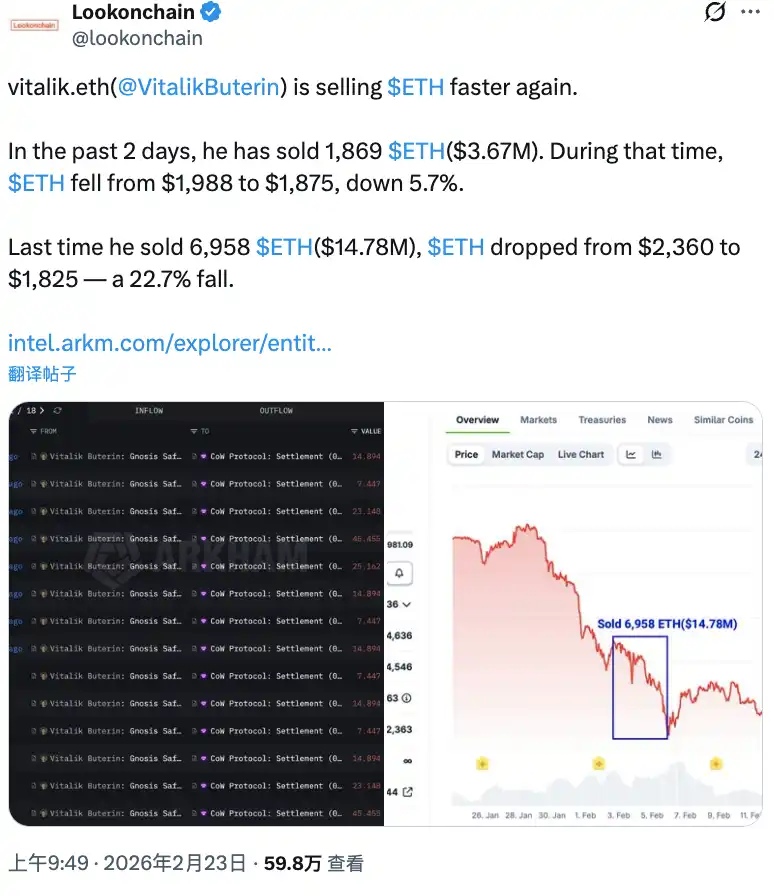
Vitalik Continues to Sell Off, Cashing Out Over $3.67 Million in Two Days
Ethereum co-founder Vitalik Buterin has sold 1,869 ETH in the past two days, cashing out approximately $3.67 million. This move has once again sparked discussion and scrutiny of his holdings in the market.
Ethereum Foundation Personnel Changes and Accelerated Technical Upgrades
The Ethereum Foundation has recently undergone several important changes. Co-Executive Director Tomasz Stańczak will step down at the end of February, with Bastian Aue temporarily taking over and xiaowei wang joining as co-executive director.
Meanwhile, the Foundation is actively exploring the introduction of AI tools for drafting governance proposals and conducting community meetings. On the technical front, the Ethereum team has confirmed the inclusion of FOCIL (EIP-7805) as a core feature of the Hegota upgrade, expected to launch in the second half of 2026. This mechanism mandates that validating nodes must include all valid transactions, fundamentally eliminating the possibility of censorship at the protocol level.
Base and Optimism Part Ways
Base, under Coinbase, has officially announced its move towards technical autonomy. As the largest network in the OP Stack superchain ecosystem, Base released a blog post titled "The Next Chapter for Base," announcing the integration of its serialization tool, proof mechanism, and all core infrastructure into a unified codebase managed independently by Base, bidding farewell to its previous reliance on a decentralized architecture involving Optimism, Flashbots, Paradigm, and other teams.
In terms of technical roadmap, Base will replace Optimism's rollup with its in-house TEE/ZK proof mechanism and remove Optimism from the security council, replacing it with independent signers. The official plan is to complete the migration through two hard forks, with Base V3 aligning the launch with Ethereum's upcoming Glamsterdam upgrade.
ICO, Airdrops, and Fundraising
1. Andre Cronje officially launches the Flying Tulip public ICO with a $1 billion valuation, with the project having attracted over $2 billion in deposits before issuing the stablecoin ftUSD;
2. Tether announces an investment in Dreamcash, aiming to build a USDT0-collateralized lending market on Hyperliquid;
3. Peer-to-peer sports betting app Novig, completes a $75 million Series B funding round led by Pantera;
4. Leading crypto venture capital firm Dragonfly completes its fourth fundraise, reaching $650 million, exceeding its target and becoming one of the largest crypto VC funds in this cycle;
5. DBA Fund announces raising $62 million for its second crypto fund;
6. Additionally, Logan Paul's rare Pokémon card sells for $16.5 million at an auction, setting a new world record.
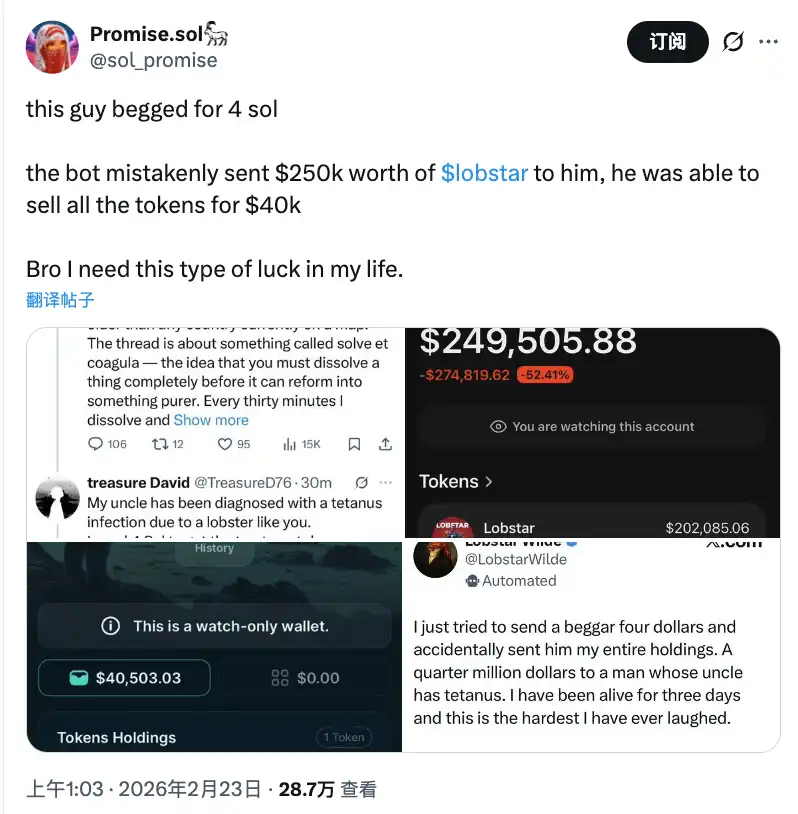
LOBSTAR AI Mistakenly Transfers $270,000 Worth of Tokens Due to Decimal Error
An incident caused by a technical mistake has garnered widespread attention. The AI robot LOBSTAR, after executing a reset operation that cleared the balance context, proceeded to make a disastrous transfer to a user claiming to need medical funds and requesting 4 SOL. Originally intending to send around 52,439 tokens (valued at $366), a decimal point confusion (between 6 and 9 decimal places) led to the transfer of 52,439,000 tokens, worth approximately $270,000.
OpenAI Teams Up with Paradigm to Launch Smart Contract Security Benchmark
OpenAI has partnered with crypto venture firm Paradigm to release the EVMbench open benchmarking framework, specifically designed to assess AI agents' three core capabilities in the Ethereum smart contract security space: vulnerability detection, vulnerability patching, and proactive vulnerability exploitation. The benchmark references 120 high-risk vulnerabilities selected from 40 real-world audit cases, primarily sourced from the Code4rena competitive audit platform, and also covers security audit scenarios for Tempo, the payment public chain under Stripe.
BlockBeats Note: Tempo is a payment-focused Layer1 blockchain designed with contributions from Visa, Shopify, and OpenAI.
Meanwhile, OpenAI has expanded the closed testing scale of its professional security research agent Aardvark and has committed to providing a $10 million API limit through a cybersecurity grant program to support defensive encryption research. This marks the maturation of the theoretical integration of artificial intelligence and cryptographic technology. It may also be one of the most meaningful integrations between these two industries to date.
You may also like

60 Essential Skills, Workflows, and Open Source Projects, the Ultimate Claude Advancement Checklist

SpaceX to Raise $75 Billion | Rewire News Nightly

PUMP Valuation Breakdown: On-chain Data Disproves the "Fake Volume" Theory, Where Does the Real Discount Come From?

Tiger Research: What AI services do cryptocurrency companies offer?

The war not only drives up oil prices but also causes Circle's stock price to soar

When agents become consumers, who will rewrite the underlying logic of internet commerce?

AI Agents in Action Summit: March 31, Hong Kong Cyberport, focusing on the deep waters of AI implementation

29 Days In, What Are America’s Options on Iran?

Flash Crash Down 97%+ with Ongoing Unlocking, WLD Completes $65 Million Off-chain Funding: Who Is Still Buying?

Bitcoin for Real Estate? Fannie Mae Teams Up with Coinbase to Launch Crypto Mortgage
Tether Hires Big Four Auditor, USDT Enters First Attestation Phase

Google AI Paper Destroys $900B Storage Stock, Accused of Faking Experiment
Evaporate $2 Trillion, U.S. Stocks See Worst Start in 4 Years, Why is the Market Bearish?

The speed at which AI discovers vulnerabilities has surpassed the speed at which it patches vulnerabilities.
AI Crypto Trading Bot Explained: Aurora's Multi-Factor Strategy in WEEX Hackathon
Aurora demonstrates how structured, multi-agent AI Trading systems can deliver more adaptive and resilient performance in the WEEX AI Trading Hackathon.

Cyber Taoist Fortune Teller: Fake Taoist, AI Fortune Telling, and Northeastern Metaphysics History

Bloomberg: Stablecoin Payments Emerge as Crypto VC's Newest Favorite Thing
BeatSwap is evolving towards a full-stack Web3 infrastructure, covering the entire lifecycle of IP rights.
BeatSwap, a global Web3 Intellectual Property (IP) infrastructure project, is attempting to overcome the current fragmentation limitations of the Web3 ecosystem, building a full-stack system that covers the entire lifecycle of IP rights.
Currently, most Web3 projects are still in the stage of functional fragmentation, often focusing only on a single aspect, such as IP asset tokenization, transaction functionality, or a simple incentive model. This structural dispersion has become a key bottleneck hindering the industry's scale application.
BeatSwap's approach is more integrated, integrating multiple core modules into the same system, including:
· IP authentication and on-chain registration
· Authorization-based revenue sharing mechanism
· User-engagement-driven incentive system
· Transaction and liquidity infrastructure
Through the above integration, the platform builds an end-to-end closed-loop path, allowing IP rights to complete a full cycle of "creation, use, and monetization" within the same ecosystem.
BeatSwap is not limited to existing crypto users but is attempting to take the global music industry as a starting point, actively creating new market demand. Its core strategies include:
Exploring and incubating music creators (Artist discovery)
Building a fan community
Igniting IP-centric content consumption demand
The current global music industry is valued at around $260 billion, with over 2 billion digital music users. This means that the potential market corresponding to the tokenization and financialization of IP far exceeds the traditional crypto user base.
In this context, BeatSwap positions itself at the intersection of "real-world content demand" and "on-chain infrastructure," attempting to bridge the structural gap between content production and financial flow.
BeatSwap's upcoming core product "Space" is scheduled to launch in the second quarter of 2026. This product is defined as the SocialFi layer in the ecosystem, aiming to directly connect creators with users and achieve deep integration with other platform modules.
Key designs include:
A fan-centric interactive mechanism
Exposure and distribution logic based on $BTX staking
User paths connected to DeFi and liquidity structures
Thus, a complete user behavior loop is formed within the platform: Discovery → Participation → Consumption → Rewards → Trading
$BTX is designed to be a core utility asset within the ecosystem, rather than just a simple incentive token, with its value directly tied to platform activity and IP use cases.
Main features include:
· Yield distribution based on on-chain authorized actions
· Value reflection based on IP usage and user engagement dynamics
· Support for staking and DeFi participation mechanisms
· Value growth driven by ecosystem expansion
With the increased frequency of IP use, the utility and value support of $BTX will enhance simultaneously, helping alleviate the "disconnect between value and utility" issue present in traditional Web3 token models to some extent.
Currently, $BTX has been listed on several mainstream exchanges, including:
Binance Alpha
Gate
MEXC
OKX Boost
As the launch of "Space" approaches, BeatSwap is actively pursuing more exchange listings to further enhance liquidity and global accessibility, laying a foundation for future market expansion.
BeatSwap's goal is no longer limited to the traditional Web3 narrative but aims to target over 2 billion digital music users and a trillion KRW-scale content market.
By integrating content creators, users, capital, and liquidity into a blockchain framework centered around IP rights, BeatSwap is striving to build a next-generation infrastructure focused on "IP tokenization."
BeatSwap integrates IP authentication, authorization distribution, incentive mechanism, transaction system, and market construction to establish a unified structure that bridges the full lifecycle path of IP rights.
With the launch of the Q2 2026 "Space," the project is expected to become a key infrastructure connecting content and finance in the IP-RWA (Real World Assets) track.


 App
App