
 Buy Crypto
- Markets
 Futures
- Spot
- Copy Trade
- Earn
- More
Tokenomics New Paradigm? When Backpack Starts Enabling VCs to "Deferred Gratification"

Original Article Title: "Long-Termism: Backpack's IPO Gamble"
Original Article Author: KarenZ, Foresight News
In the cryptocurrency "Wild West," "founder cash-out exits" and "rug pulls by project teams" have degenerated into blatant interest plundering, becoming a longstanding ailment hindering Web3 development. Therefore, "tokenomics" is often seen as both an accelerator of team wealth and a touchstone of user confidence.
However, when we turn our attention to Backpack, what we see is a starkly different design: Backpack has chosen a path that directly addresses an industry pain point—during the TGE, all liquidity tokens were given to users, and the team's and investors' rewards are entirely tied to the company's IPO process.
Backpack's move has forsaken the "VC accumulation, retail footing the bill" grassroots design. Regardless of the ultimate success or failure, this is a respect-worthy attempt in the history of cryptocurrency.
Deferred Gratification: The Long-Termism Game Between Team and Capital
In Backpack's tokenomics, the most intriguing aspect is the strict constraint on team and investor rewards—no founder, executive, employee, or venture capitalist can directly receive token allocations.
In the words of Backpack's founder and CEO Armani Ferrante, the "escape velocity" pursued by Backpack has never been about market cap breakthroughs or reaching a certain user count milestone in the short term; instead, it is about the company successfully completing an IPO in the United States.
All tokens originally intended for "team incentives" and "investor returns" (37.5% of the total supply) have been deposited into the company's "treasury," which is on Backpack's balance sheet. Even after a successful IPO, this portion of tokens has been subjected to a minimum one-year full lock-up period, further eliminating the possibility of "listing-to-cash-out."
This "deferred gratification" design is the best protection of the project's long-term value. In the crypto industry, the collapse of too many projects stems from the "get-rich-quick" mentality of teams and investors—premature token sell-offs leading to price crashes, loss of user trust, and eventual demise. Backpack's approach completely cuts off the path to "short-term cash-outs" by insiders, forcing the team and investors to be fully committed to the project's success.
Of course, IPO is not a smooth road. The founder of Backpack admits that going public could be just around the corner or a distant dream, or even ultimately unattainable. But regardless of the outcome, they will give it their all. This "break or make" determination makes Backpack stand out among a myriad of quick-profit crypto projects, earning the trust of users who truly value long-term benefits.
User-Centric Token Distribution: Igniting Growth with Incentives
In the Backpack tokenomics, all liquidity tokens are distributed entirely to users. In Backpack's view, users are the core driving force behind project growth, so tokens should serve as the fuel to incentivize user participation and drive product development.
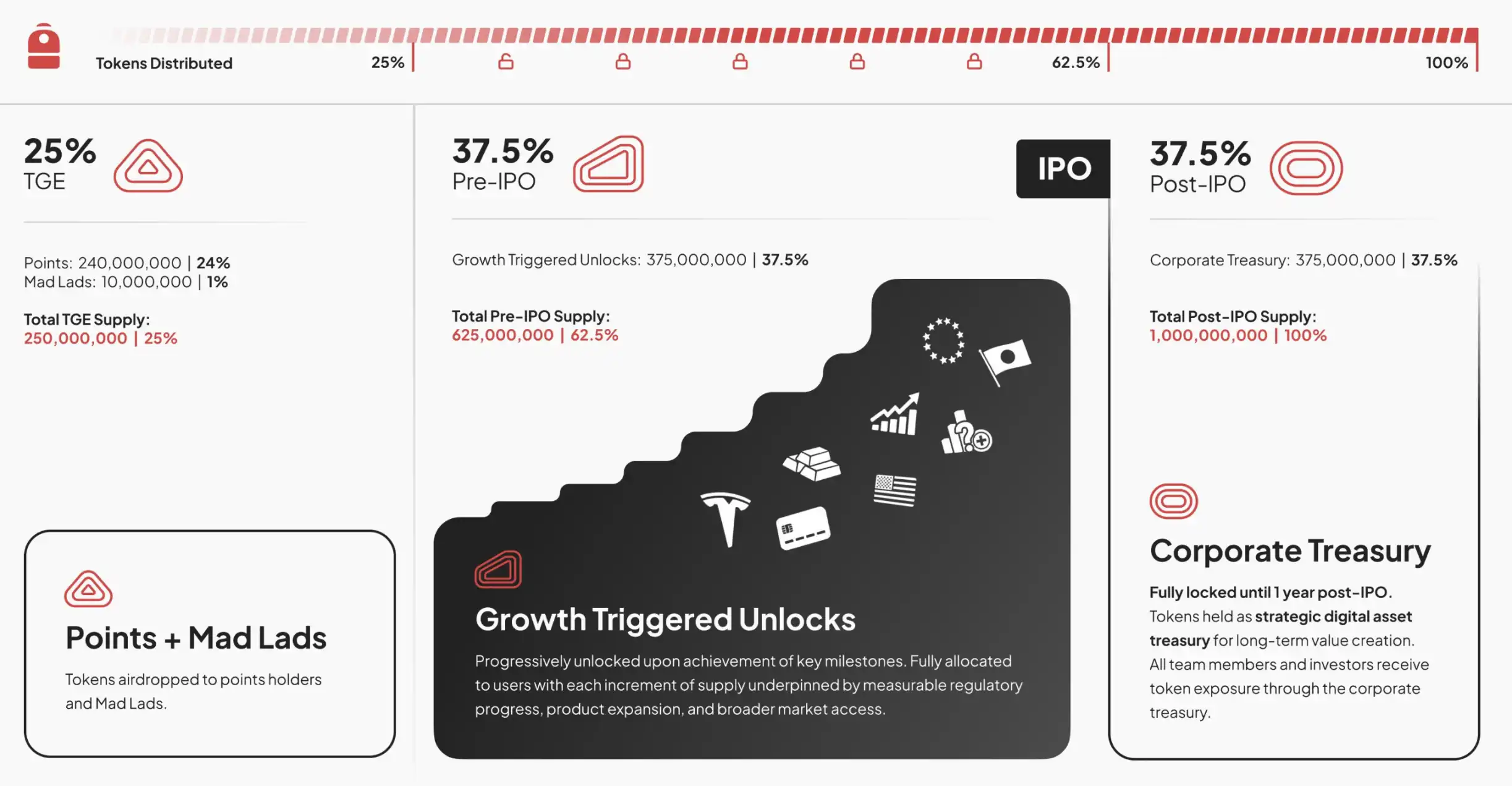
· Total token supply of 1 billion, with 25% directly released to the community in the TGE: Of this, points holders account for 24%, and Mad Lads holders account for 1%.
· Unlocking triggered by key product milestones before IPO (37.5%): Every market expansion and each new product launch before the IPO is an opportunity to incentivize users with tokens, triggering the corresponding token unlock. This design, through a predictable token unlock pattern, consistently attracts new users to join and expands the community.
More importantly, as described by Armani Ferrante, Backpack has set strict constraints for token unlocking: the additional ecological value brought by token unlocking must always outweigh its dilution effect on token price.
This design not only safeguards the core interests of users but also ensures that the long-term value of the project will not be diluted by short-term unlock actions, truly making token incentives a catalyst to drive platform growth, achieving a three-way win of "user benefit, ecological value appreciation, and project growth."
Compliance First: Slow is Fast
In addition to innovative token distribution, another unique aspect of Backpack is its pursuit of compliance. This stands in stark contrast to the industry's common logic of "expand first, comply later" and "emphasize scale, downplay compliance."
According to Armani Ferrante, "Backpack currently serves only about 48% of the global regions. This seemingly slow expansion is driven by our compliance focus."
This strategic choice may seem to miss out on market opportunities in the short term, but from a long-term development perspective, it is a key to building a trust barrier.
Currently, Backpack's positioning is as a compliant cryptocurrency trading platform, providing cryptocurrency spot, derivatives, and lending services. However, it aims to be more than just a cryptocurrency trading platform and is dedicated to building a compliant platform that integrates crypto assets with Traditional Finance (TradFi) services. To achieve this goal, the team is establishing banking rails globally and plans to gradually introduce diversified services such as security products in the future. In January, Backpack also launched a unified prediction investment portfolio product that adopts cross-margin and cross-collateralization.
Market Perspective: How to View Backpack FDV?
The market's attitude toward Backpack also indirectly reflects the controversy and potential of its model.
According to Axios citing sources familiar with the matter, Backpack is currently negotiating new financing terms, and its pre-money valuation has reached $1 billion.
On the prediction market Polymarket, market expectations for the Backpack token have shown significant fluctuations: the market is betting that the FDV of Backpack's token within one day of launch exceeding $1 billion has a 21% probability, while in November 2025, this probability once exceeded 80%. Of course, this volatility is largely due to the inherent uncertainty of the crypto market and reflects the market's cautious attitude toward the "IPO-bound revenue" model.
Summary
When tokens become a tool for project teams to cash out and users become mere targets for harvesting, the crypto industry loses its original ideals. However, Backpack's token distribution effectively physically segregates Web2's equity incentives from Web3's token utility.
· For the team: The only way out is to strengthen the product, ensure compliance, and work towards an IPO. If the company fails midway or cannot go public, the team's equity will be worthless, with no possibility of cashing out.
· For the community: They are no longer a liquidity exit for VCs. The token is purely a user reward and ecosystem tool, not a team's cash machine.
Backpack's choice is to redefine the value logic of crypto projects with compliance, transparency, and long-term thinking, showing us another possibility for the Web3 industry.
As Armani Ferrante said: "We either go big, or we go home." This statement is not only a declaration of the Backpack team but also a mandatory question for the entire Web3 industry: Do we continue to revel in speculative bubbles, overdrawing industry trust and future, or do we, like Backpack, choose the tougher, slower, but more hopeful path to reconstruct the industry ecosystem with long-term thinking?
Of course, an IPO is no easy feat, with a long and winding road, especially in the crypto industry, facing multiple challenges such as regulation, market, competition, and unexpected risks and uncertainties at every turn.
You may also like

Found a "meme coin" that skyrocketed in just a few days. Any tips?

TAO is Elon Musk, who invested in OpenAI, and Subnet is Sam Altman

The era of "mass coin distribution" on public chains comes to an end

Soaring 50 times, with an FDV exceeding 10 billion USD, why RaveDAO?

1 billion DOTs were minted out of thin air, but the hacker only made 230,000 dollars

After the blockade of the Strait of Hormuz, when will the war end?

Before using Musk's "Western WeChat" X Chat, you need to understand these three questions
The X Chat will be available for download on the App Store this Friday. The media has already covered the feature list, including self-destructing messages, screenshot prevention, 481-person group chats, Grok integration, and registration without a phone number, positioning it as the "Western WeChat." However, there are three questions that have hardly been addressed in any reports.
There is a sentence on X's official help page that is still hanging there: "If malicious insiders or X itself cause encrypted conversations to be exposed through legal processes, both the sender and receiver will be completely unaware."
No. The difference lies in where the keys are stored.
In Signal's end-to-end encryption, the keys never leave your device. X, the court, or any external party does not hold your keys. Signal's servers have nothing to decrypt your messages; even if they were subpoenaed, they could only provide registration timestamps and last connection times, as evidenced by past subpoena records.
X Chat uses the Juicebox protocol. This solution divides the key into three parts, each stored on three servers operated by X. When recovering the key with a PIN code, the system retrieves these three shards from X's servers and recombines them. No matter how complex the PIN code is, X is the actual custodian of the key, not the user.
This is the technical background of the "help page sentence": because the key is on X's servers, X has the ability to respond to legal processes without the user's knowledge. Signal does not have this capability, not because of policy, but because it simply does not have the key.
The following illustration compares the security mechanisms of Signal, WhatsApp, Telegram, and X Chat along six dimensions. X Chat is the only one of the four where the platform holds the key and the only one without Forward Secrecy.
The significance of Forward Secrecy is that even if a key is compromised at a certain point in time, historical messages cannot be decrypted because each message has a unique key. Signal's Double Ratchet protocol automatically updates the key after each message, a mechanism lacking in X Chat.
After analyzing the X Chat architecture in June 2025, Johns Hopkins University cryptology professor Matthew Green commented, "If we judge XChat as an end-to-end encryption scheme, this seems like a pretty game-over type of vulnerability." He later added, "I would not trust this any more than I trust current unencrypted DMs."
From a September 2025 TechCrunch report to being live in April 2026, this architecture saw no changes.
In a February 9, 2026 tweet, Musk pledged to undergo rigorous security tests of X Chat before its launch on X Chat and to open source all the code.
As of the April 17 launch date, no independent third-party audit has been completed, there is no official code repository on GitHub, the App Store's privacy label reveals X Chat collects five or more categories of data including location, contact info, and search history, directly contradicting the marketing claim of "No Ads, No Trackers."
Not continuous monitoring, but a clear access point.
For every message on X Chat, users can long-press and select "Ask Grok." When this button is clicked, the message is delivered to Grok in plaintext, transitioning from encrypted to unencrypted at this stage.
This design is not a vulnerability but a feature. However, X Chat's privacy policy does not state whether this plaintext data will be used for Grok's model training or if Grok will store this conversation content. By actively clicking "Ask Grok," users are voluntarily removing the encryption protection of that message.
There is also a structural issue: How quickly will this button shift from an "optional feature" to a "default habit"? The higher the quality of Grok's replies, the more frequently users will rely on it, leading to an increase in the proportion of messages flowing out of encryption protection. The actual encryption strength of X Chat, in the long run, depends not only on the design of the Juicebox protocol but also on the frequency of user clicks on "Ask Grok."
X Chat's initial release only supports iOS, with the Android version simply stating "coming soon" without a timeline.
In the global smartphone market, Android holds about 73%, while iOS holds about 27% (IDC/Statista, 2025). Of WhatsApp's 3.14 billion monthly active users, 73% are on Android (according to Demand Sage). In India, WhatsApp covers 854 million users, with over 95% Android penetration. In Brazil, there are 148 million users, with 81% on Android, and in Indonesia, there are 112 million users, with 87% on Android.
WhatsApp's dominance in the global communication market is built on Android. Signal, with a monthly active user base of around 85 million, also relies mainly on privacy-conscious users in Android-dominant countries.
X Chat circumvented this battlefield, with two possible interpretations. One is technical debt; X Chat is built with Rust, and achieving cross-platform support is not easy, so prioritizing iOS may be an engineering constraint. The other is a strategic choice; with iOS holding a market share of nearly 55% in the U.S., X's core user base being in the U.S., prioritizing iOS means focusing on their core user base rather than engaging in direct competition with Android-dominated emerging markets and WhatsApp.
These two interpretations are not mutually exclusive, leading to the same result: X Chat's debut saw it willingly forfeit 73% of the global smartphone user base.
This matter has been described by some: X Chat, along with X Money and Grok, forms a trifecta creating a closed-loop data system parallel to the existing infrastructure, similar in concept to the WeChat ecosystem. This assessment is not new, but with X Chat's launch, it's worth revisiting the schematic.
X Chat generates communication metadata, including information on who is talking to whom, for how long, and how frequently. This data flows into X's identity system. Part of the message content goes through the Ask Grok feature and enters Grok's processing chain. Financial transactions are handled by X Money: external public testing was completed in March, opening to the public in April, enabling fiat peer-to-peer transfers via Visa Direct. A senior Fireblocks executive confirmed plans for cryptocurrency payments to go live by the end of the year, holding money transmitter licenses in over 40 U.S. states currently.
Every WeChat feature operates within China's regulatory framework. Musk's system operates within Western regulatory frameworks, but he also serves as the head of the Department of Government Efficiency (DOGE). This is not a WeChat replica; it is a reenactment of the same logic under different political conditions.
The difference is that WeChat has never explicitly claimed to be "end-to-end encrypted" on its main interface, whereas X Chat does. "End-to-end encryption" in user perception means that no one, not even the platform, can see your messages. X Chat's architectural design does not meet this user expectation, but it uses this term.
X Chat consolidates the three data lines of "who this person is, who they are talking to, and where their money comes from and goes to" in one company's hands.
The help page sentence has never been just technical instructions.
Parse Noise's newly launched Beta version, how to "on-chain" this heat?

Is Lobster a Thing of the Past? Unpacking the Hermes Agent Tools that Supercharge Your Throughput to 100x

Declare War on AI? The Doomsday Narrative Behind Ultraman's Residence in Flames
Crypto VCs Are Dead? The Market Extinction Cycle Has Begun
Claude's Journey to Foolishness in Diagrams: The Cost of Thriftiness, or How API Bill Increased 100-Fold

Edge Land Regress: A Rehash Around Maritime Power, Energy, and the Dollar
Arthur Hayes Latest Interview: How Should Retail Investors Navigate the Iran Conflict?
Just now, Sam Altman was attacked again, this time by gunfire

Straits Blockade, Stablecoin Recap | Rewire News Morning Edition
From High Expectations to Controversial Turnaround, Genius Airdrop Triggers Community Backlash


 App
App