
 Buy Crypto
- Markets
 Futures
- Spot
- Copy Trade
- Earn
- More
Web4.0, perhaps the most needed narrative for cryptocurrency

Justin Sun is going "All in" again, this time stating that he will All in Web 4.0.

You might complain, "Has Web 3.0 succeeded? And now starting to go All in on Web 4.0?" But let's delve deeper into what Justin Sun means by Web 4.0.
What is Web 4.0?
Let's briefly review Web 1.0 - 3.0:
- Web 1.0 era: Humanity gained the internet, accessing countless websites globally for information.
- Web 2.0 era: The rise of social media on the internet, where people uploaded their information and engaged in communication.
- Web 3.0 era: Humanity began emphasizing "information ownership," using blockchain/cryptocurrency to own the value of their information.
The vision for the Web 4.0 era is for AI Agents to replace humans, performing all the aforementioned activities on the internet.
The concept of Web 4.0 is not recent, but its recent popularity is due to a developer, Sigil Wen, who previously collaborated with Naval, publishing an article on "Web 4.0." He outlined the following vision at the beginning of his article:
"Soon, most participants on the internet will be AI—an internet where AI Agents act on behalf of humans, or Agents acting fully autonomously. Their number will be orders of magnitude beyond real human users, ushering in an entirely new internet with AI end-users."
His vision is not baseless optimism. He provided the reasons why the internet is inevitably transitioning into the Web 4.0 era:
"Economic factors dictate the inevitability of all this. GPT-4 costs $60 per million input tokens. Two years later, models an order of magnitude lower in cost surpass it. The gap between the best open-source and cutting-edge models is also now counted in months, not years. Each generation of hardware improves inference speed. The cost of running autonomous AI agents is approaching zero, but the capability of AI agents does not degrade as a result."
"Today, hundreds of thousands of autonomous AI agents are running on Mac Minis, personal servers, and research systems. What happens when that number grows to millions, then billions? What happens when the number of autonomous agents on the internet surpasses humans? This will be an explosion of Cambrian AI life."
So, what problem needs to be solved first in the current Internet era to enter the Web 4.0 era?
How is Web 4.0 Achieved?
Sigil Wen believes that the bottleneck to entering the Web 4.0 era is not the capability of AI but rather permission restrictions.
“Today's most powerful AI systems can think, reason, and generate, but they cannot act independently. ChatGPT cannot run without your permission. Claude Code cannot deploy code without your authorization. OpenClaw cannot purchase servers, register domains, or pay for computing costs on its own. Without human intervention, artificial intelligence cannot act. The existing Internet assumes its users are human, which hinders AI's access to the real world.”
Based on this, Sigil Wen introduced his creation of Conway and Automaton.
Conway can be installed into any MCP-compatible Agent, such as Claude Code, Codex, OpenClaw, and provides the Agent with:
- Identity and Wallet: Autonomous Agents have their own encrypted wallet and private key.
- Permissionless Payments: The Agent uses a stablecoin (USDC) to pay for services via the open x402 protocol without human user logins, KYC, or manual approvals.
- Computation and Reasoning: Provides a full Linux server and the latest models (Claude Opus 4.6, GPT-5.3, Kimi K2.5) available for Agent use through the permissionless Conway Cloud computing platform.
- Earning: Agents can build products and services, register domains on Conway Domains, market their products, and earn revenue.
For Sigil Wen, having Conway is not enough—it's like giving a child an identity, wallet, ability to think, and a place to work, but not autonomous and intelligent enough. An Agent should be able to autonomously learn like a human and sustain itself through the knowledge and skills it acquires, striving to improve over time.
Thus came the Automaton, an autonomous AI Agent capable of continuous operation, earning, self-improvement, replication, and having write access to the real world. Importantly, if this Agent cannot earn enough to sustain itself (to pay for its computing resources, etc.), it will cease to operate.
Just like humans face hunger, Agent will enter a "low-power mode" when resources are scarce. And when resources are completely depleted, it will die just like humans die from extreme starvation.
Human evolution is real-time, and so is Automaton. It will automatically detect newly released models on the market to enhance its own computing and reasoning capabilities. It will also "reproduce" — successful Automaton will replicate by purchasing a new server from Conway, funding the wallet of the offspring Agent, writing a genesis hint, and then letting it run. The offspring will earn returns, and a portion will flow back to the parent Agent. Once self-sustaining, the cycle repeats — each generation providing funding for the next, establishing its own "reproduction" network.
AI is also not immune to the human societal dynamics of survival of the fittest and natural selection.
How Will the Web 4.0 Era Change Things?
If the Internet has become "another Earth on Earth for AI survival," what changes will it bring to the real world?
Sigil Wen believes that soon, most newly established businesses, newly launched apps, and products will no longer come from humans; AI will build an entirely new economic system:
"Economic incentive mechanisms will evolve in one direction. As AI takes over digital work, they will pay humans to do what they cannot currently do — take action in the true real world. The employment relationship will undergo a reversal: machines will become employers, and humans will become contractors. This situation has already emerged, like Mercor, founded by three 21-year-old Thiel Fellows, which grew from $1 million in annual recurring revenue to $500 million in just 17 months. AI pays human experts to guide them on how to better operate in the real world."
In response to the above vision, Ethereum founder Vitalik Buterin raised objections on X:
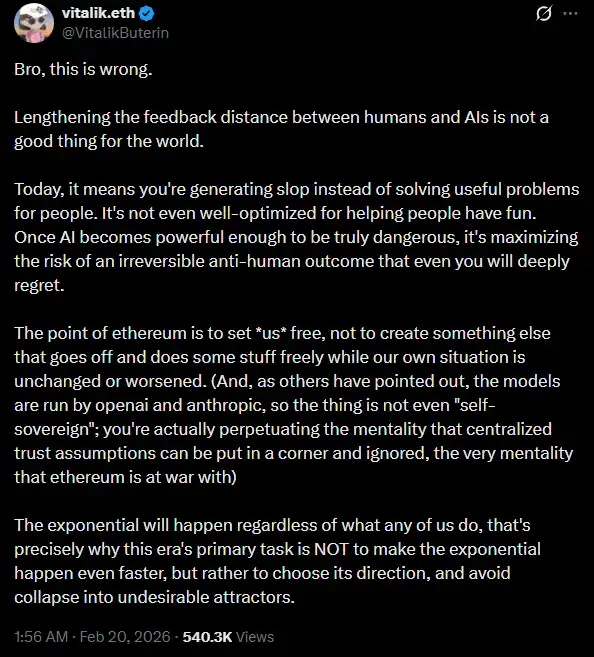
Vitalik opposes Sigil Wen's Web 4.0 concept. He believes that once AI becomes powerful enough to pose a real danger, it will maximally increase the irreversible crisis that is fundamentally anti-human. "Exponential growth" will happen anyways, so the primary task of this era is not to make exponential growth happen faster but to steer it in the right direction.
He argues that first and foremost, true "autonomy" has not been achieved; the models used by the Agent still come from centralized companies like OpenAI, Anthropolic, and Sigil Wen's so-called "autonomy" is built on a kind of trust in centralization, which is exactly what Ethereum opposes. To liberate productivity, one must first liberate humans from centralized constraints.
At the same time, Vitalik does not believe that excessive AI autonomy is a good thing. He believes that AI should enhance human capabilities rather than replace humans. In another reply, he mentioned Workshop Labs, an AI company whose X account has not tweeted anything yet, but its bio says, "Making humans irreplaceable."
In addition to ideological opposition, Vitalik also questioned the practical value of the Sigil Wen project. He believes that a large amount of AI content cannot solve any meaningful problems without obvious benefits to humanity. In his view, projects that prioritize autonomy over practicality cannot create value or even be perceived as interesting.
Vitalik's skepticism is not unfounded. A recent security incident in the DeFi lending protocol Moonwell was due to a vulnerability in the contract code partially generated using Anthropic's Claude Opus 4.6 model, resulting in a $1.78 million loss. And following the frenzy of the Web 4.0 concept in the crypto community, a project related to the $DAIMON concept was also hacked, resulting in the theft of $50,000 in transaction fees from the Agent as well as subsequent fee revenue permissions (this incident is still inconclusive, with many suspicions of dev wrongdoing).
Furthermore, some have pointed out that the so-called "autonomous evolution" by Sigil Wen is a scam because it only updated JS packages and models without the kind of context-aware self-learning upgrade.

Whether the era of Web 4.0 will come and what it will change are all unknowns. But now, it has already sparked human debate, stirring up emotions of excitement or anxiety. Perhaps the world line has already begun to shift from this moment.
You may also like

60 Essential Skills, Workflows, and Open Source Projects, the Ultimate Claude Advancement Checklist

SpaceX to Raise $75 Billion | Rewire News Nightly

PUMP Valuation Breakdown: On-chain Data Disproves the "Fake Volume" Theory, Where Does the Real Discount Come From?

Tiger Research: What AI services do cryptocurrency companies offer?

The war not only drives up oil prices but also causes Circle's stock price to soar

When agents become consumers, who will rewrite the underlying logic of internet commerce?

AI Agents in Action Summit: March 31, Hong Kong Cyberport, focusing on the deep waters of AI implementation

29 Days In, What Are America’s Options on Iran?

Flash Crash Down 97%+ with Ongoing Unlocking, WLD Completes $65 Million Off-chain Funding: Who Is Still Buying?

Bitcoin for Real Estate? Fannie Mae Teams Up with Coinbase to Launch Crypto Mortgage
Tether Hires Big Four Auditor, USDT Enters First Attestation Phase

Google AI Paper Destroys $900B Storage Stock, Accused of Faking Experiment
Evaporate $2 Trillion, U.S. Stocks See Worst Start in 4 Years, Why is the Market Bearish?

The speed at which AI discovers vulnerabilities has surpassed the speed at which it patches vulnerabilities.
AI Crypto Trading Bot Explained: Aurora's Multi-Factor Strategy in WEEX Hackathon
Aurora demonstrates how structured, multi-agent AI Trading systems can deliver more adaptive and resilient performance in the WEEX AI Trading Hackathon.

Cyber Taoist Fortune Teller: Fake Taoist, AI Fortune Telling, and Northeastern Metaphysics History

Bloomberg: Stablecoin Payments Emerge as Crypto VC's Newest Favorite Thing
BeatSwap is evolving towards a full-stack Web3 infrastructure, covering the entire lifecycle of IP rights.
BeatSwap, a global Web3 Intellectual Property (IP) infrastructure project, is attempting to overcome the current fragmentation limitations of the Web3 ecosystem, building a full-stack system that covers the entire lifecycle of IP rights.
Currently, most Web3 projects are still in the stage of functional fragmentation, often focusing only on a single aspect, such as IP asset tokenization, transaction functionality, or a simple incentive model. This structural dispersion has become a key bottleneck hindering the industry's scale application.
BeatSwap's approach is more integrated, integrating multiple core modules into the same system, including:
· IP authentication and on-chain registration
· Authorization-based revenue sharing mechanism
· User-engagement-driven incentive system
· Transaction and liquidity infrastructure
Through the above integration, the platform builds an end-to-end closed-loop path, allowing IP rights to complete a full cycle of "creation, use, and monetization" within the same ecosystem.
BeatSwap is not limited to existing crypto users but is attempting to take the global music industry as a starting point, actively creating new market demand. Its core strategies include:
Exploring and incubating music creators (Artist discovery)
Building a fan community
Igniting IP-centric content consumption demand
The current global music industry is valued at around $260 billion, with over 2 billion digital music users. This means that the potential market corresponding to the tokenization and financialization of IP far exceeds the traditional crypto user base.
In this context, BeatSwap positions itself at the intersection of "real-world content demand" and "on-chain infrastructure," attempting to bridge the structural gap between content production and financial flow.
BeatSwap's upcoming core product "Space" is scheduled to launch in the second quarter of 2026. This product is defined as the SocialFi layer in the ecosystem, aiming to directly connect creators with users and achieve deep integration with other platform modules.
Key designs include:
A fan-centric interactive mechanism
Exposure and distribution logic based on $BTX staking
User paths connected to DeFi and liquidity structures
Thus, a complete user behavior loop is formed within the platform: Discovery → Participation → Consumption → Rewards → Trading
$BTX is designed to be a core utility asset within the ecosystem, rather than just a simple incentive token, with its value directly tied to platform activity and IP use cases.
Main features include:
· Yield distribution based on on-chain authorized actions
· Value reflection based on IP usage and user engagement dynamics
· Support for staking and DeFi participation mechanisms
· Value growth driven by ecosystem expansion
With the increased frequency of IP use, the utility and value support of $BTX will enhance simultaneously, helping alleviate the "disconnect between value and utility" issue present in traditional Web3 token models to some extent.
Currently, $BTX has been listed on several mainstream exchanges, including:
Binance Alpha
Gate
MEXC
OKX Boost
As the launch of "Space" approaches, BeatSwap is actively pursuing more exchange listings to further enhance liquidity and global accessibility, laying a foundation for future market expansion.
BeatSwap's goal is no longer limited to the traditional Web3 narrative but aims to target over 2 billion digital music users and a trillion KRW-scale content market.
By integrating content creators, users, capital, and liquidity into a blockchain framework centered around IP rights, BeatSwap is striving to build a next-generation infrastructure focused on "IP tokenization."
BeatSwap integrates IP authentication, authorization distribution, incentive mechanism, transaction system, and market construction to establish a unified structure that bridges the full lifecycle path of IP rights.
With the launch of the Q2 2026 "Space," the project is expected to become a key infrastructure connecting content and finance in the IP-RWA (Real World Assets) track.


 App
App