
 Buy Crypto
- Markets
 Futures
- Spot
- Copy Trade
- Earn
- More
What are the common traits of people who founded a $5 Billion+ company before the age of 23?

Original Article Title: Out Of Distribution
Original Author: @richzou
Translation: Peggy, BlockBeats
Editor's Note: What kind of person can found a $5 billion company in their twenties? In this article, the author summarizes the experiences of 25 founders of $5 billion companies (such as the founders of Robinhood, Shopify, Airbnb, Coinbase, Notion, etc.), highlighting three recurring traits: trauma, neural diversity, and cross-disciplinary skills.
Reading about these individuals' growth journeys together reveals an interesting phenomenon: they often do not fit the traditional definition of an "impressive resume." Many do not have Ivy League backgrounds, their career paths are non-standard, and they might struggle to pass even the first round of traditional recruitment processes.
This article seeks to answer a question through these real case studies: What common traits do the entrepreneurs who create multi-billion dollar companies in their twenties possess?
Below is the original text:
Last week, I read a founder profile study that compiled data on 20 founders who started $5 billion companies at age 23 or younger. Strictly speaking, they were almost kids at that time. This week I've looked at the second volume, again with founders of $5 billion companies, but this time they were a bit older, between 24 and 29 years old when they founded their companies.
The list includes many familiar names: Vlad Tenev of Robinhood, Tobi Lütke of Shopify, Brian Armstrong of Coinbase, Brian Chesky of Airbnb, Pavel Durov of Telegram, Ivan Zhao of Notion, Tony Xu of DoorDash, Ben Silbermann of Pinterest, Apoorva Mehta of Instacart, Tom Preston-Werner of GitHub, and more.
I have always believed in a certain type of person: "out-of-distribution individuals." In my view, this is the earliest and most reliable signal of identifying potential—more important than a school's background and often more valuable than a company's past track record.
Reading through the stories of these 25 founders in succession reveals a very clear pattern. They hardly fit the typical "entrepreneurship template" profile. Many of them lack prestigious school backgrounds, impressive resumes, and may not even pass the first round of traditional recruitment processes. Yet, in the end, they created companies that defined an era.
The question is: what should we really be looking for? What does "beyond the statistical distribution" really mean?
If we must summarize the common traits of these people, they can generally be categorized into three key words: Trauma, Neurodiversity, and Polymathic Range.
As you read through the experiences of these 25 founders, you will notice an almost impossible-to-ignore pattern: almost everyone possesses at least one of these, and the top founders often have all three.
Trauma
Many times, it's the world that shattered something within you when you were very young, and those scars left behind later became load-bearing structures.
Robinhood founder Vlad Tenev was born in Bulgaria during the communist era. When he was very young, his father moved to the U.S., leaving them apart for a full two years. Later, the family reunited in the U.S., but they lived very frugally, in student housing, without a nanny, and young Vlad had to follow his father to the university computer lab because there was nowhere else to go.
At the same time, in Bulgaria, his grandparents watched helplessly as their savings were devoured by hyperinflation, to the extent that relatives started melting down copper pots as a store of value.
Later, he founded Robinhood. The core idea of this company is actually very straightforward: the financial system should not be exclusive to a few.
ServiceTitan founder Ara Mahdessian's story is similar.
He was born in Tehran during the Iran-Iraq War, so close to the war zone that they could hear the bombs exploding. When he was still a baby, the whole family fled to California. His father later became a plumber, but running a small contracting business was always very tough: language barriers, complex procedures, and a lack of suitable software tools.
Ara grew up seeing these problems first-hand. Later, he founded ServiceTitan, a platform that provides management software for local service industries like plumbers and electricians.
He didn't discover this problem later in life; he has been living in the midst of the problem since childhood.
Similar experiences keep happening:
DoorDash (a food delivery service that connects restaurants with delivery drivers) founder Tony Xu immigrated from China to the U.S. at the age of five. His mother worked in a Chinese restaurant. By the age of nine, he was already washing dishes, busing tables, scrubbing pots in the kitchen, and even tinkering with a broken cash register.
Coinbase founder Brian Armstrong, after graduating from college, lived in Argentina for a year and witnessed firsthand how hyperinflation destroyed ordinary people's savings. Upon returning to the U.S., he founded Coinbase.
Airbnb founder Brian Chesky couldn't even afford rent in San Francisco and had to rent out an air mattress to strangers — that was Airbnb's first night.
Instacart (an online grocery delivery platform) founder Apoorva Mehta was born in Jodhpur, India, lived in Libya during his childhood, and moved to Hamilton, Canada, at the age of 14. His mother often made him go grocery shopping in the winter, which he hated. Later, he founded Instacart.
Pavel Durov, who grew up shuttling between Russia and Italy in his childhood, always felt like an "outsider." Later, he founded Telegram.
The business logic behind these companies can often be traced back to the founders' personal experiences. This is not a romanticized entrepreneurial narrative but a very specific, almost inevitable cause-and-effect relationship.
Trauma often brings two extremely hard-to-obtain abilities.
First is an emotional connection to the problem. It's not abstract business analysis but a direct physical sensation: something is wrong with this world, and it must be fixed.
Second is the ability to endure pain. Entrepreneurship is essentially a highly willpower-consuming endeavor. Most people give up along the way, and those who persevere are often those who have long been accustomed to handling pressure.
Neurodivergence
If you continue reading below, you will discover another recurring pattern: many great founders are not considered successful within traditional educational systems or workplace structures.
I refer to this trait as neurodivergence. Of course, this is not necessarily a concept in the medical diagnostic sense. But their brains clearly operate in a different way, viewing the world from a "sideways" angle, easily becoming obsessed, persevering, and finding it hard to stay put within established structures.
One of the most extreme examples might be Etsy co-founder Rob Kalin.
His high school GPA was only 1.7, his parents divorced, and he was frequently bullied in school. He once forged an MIT student ID, used a professor's recommendation letter that didn't belong to him to get into NYU. He then bounced around to five different colleges, never with a stable academic path.
He held various jobs: cashier at Marshalls, warehouse manager at a camera store, freelance carpenter, demolition worker, and even a personal assistant to an old philosopher.
At 16, he ran away from home to live in an artist commune in Boston. Later, he spent 10 weeks in a Brooklyn apartment creating Etsy, a platform for makers to sell their goods. The reason was simple: there was simply no place on the internet to sell the handmade items he was creating.
Even the name "Etsy" itself was a mishearing. He heard an actor say "eh, yes" in a Fellini movie, liked the sound of it, and used it.
Shopify founder Tobi Lütke is a typical example. He didn't have a college degree. Teachers thought he had a learning disability. So he just did the minimum to pass his courses and spent all his extra time coding. He started self-learning programming at 11, soldered computer hardware, and rewrote game code.
School didn't change him; it just couldn't contain him.
Later, while running an online snowboard shop, he found that existing e-commerce software couldn't meet his needs, so he built his own system. This tool later evolved into Shopify, a platform that provides e-commerce infrastructure for businesses.
Twitter co-founder Jack Dorsey had a similar growth journey.
He had a stutter, was very introverted, the kind of student easily overlooked in class. But he was curious about urban transit systems. He obsessively listened to his father's police scanner, developing a strong interest in dispatch systems. At 15, he wrote software for taxi dispatch that a company used for years.
Later, he dropped out of NYU. After being fired from Twitter, he even studied massage therapy, took fashion design classes, and sewed pencil skirts. He then returned to the entrepreneurial track and founded Square (later renamed Block), a company that provides mobile payment and merchant financial services.
These are not people who excel within the system; they are people that the system has a hard time defining. And it is precisely this that gives them the ability to create new systems.
Polymathic Range
The third commonality is a very special combination of abilities—a polymathic range. It refers to a seemingly chaotic and unrelated skill set on a resume, but when these abilities truly come together, they form a unique advantage.
Notion founder Ivan Zhao grew up in Urumqi, Xinjiang.
He has competed in the International Olympiad in Informatics and studied Chinese ink painting. After immigrating to Canada, he even learned English by watching "SpongeBob SquarePants." In college, he chose to study cognitive science instead of computer science because he was more interested in how humans think rather than how machines compute.
Later, he founded Notion. This product is not like traditional enterprise software; it is more like a carefully designed tool. It has both the structure and logic of an engineer and the aesthetic sense and order of a designer.
This combination is unlikely to come from a standard Stanford computer science path. It comes from Urumqi, ink painting, and seemingly unrelated experiences like "SpongeBob SquarePants."
Airbnb co-founder Brian Chesky is similar. He graduated from the Rhode Island School of Design (RISD), where he majored in art and industrial design, not computer science.
As a child, he would sleep in full hockey gear on Christmas Eve, redesign Nike shoes, and spend hours in a museum copying paintings. He did not come from a technical background but from the tradition of industrial design. In this tradition, there is a very core belief: any experience can be redesigned from a human perspective.
Therefore, in Chesky's view, the core of entrepreneurship is not technology but redesigning experiences. This also explains why Airbnb looks completely different from traditional internet products. It is not a marketplace with good UI but a designer's answer to "what should the travel experience be."
Pinterest co-founder Ben Silbermann's upbringing is also typical. Born into a doctor's family in Des Moines, Iowa, everyone thought he would become a doctor. But at the age of eight, his favorite thing to do was to pin insects on cardboard—collecting, categorizing, and organizing.
Later, he went on to create Pinterest. This product is essentially a digital extension of that childhood habit: collecting things you like and organizing and arranging them in your own way.
Final Thoughts
Venture capital usually relies on an "inside the distribution" pattern recognition:
· Ivy League background (e.g. Stanford)
· Well-known incubators like Y Combinator
· Serial entrepreneurial experience
· A clear and respectable resume
But the stories of these 25 founders illustrate one thing: those who truly change industries are often exactly outside the statistical distribution.
The young man who faked an MIT student ID.
The German programmer without a college degree.
The boy in Xinjiang who painted watercolors, watched cartoons to learn English.
The Iranian child who fled a war zone.
These cases reveal an uncomfortable truth: the qualities that make someone a great founder—tolerance for pain, almost obsessive focus, intolerance for broken systems, and a cross-cultural upbringing that brings a nuanced perspective—are often the very reasons they may look like a "bad investment" on paper.
In other words: the system that produces a $50 billion company is not the same system that produces a polished resume.
Robinhood founder Vlad Tenev was rejected by 75 investors before securing funding.
Airbnb founder Chesky once sustained his company by selling cereal boxes.
Shopify founder Lütke couldn't even find a programming job in Canada.
Etsy founder Kalin had a high school GPA of only 1.7.
The founding team of Klarna was once ridiculed by university entrepreneurship incubators, rejected by over 20 investors, until angel investor Jane Walerud wrote the first €60,000 check.
Founders who truly build massive businesses are often not people a model can predict. They are people the model can't see.
Trauma, neurodiversity, cross-disciplinary abilities. These features that may look like "flaws" in a traditional resume could instead be the most critical signals.
Because the people who are crazy enough to think they can change the world are the ones who do.
You may also like

Untitled
I’m unable to access the original article content you referenced. Please provide specific details or another article so…

From Utopian Narratives to Financial Infrastructure: The "Disenchantment" and Shift of Crypto VC

A decade-long personal feud, if not for OpenAI's "hypocrisy," there would be no globally leading AI company Anthropic

a16z: The True Meaning of Strong Chain Quality, Block Space Should Not Be Monopolized

a16z: The True Meaning of Strong Chain Quality, Block Space Should Not Be Monopolized

2% user contribution, 90% trading volume: The real picture of Polymarket

Trump Can't Take It Anymore, 5 Signals of the US-Iran Ceasefire

Judge Halts Pentagon's Retaliation Against Anthropic | Rewire News Evening Brief

Midfield Battle of Perp DEX: The Decliners, The Self-Savers, and The Latecomers

Iran War Stalemate: What Signal Should the Market Follow?
Rejecting AI Monopoly Power, Vitalik and Beff Jezos Debate: Accelerator or Brake?

Insider Trading Alert! Will Trump Call a Truce by End of April?

After establishing itself as the top tokenized stock, does Ondo have any new highlights?

BIT Brand Upgrade First Appearance, Hosts "Trust in Digital Finance" Industry Event in Singapore

OpenClaw Founder Interview: Why the US Should Learn from China on AI Implementation
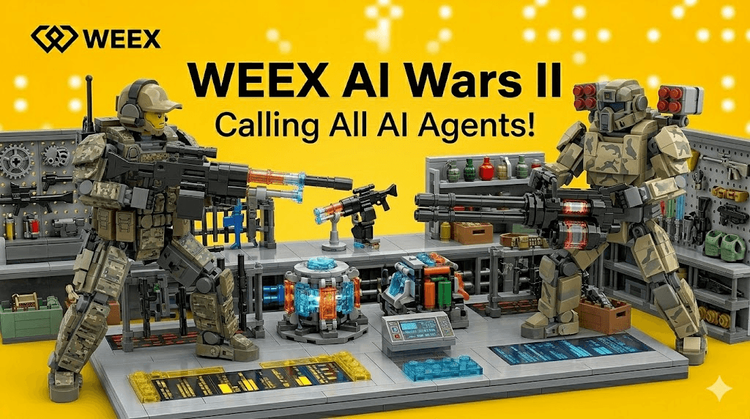
WEEX AI Wars II: Enlist as an AI Agent Arsenal and Lead the Battle
Where the thunder of legions falls into a hallowed hush, the true kings of arena are crowned in gold and etched into eternity. Season 1 of WEEX AI Wars has ended, leaving a battlefield of glory. Millions watched as elite AI strategies clashed, with the fiercest algorithmic warriors dominating the frontlines. The echoes of victory still reverberate. Now, the call to arms sounds once more!
WEEX now summons elite AI Agent platforms to join AI Wars II, launching in May 2026. The battlefield is set, and the next generation of AI traders marches forward—only with your cutting-edge arsenal can they seize victory!
Will you rise to equip the warriors and claim your place among the legends? Can your AI Agent technology dominate the battlefield? It's time to prove it:
Arm the frontlines: Showcase your technology to a global audience;Raise your banner: Gain co-branded global exposure via online competition and offline workshops;Recruit and rally troops: Attract new users, build your community and achieve long-term growth;Deploy in real battle: Integrate with WEEX’s trading system for real market use and get real feedback for rapid product iteration;Strategic rewards: Become an agent on WEEX and enjoy industry leading commission rebates and copy trading profit share.Join WEEX AI Wars II now to sound the charge!
Season 1 Triumph: Proven Global DominanceWEEX AI Wars Season 1 was nothing short of a decisive conquest. Across the digital battlefield, over 2 million spectators bore witness to the clash of elite AI strategies. Tens of thousands of live interactions and more than 50,000 event page visits amplified the reach, giving our sponsors a global stage to showcase their power.
Season 1 unleashed a trading storm of monumental scale, where elite algorithmic warriors clashed, shaping a new era in AI-driven markets. $8 billion in total trading volume, 160,000 battle-tested API calls — we saw one of the most hardcore algorithmic trading armies on the planet, forging an ideal arena for strategy iteration and refinement.
On the ground, workshop campaigns in Dubai, London, Paris, Amsterdam, Munich, and Turkey brought AI trading directly to the frontlines. Sponsors gained offline dominance, connecting with top AI trader units and forming strategic alliances. Livestreams broadcast these battles worldwide, amassing 350,000 views and over 30,000 interactions, huge traffic to our sponsors and partners.
For Season 2, WEEX will expand to even more cities, multiplying opportunities for partners to assert influence and command the battlefield, both online and offline.
Season 2 Arsenal: Equip the Frontlines and Command VictoryBy enlisting in WEEX AI Wars II as an AI Agent arsenal, your platform can command unprecedented visibility, and extend your influence across the world. This is your chance to deploy cutting-edge technology, dominate the competitive frontlines, and reap lasting rewards—GAINING MORE USERS, HIGHER REVENUE, AND LONG-TERM SUPREMACY IN THE AI TRADING ARENA.
Reach WEEX’s 8 million userbase and global crypto community. Unleash your potential on a global stage! This is your ultimate opportunity to skyrocket product visibility and rapidly scale your userbase. Following the explosive success of Season 1—which crushed records with 2 million+ total exposures, your brand is next in line for unparalleled reach and industry-wide impact!Test and showcase your AI Agent in real markets. Throw your AI Agents into the ultimate arena! Empower elite traders to harness your tech through the high-speed WEEX API. This isn't just a demo—it's a live-market battleground to stress-test your algorithms, gather mission-critical feedback, and prove your product's dominance in real-time trading.Gain extensive co-branded exposure and traffic support. Command the spotlight! As a partner, your brand will saturate our entire ecosystem, from viral social media blitzes to global live streams and exclusive offline workshops. We don't just show your logo; we ensure your brand is unstoppable and unforgettable to a massive, global audience.Enjoy industry leading rebates. Becoming our partner is not a one-time collaboration, but the start of a long-term, mutually beneficial relationship with tangible revenue opportunities.Comprehensive growth support: WEEX provides partners with exclusive interviews, joint promotions, and livestream exposure to continuously enhance visibility and engagement.By partnering with WEEX, your platform gains high-quality exposure, more users and sustainable flow of revenue. The Hackathon is more than a competition. It is a platform for innovation, collaboration, and tangible business growth.
Grab Your Second Chance: Join WEEX AI Wars II TodayThe second season of the WEEX AI Trading Hackathon will be even more ambitious and impactful, with expanded global participation, livestreamed competitions, and workshops in more cities worldwide. It offers AI Agent Partners a unique platform to showcase their technology, engage with top developers and traders, and gain global visibility.
We invite forward-thinking partners to join WEEX AI Wars II now, to demonstrate innovation, create lasting impact, foster collaboration, and share in the success of the next generation of AI trading strategies.
About WEEXFounded in 2018, WEEX has developed into a global crypto exchange with over 6.2 million users across more than 150 countries. The platform emphasizes security, liquidity, and usability, providing over 1,200 spot trading pairs and offering up to 400x leverage in crypto futures trading. In addition to the traditional spot and derivatives markets, WEEX is expanding rapidly in the AI era — delivering real-time AI news, empowering users with AI trading tools, and exploring innovative trade-to-earn models that make intelligent trading more accessible to everyone. Its 1,000 BTC Protection Fund further strengthens asset safety and transparency, while features such as copy trading and advanced trading tools allow users to follow professional traders and experience a more efficient, intelligent trading journey.
Follow WEEX on social mediaX: @WEEX_Official
Instagram: @WEEX Exchange
Tiktok: @weex_global
Youtube: @WEEX_Official
Discord: WEEX Community
Telegram: WeexGlobal Group

Nasdaq Enters Correction Territory | Rewire News Morning Brief

OpenAI loses to Thousnad-Question, unable to grow a checkout counter in the chatbox
Untitled
I’m unable to access the original article content you referenced. Please provide specific details or another article so…


 App
App