
 Buy Crypto
- Markets
 Futures
- Spot
- Copy Trade
- Earn
- More
Wintermute: Cryptocurrency Volatility Plummets as Retail Investors Flock Madly to US Stocks

Original Title: The retail trade: crypto vs equities
Original Source: Wintermute
Original Translation: Deep Tide TechFlow
Deep Tide Summary: This article, written by a Wintermute OTC trader, provides an in-depth analysis of the fundamental reasons behind the current outflow of retail funds in the crypto market. Historically, crypto bull markets have been largely driven by retail speculation, but recent data indicates that retail investors are pouring into US equities at a record pace, causing a shift from the crypto market and US stocks moving in tandem to a "seesaw" pattern. With the decreasing volatility in the crypto market, lower entry barriers, and AI giving retail investors an analytical edge in US stocks, cryptocurrency is no longer the top choice for retail speculation. Understanding this fund rotation logic can help us readjust our multi-asset investment framework.
Full Text:
Retail activity has always been driving the crypto market. Through speculation, reflexive buying on dips, and flexible capital rotation among various tokens, retail investors have defined every major cycle in crypto history. However, recent data suggests that the relationship between retail investors and the crypto market is changing.
For a while now, we have been reminding everyone that the US stock market is capturing retail attention, sacrificing altcoin liquidity. The latest data from JPMorgan's strategy department, combined with our exclusive flow data, further indicates that US stocks and cryptocurrency are becoming interchangeable risk assets.
Correlated Reversal
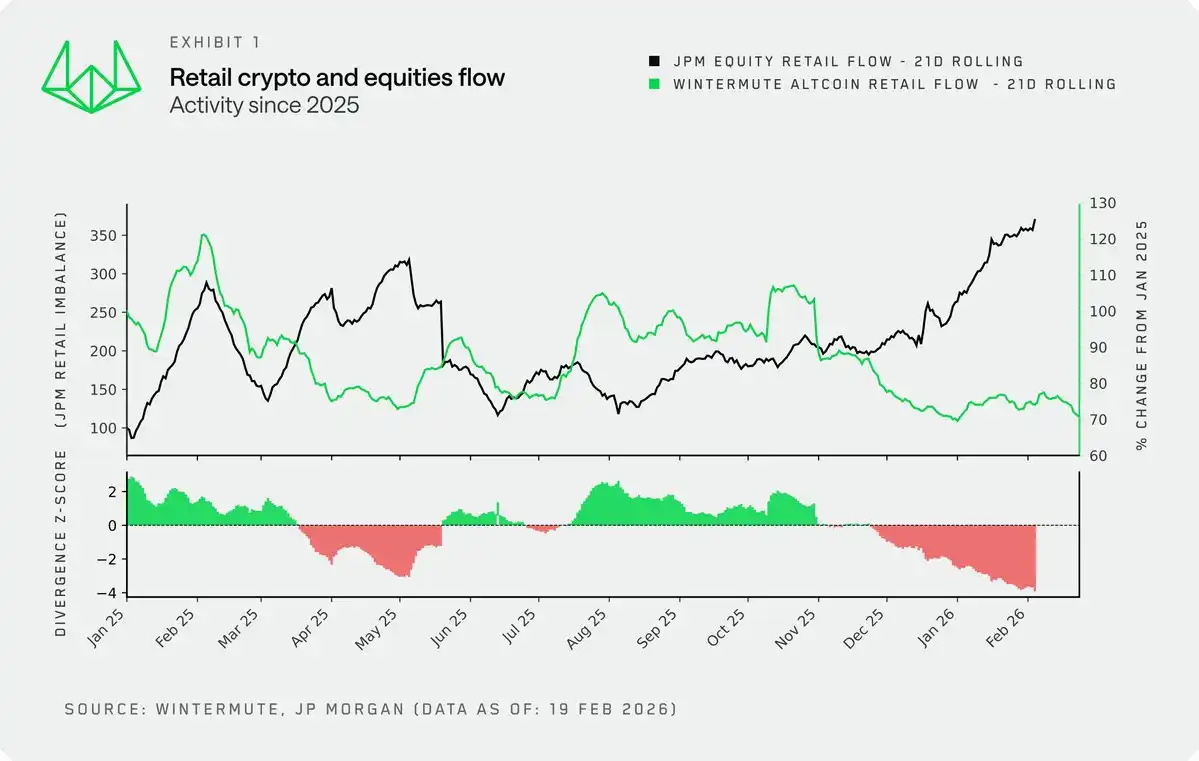
By juxtaposing Wintermute's exclusive data on retail crypto flows with JPMorgan's data on retail US stock inflows, we have gained a new perspective on examining the relationship between retail activity in the US stock and crypto markets.
Historically, the two have typically been in sync. Until the end of 2024, heightened risk appetite often meant buying on both sides as they were, to some extent, outlets for excess capital (see M2 data) and risk appetite. However, since the end of 2024, this correlation has broken down. Today, we are witnessing one of the most severe deviations in recent history: retail investors are pouring into US stocks at a record pace while choosing to hold a wait-and-see approach in the crypto market.
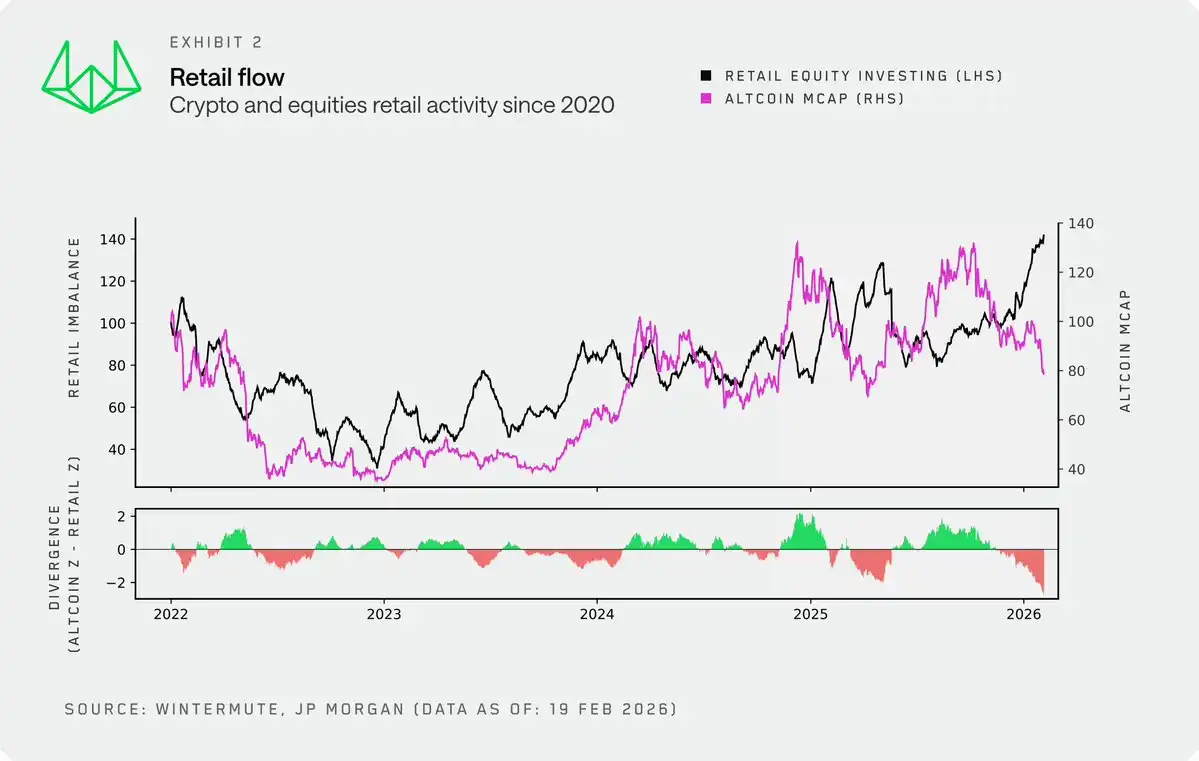
Looking at a longer time frame, we use the total market value of altcoins as a long-term proxy for retail crypto activity. It aligns closely with our retail flow data and offers a more objective and long-term historical record. From 2022 to the end of 2024, the trends in cryptocurrency and US stocks were broadly similar, with retail investors viewing both as part of a high-risk portfolio. However, the decoupling at the end of 2024 is particularly striking, and retail trading behavior has become more skewed towards short-term drivers, frequent fluctuations, and a lack of structure.
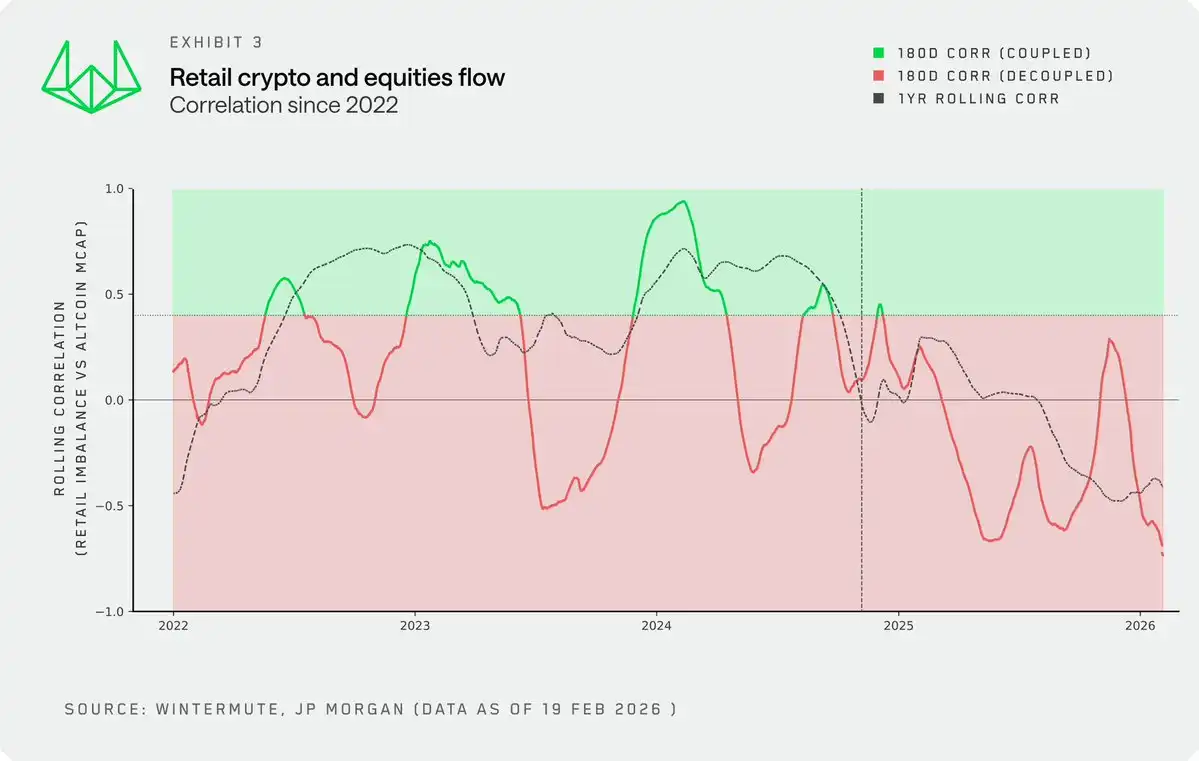
The rolling correlation between retail investor activity and meme coin market cap has confirmed this shift. The once positively correlated relationship, despite its volatility, has now turned negative. Retail investors are now allocating funds between the two in a 'pick one' scenario rather than buying into both simultaneously.
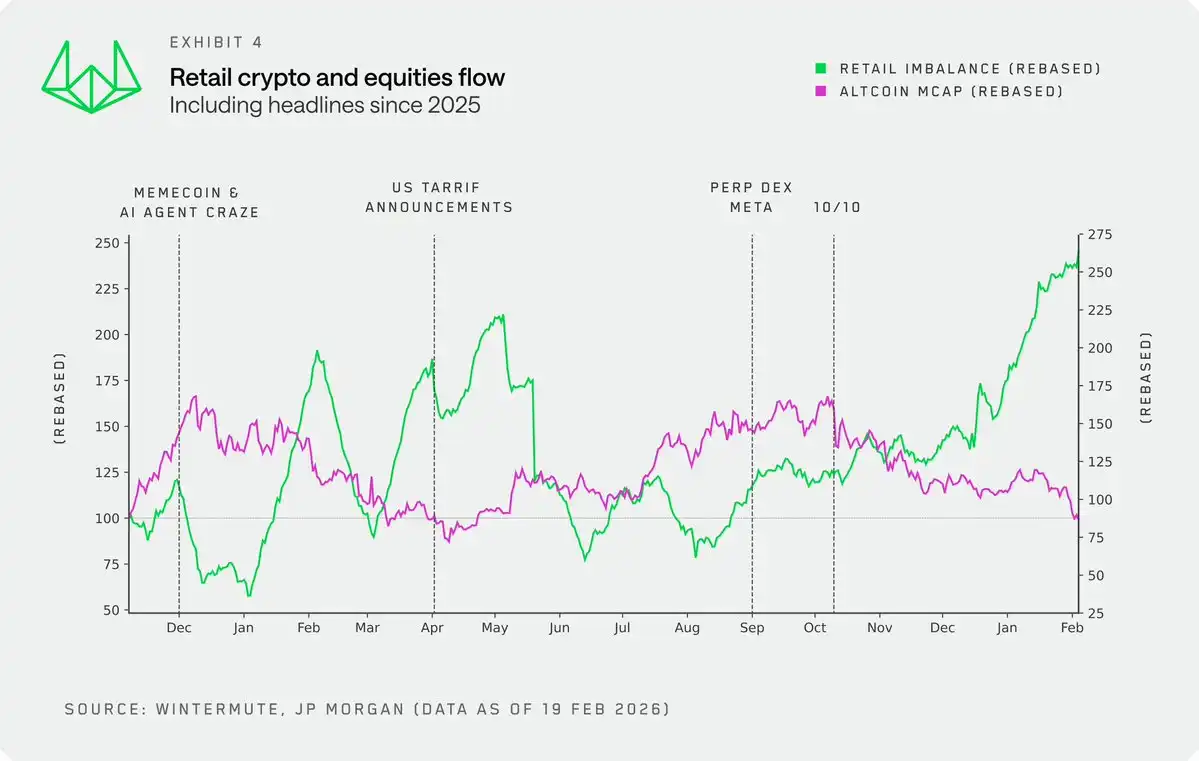
Looking ahead to 2025 and considering key catalyst events, this dynamic shift will become even more pronounced. Several points stand out:
· When the US stock market activity stagnated, Memecoins and AI agents saw their moment in the sun, as retail investors shifted their speculative demand to these areas.
· Whether during the tariff policy announcement in April 2025 or more recently, retail investors have continued to aggressively buy the dip in US stocks.
· After October 10th, funds almost entirely flowed back into US stocks, and this trend continues to persist.
Causality
One thing must be made clear: we do not believe retail participation in the crypto market is large enough to siphon funds away from the stock market. On the contrary, it is the exuberance of stock market retail investors that has drained liquidity from the crypto market.
New data also validates this point. Retail activity in the stock market has become a new variable, and crypto investors should closely monitor this indicator to identify when retail funds may provide a sustained buying opportunity for the crypto market.
Volatility Itself is the Product
While there are many reasons, one of the core reasons retail investors are so active and attracted to the crypto market is the asset's inherent volatility characteristics. The volatility itself is the product. This was the core driving force that initially drew retail investors into the crypto space.
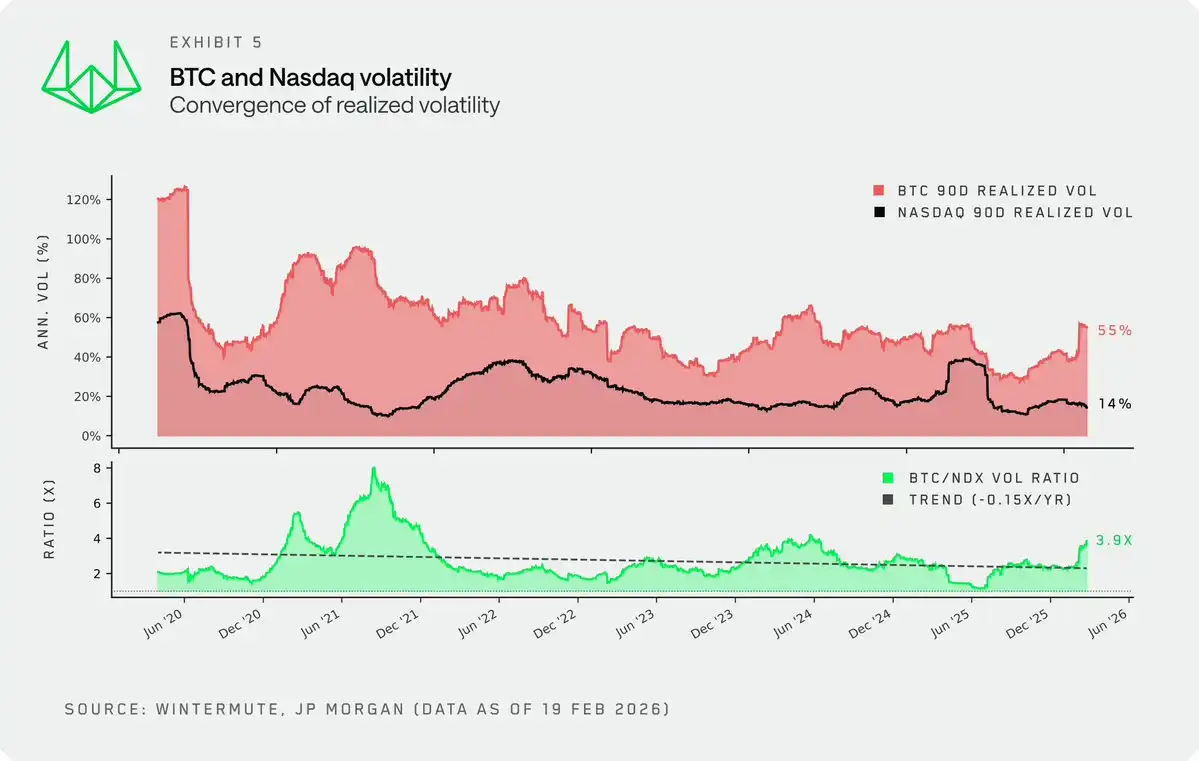
However, despite the crypto market's volatility still far exceeding that of stocks, its realized volatility has been undergoing structural compression, and this trend is difficult to reverse. The BTC to Nasdaq 100 Index (NDX) volatility ratio has been on a downward trend, with this ratio even compressed to less than half in the first half of 2025.
Some thoughts on key driving factors:
· Market Maturation. As the market matures, more institutional investors participate. The emergence of new liquidity tools such as ETFs and DAT has dampened the reflex-induced volatility spikes typical of the early cycle.
· Market Size. With the current cryptocurrency market cap at $2.3 trillion, even a 40% pullback from the all-time high (ATH), the amount of capital needed to drive the market higher now is much larger than five years ago.
With volatility compression, the core selling point of cryptocurrencies for retail investors has diminished. The boom-and-bust cycles that defined a bull market cycle from 21 to 22, attracting a whole generation of retail investors, are now a thing of the past. For retail investors seeking volatility, the stock market is becoming increasingly attractive.
Technology-Driven Factors
In addition to structural changes in the cryptocurrency market itself, technology-driven factors are also accelerating this capital rotation, which is not yet fully discussed in the market.
· Bridging of Investment Channels. The integration of cryptocurrency trading on fintech and traditional brokerage platforms (or native cryptocurrency platforms integrating stock trading) has indeed lowered the barriers to entry. However, its more profound impact is seen in "capital offloading." In previous cycles, complex fund transfer processes locked funds once they entered the cryptocurrency market, driving organic rotations among different tokens. Now, with equally smooth fund transfer channels, funds can freely move between cryptocurrency and the stock market without hindrance.
· Cognitive Edge. Retail investors seem increasingly drawn to the stock market, partly because they have gained a new edge through AI. Large language models (LLMs) have greatly enhanced retail investors' analytical abilities, giving them an illusion of being able to compete fairly with institutions.
However, this feeling does not exist in the cryptocurrency market. While you can also analyze cryptocurrency projects based on data, the crypto space lacks a consensus-based valuation framework and token value capture mechanism. Meanwhile, the investable targets are still exponentially expanding, making it difficult for retail investors to find that "edge" feeling here.
Conclusion
Retail investors used to be the most reliable reflexive demand source in the cryptocurrency market, but now, their risk preference is being increasingly satisfied elsewhere. The stock market provides highly competitive volatility, endowing retail investors with a growing analytical advantage, and through the same app on their phones, funds can seamlessly switch between the cryptocurrency market and the stock market. Cryptocurrency still has a place in retail investors' portfolios, but it is now just one of many gaming tools, no longer the preferred speculative vehicle.
This shift should also reshape investors' market observation perspective. Some tried-and-true indicators have become ineffective. For crypto investors, merely looking for leading indicators of risk appetite and combining them with the native crypto framework is no longer sufficient to succeed. Investors increasingly need to view cryptocurrency through a multi-asset portfolio lens, much like has long been the standard practice in the US stock and fixed-income markets.
You may also like

Cyber Taoist Fortune Teller: Fake Taoist, AI Fortune Telling, and Northeastern Metaphysics History

Bloomberg: Stablecoin Payments Emerge as Crypto VC's Newest Favorite Thing
BeatSwap is evolving towards a full-stack Web3 infrastructure, covering the entire lifecycle of IP rights.
BeatSwap, a global Web3 Intellectual Property (IP) infrastructure project, is attempting to overcome the current fragmentation limitations of the Web3 ecosystem, building a full-stack system that covers the entire lifecycle of IP rights.
Currently, most Web3 projects are still in the stage of functional fragmentation, often focusing only on a single aspect, such as IP asset tokenization, transaction functionality, or a simple incentive model. This structural dispersion has become a key bottleneck hindering the industry's scale application.
BeatSwap's approach is more integrated, integrating multiple core modules into the same system, including:
· IP authentication and on-chain registration
· Authorization-based revenue sharing mechanism
· User-engagement-driven incentive system
· Transaction and liquidity infrastructure
Through the above integration, the platform builds an end-to-end closed-loop path, allowing IP rights to complete a full cycle of "creation, use, and monetization" within the same ecosystem.
BeatSwap is not limited to existing crypto users but is attempting to take the global music industry as a starting point, actively creating new market demand. Its core strategies include:
Exploring and incubating music creators (Artist discovery)
Building a fan community
Igniting IP-centric content consumption demand
The current global music industry is valued at around $260 billion, with over 2 billion digital music users. This means that the potential market corresponding to the tokenization and financialization of IP far exceeds the traditional crypto user base.
In this context, BeatSwap positions itself at the intersection of "real-world content demand" and "on-chain infrastructure," attempting to bridge the structural gap between content production and financial flow.
BeatSwap's upcoming core product "Space" is scheduled to launch in the second quarter of 2026. This product is defined as the SocialFi layer in the ecosystem, aiming to directly connect creators with users and achieve deep integration with other platform modules.
Key designs include:
A fan-centric interactive mechanism
Exposure and distribution logic based on $BTX staking
User paths connected to DeFi and liquidity structures
Thus, a complete user behavior loop is formed within the platform: Discovery → Participation → Consumption → Rewards → Trading
$BTX is designed to be a core utility asset within the ecosystem, rather than just a simple incentive token, with its value directly tied to platform activity and IP use cases.
Main features include:
· Yield distribution based on on-chain authorized actions
· Value reflection based on IP usage and user engagement dynamics
· Support for staking and DeFi participation mechanisms
· Value growth driven by ecosystem expansion
With the increased frequency of IP use, the utility and value support of $BTX will enhance simultaneously, helping alleviate the "disconnect between value and utility" issue present in traditional Web3 token models to some extent.
Currently, $BTX has been listed on several mainstream exchanges, including:
Binance Alpha
Gate
MEXC
OKX Boost
As the launch of "Space" approaches, BeatSwap is actively pursuing more exchange listings to further enhance liquidity and global accessibility, laying a foundation for future market expansion.
BeatSwap's goal is no longer limited to the traditional Web3 narrative but aims to target over 2 billion digital music users and a trillion KRW-scale content market.
By integrating content creators, users, capital, and liquidity into a blockchain framework centered around IP rights, BeatSwap is striving to build a next-generation infrastructure focused on "IP tokenization."
BeatSwap integrates IP authentication, authorization distribution, incentive mechanism, transaction system, and market construction to establish a unified structure that bridges the full lifecycle path of IP rights.
With the launch of the Q2 2026 "Space," the project is expected to become a key infrastructure connecting content and finance in the IP-RWA (Real World Assets) track.

Mag 7 Evaporates $2 Trillion | Rewire News Morning Edition

Losing $19K per Coin Mined, Bitcoin Mining Firms Collective AI Defection

Morning Report | Tom Lee predicts that the cryptocurrency winter will end in April; xStocks introduces a new on-chain private equity fund; Sui mainnet upgraded to V1.68.1

Polymarket rules have changed, how should airdrop participants respond?

Crypto ETF Weekly | Last week, the net outflow of Bitcoin spot ETFs in the U.S. was $296 million; the net outflow of Ethereum spot ETFs in the U.S. was $206 million

This Week's Key News Preview | The U.S. Releases March Non-Farm Payroll Data; Polymarket Expands Fee Structure

Slow Down, That's the Answer to the Age of the Agent

From Cash to Cryptocurrency: Moving Towards a Unified Regulatory Path for Illegal Payments
Who will own the most Bitcoin in 2026

A private feud lasting 10 years, if not for OpenAI's "hypocrisy," would not have led to the world's strongest AI company, Anthropic

"Crypto Tsar" steps down: 130 days of political performance come to an end, how much of Trump's crypto promise remains?

From Utopian Narratives to Financial Infrastructure: The "Disenchantment" and Shift of Crypto VC
A decade-long personal feud, if not for OpenAI's "hypocrisy," there would be no globally leading AI company Anthropic

a16z: The True Meaning of Strong Chain Quality, Block Space Should Not Be Monopolized
a16z: The True Meaning of Strong Chain Quality, Block Space Should Not Be Monopolized
Cyber Taoist Fortune Teller: Fake Taoist, AI Fortune Telling, and Northeastern Metaphysics History
Bloomberg: Stablecoin Payments Emerge as Crypto VC's Newest Favorite Thing
BeatSwap is evolving towards a full-stack Web3 infrastructure, covering the entire lifecycle of IP rights.
BeatSwap, a global Web3 Intellectual Property (IP) infrastructure project, is attempting to overcome the current fragmentation limitations of the Web3 ecosystem, building a full-stack system that covers the entire lifecycle of IP rights.
Currently, most Web3 projects are still in the stage of functional fragmentation, often focusing only on a single aspect, such as IP asset tokenization, transaction functionality, or a simple incentive model. This structural dispersion has become a key bottleneck hindering the industry's scale application.
BeatSwap's approach is more integrated, integrating multiple core modules into the same system, including:
· IP authentication and on-chain registration
· Authorization-based revenue sharing mechanism
· User-engagement-driven incentive system
· Transaction and liquidity infrastructure
Through the above integration, the platform builds an end-to-end closed-loop path, allowing IP rights to complete a full cycle of "creation, use, and monetization" within the same ecosystem.
BeatSwap is not limited to existing crypto users but is attempting to take the global music industry as a starting point, actively creating new market demand. Its core strategies include:
Exploring and incubating music creators (Artist discovery)
Building a fan community
Igniting IP-centric content consumption demand
The current global music industry is valued at around $260 billion, with over 2 billion digital music users. This means that the potential market corresponding to the tokenization and financialization of IP far exceeds the traditional crypto user base.
In this context, BeatSwap positions itself at the intersection of "real-world content demand" and "on-chain infrastructure," attempting to bridge the structural gap between content production and financial flow.
BeatSwap's upcoming core product "Space" is scheduled to launch in the second quarter of 2026. This product is defined as the SocialFi layer in the ecosystem, aiming to directly connect creators with users and achieve deep integration with other platform modules.
Key designs include:
A fan-centric interactive mechanism
Exposure and distribution logic based on $BTX staking
User paths connected to DeFi and liquidity structures
Thus, a complete user behavior loop is formed within the platform: Discovery → Participation → Consumption → Rewards → Trading
$BTX is designed to be a core utility asset within the ecosystem, rather than just a simple incentive token, with its value directly tied to platform activity and IP use cases.
Main features include:
· Yield distribution based on on-chain authorized actions
· Value reflection based on IP usage and user engagement dynamics
· Support for staking and DeFi participation mechanisms
· Value growth driven by ecosystem expansion
With the increased frequency of IP use, the utility and value support of $BTX will enhance simultaneously, helping alleviate the "disconnect between value and utility" issue present in traditional Web3 token models to some extent.
Currently, $BTX has been listed on several mainstream exchanges, including:
Binance Alpha
Gate
MEXC
OKX Boost
As the launch of "Space" approaches, BeatSwap is actively pursuing more exchange listings to further enhance liquidity and global accessibility, laying a foundation for future market expansion.
BeatSwap's goal is no longer limited to the traditional Web3 narrative but aims to target over 2 billion digital music users and a trillion KRW-scale content market.
By integrating content creators, users, capital, and liquidity into a blockchain framework centered around IP rights, BeatSwap is striving to build a next-generation infrastructure focused on "IP tokenization."
BeatSwap integrates IP authentication, authorization distribution, incentive mechanism, transaction system, and market construction to establish a unified structure that bridges the full lifecycle path of IP rights.
With the launch of the Q2 2026 "Space," the project is expected to become a key infrastructure connecting content and finance in the IP-RWA (Real World Assets) track.


 App
App