
 Buy Crypto
- Markets
 Futures
- Spot
- Copy Trade
- Earn
- More
Zuckerberg Retweets Stablecoin, Can Meta Win This "Comeback Game"?

Original Title: "Zuckerberg Reiterates Stablecoin Push, Can Meta Win the 'Redemption Round' this Time?"
Original Author: Sanqing, Foresight News
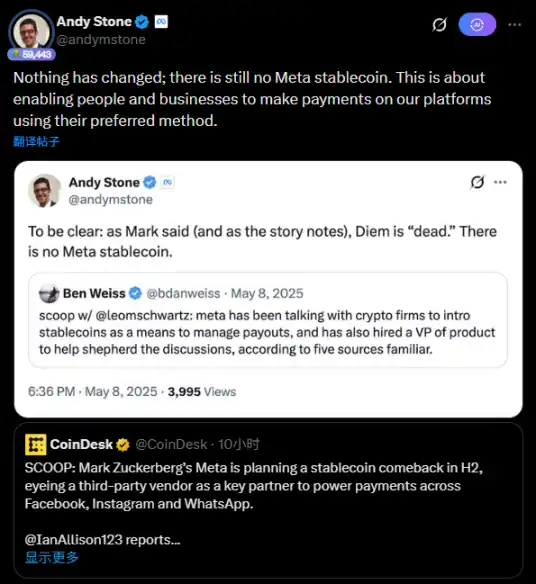
On February 24, according to CoinDesk citing sources, Zuckerberg's tech giant Meta plans to re-enter the stablecoin arena in the latter half of this year, with plans to integrate third-party vendors to support stablecoin payments and launch a new wallet. Meta has already sent out product requirement invitations to third-party companies, with its long-time partner Stripe being a potential pilot institution.
Subsequently, Meta spokesperson Andy Stone tweeted, "All remains as is, there is still no Meta stablecoin. The key to Meta's plan to relaunch stablecoin business in the latter half of 2026 is to enable individuals and businesses to use their preferred payment methods on the Meta platform for transactions."
Dormant Ambition: From Libra to Diem's Failure
Looking back at Meta's stablecoin journey, the 2019 launch of the Libra project was undoubtedly a controversial starting point, where Meta attempted to establish a global digital currency backed by a basket of fiat currencies and government bonds.
The goal was to leverage its multiple social apps with billions of monthly active users to bypass the traditional banking system and enable peer-to-peer global instant cross-border payments. However, this grand vision was met with united resistance from global regulatory bodies.
Legislators were deeply concerned about Meta controlling the global financial lifeline, especially as the company was embroiled in the Cambridge Analytica privacy scandal (in 2018, Facebook was found to have allowed the political consulting firm Cambridge Analytica to improperly access the personal data of up to 87 million users), eroding public trust in its handling of sensitive financial data to near zero.
Libra heads David Marcus and Zuckerberg faced scrutiny from the U.S. Congress. Lawmakers even likened the potential threat of Libra to the 9/11 attacks, fearing it would become a breeding ground for money laundering and terrorist financing.
Under stringent regulatory signals, the initial founding members (such as Visa, Mastercard, PayPal, and Stripe) chose to withdraw from the Libra Association one after another to avoid being embroiled in the political whirlpool.
Despite later rebranding the project as Diem and attempting to seek compromise through downsizing and pegging to a single fiat currency, regulatory pressures never dissipated. Ultimately, Diem failed to even launch officially in the United States, and was forced to shut down and sell off all assets in early 2022. Its team's core members also split into two Layer 1 blockchain projects, Aptos and Sui.
2026 New Logic: Strategic Shift from "Challenger" to "Gateway"
Compared to the Libra era of 2019 when it sought to challenge the global financial system head-on, Meta in 2026 has shown a more conservative approach focused on compliance.
Meta spokesperson Andy Stone also specifically emphasized in response that Meta currently supports 50+ currencies and payment methods in 100+ countries/regions, attempting to downplay the uniqueness of "stablecoins" and package them as an "extension of existing payment infrastructure."

The core of this shift lies in integrating external capabilities through modularization. Meta's latest RFP (Request for Proposals) clearly indicates that it has entrusted compliance responsibilities to third parties.
Meta's deep partner Stripe (whose CEO Patrick Collison holds a seat on Meta's board) as early as October 2024 filled the stablecoin route through the acquisition of the stablecoin platform Bridge, and in June 2025, also acquired the crypto wallet Privy.
This compliance-segregated model allows Meta to seamlessly embed low-cost real-time settlement capabilities on its massive base of over 3 billion monthly active users, while maintaining a safe distance from legal and regulatory pressures.
Regulation and Competition: The Dual Hurdles Meta Must Overcome
The current regulatory environment has significantly evolved since 2019. While the challenges remain steep, U.S. acts like the GENIUS Act and Clarity Act have laid a preliminary legal foundation for stablecoin issuers, opening the gates for new market entrants.
U.S. regulatory agencies are currently in the early stages of drafting specific implementation guidelines. Meta may well be aware that any overly aggressive move could once again trigger regulatory defense mechanisms, hence choosing intervention through third parties is currently the most prudent path.
On the competitive market front, Meta faces a highly crowded and matured race track.
Elon Musk's social platform X has been advancing its "super app" plan, striving to internalize payment functionality, while Telegram has long taken the lead in the encrypted payment field with its TON ecosystem.
Meanwhile, traditional crypto giants like Coinbase and Kraken are also constantly pushing boundaries, beginning to offer round-the-clock tokenized stock trading and other complex financial services.
For Meta, re-entering the stablecoin field is not only to reduce traditional bank fees but also a battle for leadership in social e-commerce. And with Meta's aggressive investment in the Llama series large models, stablecoin payments will also become the financial foundation of its AI strategy.
You may also like

Stablecoin mergers: there will be no "winner takes all"

Warmonger Trump has forgotten about Americans waiting in airport lines for hours

Houthi Have a Checkpoint | Rewire News Morning Brief

The Money-Saving Philosophy of the AI Era: How to Spend Every Token Wisely

$240 Billion Dark Forest, The Fall of Iron Finance

3 hellos limit, where did your Claude Code limit go? A 28-day cache Bug, and an official response that encourages you to "use it sparingly."

How to Make Money on Polymarket Using AI?

Morning Report | YZi Labs strategically increases investment in Predict.fun; Drift Protocol suffers an attack with losses of at least $200 million; Coinbase's x402 joins the Linux Foundation

The $590 Billion Dream: How Did the Female Warren Buffett Fall from Grace?

Dialogue with the founder of Pantera: Bitcoin has reached escape velocity, traditional assets are being left behind

The growth dilemma of Base: everything was done right, yet users still leave
Predicting the World Cup "Showdown": Over 150 projects are gearing up, with a total investment of nearly 6 billion dollars
RootData launches the "A-Level Transparency Project Briefing," directly reaching the cryptocurrency listing decision-making chain
What does DeFi look like that Wall Street wants?

Drift Protocol Hack: Understanding One of the Largest Solana Ecosystem Breaches
Key Takeaways Drift Protocol, a decentralized exchange on Solana, experienced a $270 million hack, making it one of…

Navigating the Drift Protocol Security Incident: What You Need to Know
Key Takeaways On April 2, Drift Protocol experienced a security breach where a malicious actor gained administrative control.…
Upbit and Bithumb Designate DRIFT as a Trading Alert Item
Key Takeaways Upbit and Bithumb have labeled DRIFT as a “trading alert” asset following guidance from the Digital…
“Brother Maji” Faces Potential Liquidation with ETH Long Position
Key Takeaways “Brother Maji” currently holds a substantial 25x leveraged long position of 6,000 ETH. The position was…


 App
App